Skip to main content
Anatomy & Physiology
My Course
Learn
Exam Prep
AI Tutor
Study Guides
Textbook Solutions
Flashcards
Explore
Try the app
My Course
Learn
Exam Prep
AI Tutor
Study Guides
Textbook Solutions
Flashcards
Explore
Try the app
Back
Nervous System Anatomy & Physiology Study Guide
You can tap to flip the card.
Approximate number of neurons in the human brain
You can tap to flip the card.
👆
Approximate number of neurons in the human brain
About
20 billion
neurons.
Track progress
Control buttons has been changed to "navigation" mode.
1/30
Recommended videos
Guided course
0:50
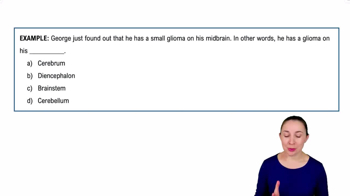
Introduction to the Central Nervous System Example 1
14101
views
263
rank
2
comments
Guided course
2:41
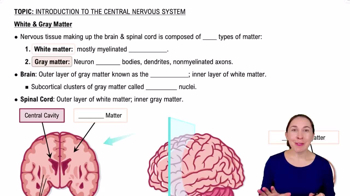
White & Gray Matter
14086
views
256
rank
Guided course
3:34
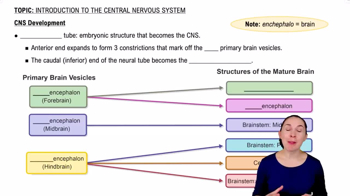
CNS Development
14690
views
295
rank
2
comments
Terms in this set (30)
Hide definitions
Approximate number of neurons in the human brain
About
20 billion
neurons.
Structure separating the left and right cerebral hemispheres
The
longitudinal fissure
.
Grooves on the surface of the brain
Called
sulci
.
Ridges on the surface of the brain
Called
gyri
.
Brain region responsible for conscious thought and memory
The
cerebrum
.
Brain region that processes sensory information before the cerebrum
The
thalamus
.
Structure regulating emotions, autonomic functions, and hormone production
The
hypothalamus
.
Brain structure coordinating complex motor patterns and balance
The
cerebellum
.
Part of the brainstem controlling heart rate and breathing
The
medulla oblongata
.
Function of the pons
Relays signals between brain regions.
Another name for the midbrain
The
mesencephalon
.
Four fluid-filled cavities in the brain
Called
ventricles
.
Fluid filling the brain ventricles
Cerebrospinal fluid (
CSF
).
Structure producing cerebrospinal fluid
The
choroid plexus
.
Frequency of cerebrospinal fluid replacement
About every
8 hours
.
Three layers of the cranial meninges
Dura mater
,
arachnoid mater
, and
pia mater
.
Outermost meningeal layer
The
dura mater
.
Meningeal layer directly covering the brain surface
The
pia mater
.
Function of the blood-brain barrier
Protects the brain from harmful substances.
Artery supplying arterial blood to the brain
The
internal carotid arteries
.
Structure connecting the left and right cerebral hemispheres
The
corpus callosum
.
Lobe processing visual information
The
occipital lobe
.
Lobe processing auditory information
The
temporal lobe
.
Lobe controlling voluntary skeletal muscle movement
The
frontal lobe
.
Lobe processing touch and pressure sensations
The
parietal lobe
.
Function of the hippocampus
Memory formation.
Structure processing emotions such as fear and aggression
The
amygdala
.
Brain structure containing the pineal gland
The
epithalamus
.
Hormone produced by the pineal gland
Melatonin
.
Brain structure regulating body temperature and thirst
The
hypothalamus
.
 BackBack
 0:50