Skip to main content
Anatomy & Physiology
My Course
Learn
Exam Prep
AI Tutor
Study Guides
Textbook Solutions
Flashcards
Explore
Try the app
My Course
Learn
Exam Prep
AI Tutor
Study Guides
Textbook Solutions
Flashcards
Explore
Try the app
Back
Nervous System & Special Senses - Anatomy & Physiology
You can tap to flip the card.
Meninges
You can tap to flip the card.
👆
Meninges
Three protective membranes covering the brain and spinal cord: dura mater, arachnoid mater, and pia mater.
Track progress
Control buttons has been changed to "navigation" mode.
1/29
Recommended videos
Guided course
0:50
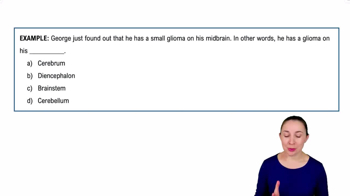
Introduction to the Central Nervous System Example 1
14101
views
263
rank
2
comments
Guided course
2:41
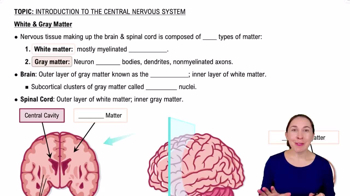
White & Gray Matter
14086
views
256
rank
Guided course
3:34
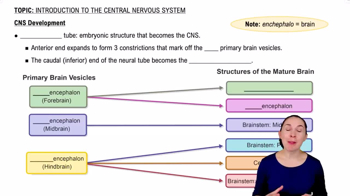
CNS Development
14690
views
295
rank
2
comments
Terms in this set (29)
Hide definitions
Meninges
Three protective membranes covering the brain and spinal cord: dura mater, arachnoid mater, and pia mater.
Epidural space
The space between the dura mater and the vertebral wall containing fat and blood vessels.
Dura mater
The tough, outermost layer of the meninges that protects the brain and spinal cord.
Arachnoid mater
The middle meningeal layer, a web-like structure that cushions the central nervous system.
Subarachnoid space
The space between the arachnoid mater and pia mater filled with cerebrospinal fluid.
Pia mater
The delicate, innermost meningeal layer that closely adheres to the brain and spinal cord surface.
Central nervous system (CNS)
Comprises the brain and spinal cord, responsible for processing and sending neural signals.
Peripheral nervous system (PNS)
Includes cranial and spinal nerves that connect the CNS to limbs and organs.
Cerebrum
The largest brain part, responsible for voluntary actions, sensory perception, and cognition.
Cerebral cortex
The outer layer of the cerebrum involved in complex brain functions like thought and action.
Corpus callosum
A thick band of white matter connecting the two cerebral hemispheres for communication.
Brain lobes
Four main lobes: frontal, parietal, temporal, and occipital, each with distinct functions.
Primary motor area
Region of the frontal lobe controlling voluntary muscle movements.
Primary somatosensory area
Region of the parietal lobe processing sensory information from the body.
Hypothalamus
Part of the diencephalon regulating homeostasis, hormone release, and autonomic functions.
Thalamus
Relay station in the diencephalon that directs sensory signals to the cerebral cortex.
Cerebellum
Brain region coordinating voluntary movements, balance, and posture.
Brain stem
Includes midbrain, pons, and medulla oblongata; controls vital functions like breathing and heart rate.
Ventricles of the brain
Four fluid-filled cavities producing and circulating cerebrospinal fluid: lateral, third, and fourth ventricles.
Choroid plexus
Network of cells in ventricles that produces cerebrospinal fluid.
Spinal cord gray matter
Contains neuron cell bodies and is involved in processing and reflexes.
Spinal cord white matter
Contains myelinated axons that transmit signals up and down the spinal cord.
Dorsal root ganglion
Cluster of sensory neuron cell bodies located outside the spinal cord.
Phrenic nerve
Nerve from the cervical plexus that controls the diaphragm for breathing.
Eye fibrous layer
Outer layer including the sclera and cornea providing protection and shape.
Eye vascular layer
Middle layer including the choroid, iris, and pupil controlling light entry and nourishment.
Retina
Nervous layer of the eye containing photoreceptors for vision.
Auditory ossicles
Three small bones in the middle ear (malleus, incus, stapes) that transmit sound vibrations.
Vestibulocochlear nerve
Cranial nerve responsible for hearing and balance.
 BackBack
 0:50