 Back
BackNervous System Basics and Neuron Function
 0:50
0:50
Terms in this set (48)
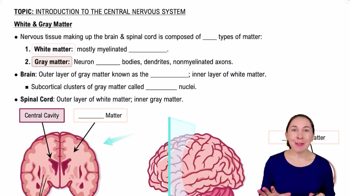
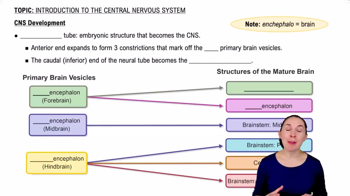
The CNS consists of the brain and spinal cord.
The PNS includes all nerves outside the CNS.
The PNS carries information to and from the CNS.
The afferent (sensory) division carries information to the CNS.
The efferent (motor) division carries information from the CNS.
Neurons are cells that conduct electrical signals.
Neuroglia support, protect, and nourish neurons.
Ependymal cells produce and circulate cerebrospinal fluid (CSF).
Astrocytes form the blood-brain barrier, repair tissue, and provide support.
Oligodendrocytes produce myelin in the CNS.
Microglia perform phagocytosis and immune defense in the CNS.
Satellite cells surround neuron cell bodies in the PNS.
Schwann cells produce myelin in the PNS.
One Schwann cell myelinates one axon segment, while oligodendrocytes myelinate multiple axons.
Dendrites receive signals from other cells.
The cell body (soma) contains the nucleus.
The axon carries electrical signals away from the cell body.
Axon terminals release neurotransmitters into the synapse.
Multipolar neurons are the most common type.
Bipolar neurons are found in special sensory organs.
Unipolar neurons function as sensory neurons.
Sensory (afferent) neurons carry information to the CNS.
Motor (efferent) neurons carry commands from the CNS.
Interneurons connect neurons in the CNS and make up 99% of neurons.
A synapse is the communication junction between two neurons.
The synaptic cleft is the gap between neurons at a synapse.
The presynaptic cell sends the signal.
The postsynaptic cell receives the signal.
Resting potential is the negative charge inside a neuron at rest.
A graded potential is a local, variable change in membrane potential.
An action potential is an all-or-none electrical signal.
Depolarization occurs when Na⁺ ions enter the neuron, making it more positive.
Repolarization occurs when K⁺ ions exit the neuron, restoring negativity.
Hyperpolarization is when the membrane potential temporarily becomes more negative than resting.
Once threshold is reached, a full action potential occurs; otherwise, none occurs.
During the absolute refractory period, no new action potential can be generated.
During the relative refractory period, a stronger stimulus is required.
Continuous conduction is slow and occurs in unmyelinated axons.
Saltatory conduction is fastest, jumping between nodes of Ranvier.
Myelin speeds up electrical conduction along axons.
Oligodendrocytes produce myelin in the CNS.
Schwann cells produce myelin in the PNS.
Na⁺ (sodium) ions entering the cell cause depolarization.
K⁺ (potassium) ions exiting the cell cause repolarization.
Neurons send signals; neuroglia support and protect neurons.
Myelin increases the speed of electrical signal conduction.
An action potential is an all-or-none electrical signal.
Saltatory conduction is the fastest conduction type.