 Back
Nervous System Fundamentals - Anatomy & Physiology
 0:50

Terms in this set (20)
Sensory input, integration, motor output, and response.
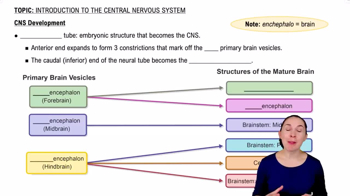
The CNS acts as the integration and command center of the nervous system.
Cranial nerves, spinal nerves, peripheral nerves, and ganglia.
Afferent pathways carry sensory input toward the CNS; efferent pathways carry motor output away from the CNS.
Cell body: biosynthesis and reception; dendrites: receive signals; axon hillock: initiates action potential; axon: conducts action potentials; terminal boutons: release neurotransmitters.
Nissl bodies are rough ER and ribosomes responsible for protein production and membrane renewal.
Multipolar: many dendrites, one axon; most common in CNS. Bipolar: one dendrite, one axon; special sensory. Pseudounipolar: one process splits into two branches; general sensory neurons.
Neuroglia are support cells that protect, nourish, insulate neurons and retain the ability to divide.
Oligodendrocytes myelinate CNS axons; Schwann cells myelinate PNS axons.
They are gaps between myelin segments that allow saltatory conduction, speeding up action potential transmission.
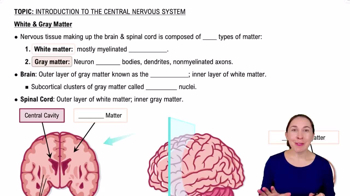
Gray matter contains neuron cell bodies and synapses for integration; white matter contains myelinated axons for long-distance communication.
Endoneurium surrounds individual axons, perineurium surrounds fascicles, and epineurium surrounds the entire nerve.
Receptor, sensory neuron, integration center, motor neuron, effector.
Monosynaptic reflexes have one synapse between sensory and motor neurons; polysynaptic reflexes involve one or more interneurons.
The quadriceps motor neuron is activated while an interneuron inhibits the hamstring motor neuron, allowing relaxation of the opposing muscle.
Serial processing passes signals along one pathway; parallel processing sends input simultaneously along multiple pathways.
Many neurons synapse on one neuron, integrating multiple inputs.
One neuron sends output to many targets through terminal branches.
CNS glia inhibit growth and do not form guiding tubes; astrocytes form scar tissue blocking regrowth.
An autoimmune disease damaging CNS myelin, disrupting conduction and causing neurological symptoms.