 Back
BackNeural Integration and Sensory Systems in Anatomy & Physiology
 2:47
2:47
Terms in this set (23)
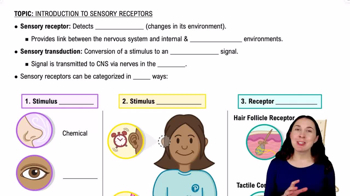
Sensation is the conscious and unconscious awareness of changes in the external or internal environment.
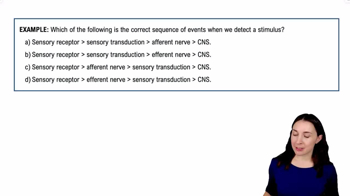
Stimulation of sensory receptor → transduction into nerve impulse → conduction to CNS → translation by CNS into sensation.
General senses (internal conditions) and special senses (smell, taste, vision, hearing, equilibrium).
Free nerve endings, encapsulated nerve endings (e.g., Pacinian corpuscles), and modified nerve endings (e.g., Merkel cells).
Exteroceptors, interoceptors, and proprioceptors.
Mechanoreceptors, thermoreceptors, nociceptors, photoreceptors, chemoreceptors, and osmoreceptors.
Tactile, thermal, pain, and proprioceptive sensations.
Meissner corpuscles, hair root plexuses, Merkel discs, Pacinian corpuscles, and free nerve endings.
Crude touch detects contact; discriminative touch identifies the exact point touched. Meissner's corpuscle mediates discriminative touch.
Pacinian corpuscle detects longer-lasting pressure over a larger, deeper area.
Meissner corpuscles detect low-frequency vibration; Pacinian corpuscles detect high-frequency vibration.
Free nerve endings mediate both; tickle cannot be self-induced.
Free nerve endings that detect cold and warm sensations.
Nociceptors are free nerve endings detecting pain; pain types include visceral (organs) and somatic (deep or superficial tissues).
Proprioceptors monitor body position and movement, aiding balance and posture.
First-order neuron: receptor to brainstem/spinal cord; second-order: brainstem/spinal cord to thalamus/cerebellum; third-order: thalamus to primary somatosensory cortex.
Starts at cerebral cortex → cerebellum → medulla oblongata → spinal cord → muscle.
Neurons projecting from reticular formation to cerebral cortex; increased activity causes awakening (arousal) from sleep.
Non-rapid eye movement (NREM) sleep and rapid eye movement (REM) sleep.
Increased heart rate, blood pressure, body temperature; decreased GI motility and skeletal muscle activity; most dreaming occurs.
Learning is acquiring new information or skills; memory is storing and retrieving learned information.
Short-term memory is temporary recall with synaptic changes; long-term memory is more permanent with biochemical and anatomical synaptic changes.
Rehearsal, emotional state, association with old data, and automatic memory formation.