Skip to main content
Anatomy & Physiology
My Course
Learn
Exam Prep
AI Tutor
Study Guides
Textbook Solutions
Flashcards
Explore
Try the app
My Course
Learn
Exam Prep
AI Tutor
Study Guides
Textbook Solutions
Flashcards
Explore
Try the app
Back
Organization of the Abdominopelvic Cavity
You can tap to flip the card.
What is the abdominopelvic cavity?
You can tap to flip the card.
👆
What is the abdominopelvic cavity?
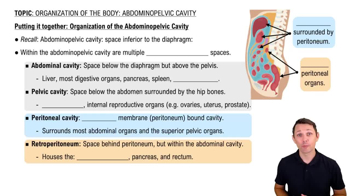
The space inferior to the diaphragm that contains multiple organ spaces.
Track progress
Control buttons has been changed to "navigation" mode.
1/20
Recommended videos
2:13
Organization of the Body: Abdominopelvic Cavity Example 1
5619
views
101
rank
5:46
Organization of the Abdominopelvic Cavity
7353
views
124
rank
1
comments
Terms in this set (20)
Hide definitions
What is the abdominopelvic cavity?
The space inferior to the diaphragm that contains multiple organ spaces.
What organs are found in the abdominal cavity?
Liver, most digestive organs, pancreas, spleen, and kidneys.
What defines the pelvic cavity?
Space below the abdomen surrounded by the hip bones, containing the bladder and internal reproductive organs.
What is the peritoneal cavity?
A cavity bound by the peritoneum membrane that surrounds most abdominal organs and superior pelvic organs.
What is the retroperitoneum?
Space behind the peritoneum but within the abdominal cavity housing the kidneys, pancreas, and rectum.
Which cavity surrounds the bladder?
The pelvic cavity.
Which cavity surrounds the stomach?
The abdominal cavity and peritoneal cavity.
Are the lungs within the abdominopelvic cavity?
No, the lungs are not surrounded by the abdominopelvic cavity.
Which cavity surrounds the large intestine?
The abdominal cavity and peritoneal cavity.
Are the kidneys within the peritoneal cavity?
No, kidneys are retroperitoneal, located behind the peritoneum.
What serous membrane must be cut to operate on the stomach?
The peritoneum must be cut to access the stomach.
Do you have to cut through the peritoneum to operate on the kidneys via the posterior lumbar region?
No, because the kidneys are posterior to the peritoneum.
How can infection from a burst appendix spread rapidly?
The peritoneum spans the entire ventral cavity, allowing infection to travel to virtually all organs.
What role does the peritoneal cavity's serous fluid play in infection spread?
It allows infection to quickly spread throughout the abdominopelvic cavity.
What organs are located in the retroperitoneum?
Kidneys, pancreas, and rectum.
What organs are surrounded by the peritoneum?
Most abdominal organs and superior pelvic organs.
What is the anatomical location of the abdominal cavity?
Space below the diaphragm but above the pelvis.
What is the anatomical location of the pelvic cavity?
Space below the abdomen surrounded by the hip bones.
Why is the peritoneum important in abdominal surgeries?
It is a serous membrane that must be cut to access many abdominal organs.
What is the significance of the retroperitoneal space?
It contains important organs not enclosed by the peritoneum, affecting surgical approaches.
 BackBack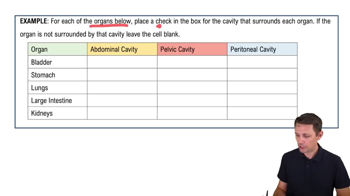
 2:13
2:13