 Back
BackOsmosis and Diffusion in Anatomy & Physiology
 02:44
02:44
Terms in this set (15)
Osmosis is the passive movement of water across a semipermeable membrane from a region of lower solute concentration to higher solute concentration.
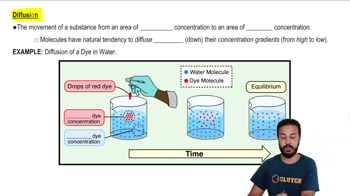
Diffusion is the passive movement of solutes from an area of higher concentration to an area of lower concentration.
Compare the solute concentration of the solution to the cell. Isotonic means equal solute concentration, hypertonic means higher solute concentration outside the cell, and hypotonic means lower solute concentration outside the cell.
Water moves out of the cell to the area of higher solute concentration.
Water moves into the cell where solute concentration is higher.
There is no net movement of water; the cell maintains its normal shape.
Solutes move from an area of higher concentration to an area of lower concentration.
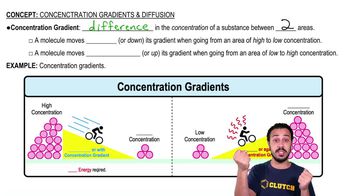
Active transport moves substances against their concentration gradient using energy.
Passive transport moves substances down their concentration gradient without energy.
Look at the solute concentration of the solution compared to the cell's solute concentration.
Movement of water indicates osmosis; movement of solute indicates diffusion.
The cell loses water and shrinks due to water moving out.
The cell gains water and may swell or burst due to water moving in.
Because water moves toward higher solute concentration, solute concentration determines the direction of water movement.
Passive transport requires no energy and moves substances down their gradient; active transport requires energy to move substances against their gradient.