 Back
BackPhysiology of the Respiratory System
 4:28
4:28
Terms in this set (21)
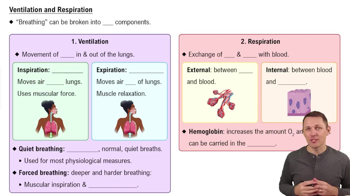
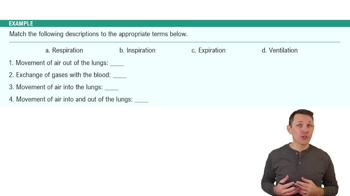
The four processes are pulmonary ventilation, external respiration, transport of gases, and internal respiration.
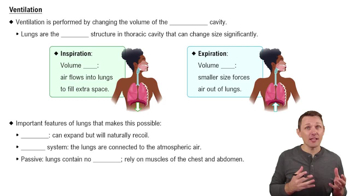
Pulmonary ventilation is the process of moving air into and out of the lungs, commonly known as breathing.
Inspiration involves the diaphragm contracting and moving downward, and the external intercostal muscles lifting the ribs, increasing thoracic volume and decreasing pressure to draw air in.
Expiration is usually passive, involving relaxation of the diaphragm and intercostal muscles, decreasing thoracic volume and increasing pressure to push air out.
Pulmonary volumes are the different measurable volumes of air in the lungs, including tidal volume, inspiratory reserve volume, expiratory reserve volume, and residual volume.
Tidal volume is the amount of air inhaled or exhaled during normal, quiet breathing, about 500 mL in adults.
Inspiratory reserve volume is the additional air that can be forcibly inhaled after a normal inspiration.
Expiratory reserve volume is the additional air that can be forcibly exhaled after a normal expiration.
Residual volume is the air remaining in the lungs after maximal expiration, preventing lung collapse.
Pulmonary capacities are combinations of pulmonary volumes, such as vital capacity, total lung capacity, inspiratory capacity, and functional residual capacity.
Vital capacity is the total amount of air that can be exhaled after a maximal inhalation; it equals TV + IRV + ERV.
Total lung capacity is the sum of all lung volumes: TV + IRV + ERV + residual volume.
Total minute volume is the volume of air inhaled or exhaled per minute, calculated as tidal volume multiplied by respiratory rate.
Forced expiratory volume measures the amount of air exhaled during the first second of a forced breath, used to assess lung function.
Partial pressure is the pressure exerted by a single gas in a mixture, driving gas exchange in the lungs and tissues.
Gas exchange occurs by diffusion across the respiratory membrane, where oxygen moves into blood and carbon dioxide moves into alveolar air due to partial pressure gradients.
Hemoglobin binds oxygen in red blood cells, greatly increasing oxygen transport capacity in the blood.
Oxygen is transported mostly bound to hemoglobin (~98.5%) and a small amount dissolved in plasma (~1.5%).
Carbon dioxide is transported as bicarbonate ions (~70%), bound to hemoglobin (~20%), and dissolved in plasma (~10%).
Systemic gas exchange is the process where oxygen leaves the blood and enters tissues, and carbon dioxide leaves tissues and enters the blood.
Breathing is influenced by chemical factors (CO2, O2, pH levels), neural controls, and other factors like emotions and physical activity.