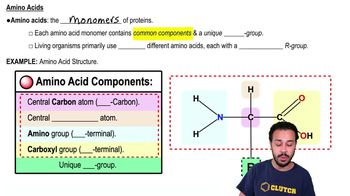
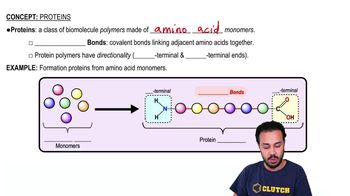
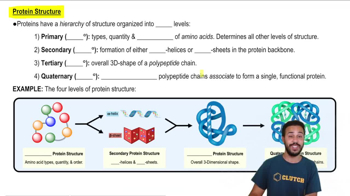
The tertiary structure is the 3-D shape formed by superimposed secondary structures like α-helices and β-sheets, held together by intramolecular bonds.
What defines the quaternary structure of a protein?
The quaternary structure consists of two or more polypeptide chains, each with its own tertiary structure, combined to form a functional protein.
What are fibrous proteins and their characteristics?
Fibrous proteins are strandlike, water-insoluble, and stable. They provide mechanical support and tensile strength, often having tertiary or quaternary structure. Examples include keratin, elastin, and collagen.
What are globular proteins and their characteristics?
Globular proteins are compact, spherical, water-soluble, and sensitive to environmental changes. They have specific functional regions (active sites) and include antibodies, hormones, and enzymes.
What is protein denaturation?
Denaturation is when globular proteins unfold and lose their functional 3-D shape, deactivating active sites. It can be caused by decreased pH or increased temperature and may be reversible or irreversible.
What role do enzymes play in biological reactions?
Enzymes are globular proteins that act as biological catalysts, increasing reaction speed by lowering the activation energy without being consumed.
What are the two parts of a functional enzyme (holoenzyme)?
A holoenzyme consists of an apoenzyme (protein portion) and a cofactor (metal ion) or coenzyme (organic molecule, often a vitamin).
How do enzymes recognize substrates?
Enzymes are highly specific and act on a very specific substrate, often named with the suffix '-ase' based on the reaction they catalyze.
What are the three steps involved in enzyme action?
1. Substrate binds to enzyme's active site forming enzyme-substrate complex. 2. Complex rearranges substrate into product. 3. Product is released from enzyme.
How do enzymes affect activation energy?
Enzymes lower the activation energy required to initiate a chemical reaction, allowing reactions to proceed quickly at body temperature.
What are nucleic acids composed of?
Nucleic acids are large molecules made of carbon, hydrogen, oxygen, nitrogen, and phosphorus, composed of nucleotide monomers with a nitrogen base, pentose sugar, and phosphate group.
What are the two major classes of nucleic acids?
The two major classes are DNA (deoxyribonucleic acid) and RNA (ribonucleic acid).
What is the structure and function of DNA?
DNA is a double-stranded helical molecule in the nucleus that holds the genetic blueprint for protein synthesis, with nucleotides containing deoxyribose sugar and nitrogen bases A, T, G, and C.
What are the complementary base-pairing rules in DNA?
In DNA, adenine (A) pairs with thymine (T) and guanine (G) pairs with cytosine (C).
How does RNA differ from DNA?
RNA is single-stranded, contains ribose sugar instead of deoxyribose, and replaces thymine with uracil. It functions mostly outside the nucleus in protein synthesis.
What are the three types of RNA involved in protein synthesis?
The three types are messenger RNA (mRNA), transfer RNA (tRNA), and ribosomal RNA (rRNA).
What is ATP and its role in the cell?
ATP (adenosine triphosphate) is the primary energy carrier in cells, capturing chemical energy from glucose breakdown to power cellular reactions.
What is the structure of ATP?
ATP consists of an adenine-containing RNA nucleotide with three phosphate groups, where energy is stored in the bonds between phosphates.
How is energy released from ATP?
Energy is released when the terminal phosphate group is transferred to other molecules, converting ATP to ADP, and further to AMP with loss of phosphate groups.
What types of cellular work are powered by ATP?
ATP powers chemical work (synthesis), transport work (pumping substances across membranes), and mechanical work (muscle contraction).
 Back
 04:53