 Back
Protein Structure in Anatomy & Physiology
 04:53

Terms in this set (20)
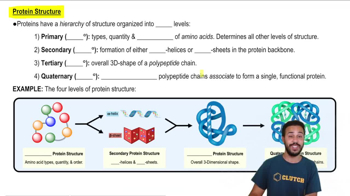
The primary structure is the linear sequence of amino acids in a polypeptide chain.
The secondary structure involves local folding into alpha helices or beta sheets stabilized by hydrogen bonds.
The tertiary structure is the overall 3D shape of a single polypeptide, formed by interactions among side chains.
The quaternary structure is the arrangement of multiple polypeptide subunits into a functional protein complex.
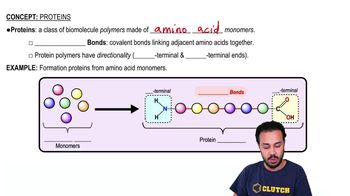
Peptide bonds link amino acids in the primary structure.
Hydrogen bonds stabilize alpha helices and beta sheets in secondary structures.
Tertiary structure is stabilized by hydrophobic interactions, hydrogen bonds, ionic bonds, and disulfide bridges.
Disulfide bridges are covalent bonds that stabilize tertiary and quaternary structures by linking cysteine residues.
Denaturation disrupts secondary, tertiary, or quaternary structures without breaking peptide bonds, causing loss of function.
Proper protein folding is essential for biological function and enzyme activity.
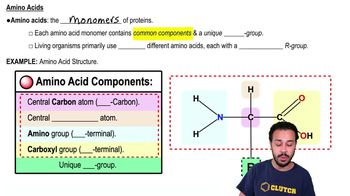
A polypeptide is a chain of amino acids linked by peptide bonds forming the backbone of proteins.
The tertiary and quaternary structures primarily determine protein function by defining its shape.
Hydrogen bonds stabilize secondary and tertiary structures by linking backbone and side chain atoms.
Proteins typically consist of 50 or more amino acids linked in a polypeptide chain.
An alpha helix is a coiled structure, while a beta sheet is formed by aligned strands connected by hydrogen bonds.
Protein misfolding can cause diseases by forming nonfunctional or toxic aggregates.
Side chains determine chemical properties and interactions that shape tertiary and quaternary structures.
Quaternary structure allows cooperative interactions between subunits, affecting protein activity.
A peptide bond is a covalent bond formed between the amino group of one amino acid and the carboxyl group of another.
Factors like heat, pH changes, and chemicals can cause protein denaturation.