Skip to main content
Anatomy & Physiology
My Course
Learn
Exam Prep
AI Tutor
Study Guides
Textbook Solutions
Flashcards
Explore
Try the app
My Course
Learn
Exam Prep
AI Tutor
Study Guides
Textbook Solutions
Flashcards
Explore
Try the app
Back
Respiratory Physiology - Anatomy & Physiology Module 7
You can tap to flip the card.
When does air move into the lungs?
You can tap to flip the card.
👆
When does air move into the lungs?
Air moves into the lungs when alveolar pressure is
less
than atmospheric pressure.
Track progress
Control buttons has been changed to "navigation" mode.
1/14
Recommended videos
4:28
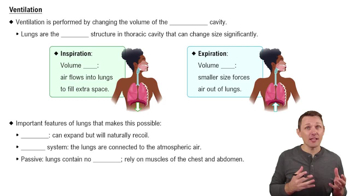
Ventilation
8264
views
195
rank
1
comments
5:55
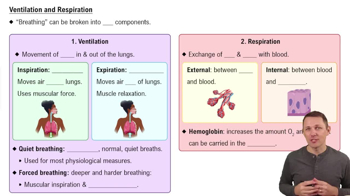
Ventilation and Respiration
12178
views
364
rank
1
comments
1:37
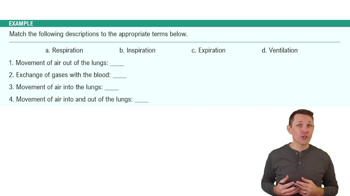
Introduction to Lung Physiology Example 1
8271
views
223
rank
1
comments
Terms in this set (14)
Hide definitions
When does air move into the lungs?
Air moves into the lungs when alveolar pressure is
less
than atmospheric pressure.
When does air move out of the lungs?
Air moves out of the lungs when alveolar pressure is
greater
than atmospheric pressure.
What pressure is always negative and helps keep the lungs inflated?
Intrapleural pressure
is always negative and helps keep the lungs inflated.
What is the function of goblet cells in the respiratory system?
Goblet cells produce
mucus
to trap particles and protect the respiratory tract.
What do type II alveolar cells produce?
Type II alveolar cells produce
surfactant
, which reduces surface tension in the alveoli.
What are the adrenergic receptors in the lungs?
The adrenergic receptors in the lungs are
beta-2 receptors
.
What prevents food from entering the trachea when swallowing?
The
epiglottis
prevents food from entering the trachea during swallowing.
Effect of acetylcholine on bronchioles, resistance, and airflow?
Acetylcholine will
bronchoconstrict
bronchioles,
increase
resistance, and
decrease
airflow.
Effect of histamine on bronchioles, resistance, and airflow?
Histamine will
bronchoconstrict
bronchioles,
increase
resistance, and
decrease
airflow.
Effect of epinephrine on bronchioles, resistance, and airflow?
Epinephrine will
bronchodilate
bronchioles,
decrease
resistance, and
increase
airflow.
What happens to blood Pco2 and pH during hyperventilation?
During hyperventilation, blood Pco2
decreases
and pH
increases
.
What blood levels are the most important stimulus controlling ventilation?
Carbon dioxide (Pco2) levels
in the blood are the most important stimulus controlling ventilation.
What vibrates in the larynx to produce sound?
The
vocal cords
in the larynx vibrate to produce sound.
What structures extend from the vocal cords to the inner wall of the larynx and do not produce sound?
The
vestibular folds
extend from the vocal cords to the inner wall of the larynx and do not produce sound.
 BackBack
 4:28