 Back
BackRespiratory System Anatomy & Physiology
 4:28
4:28
Terms in this set (20)
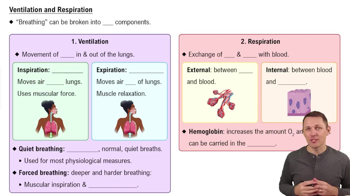
Breathing (pulmonary ventilation), gas exchange, warming and humidifying air, protecting respiratory surfaces, and producing sound.
The nasal cavity and pharynx, lined with pseudostratified columnar epithelium containing goblet cells that produce mucus and lysozyme.
The nasal septum is a central wall of bone and cartilage dividing the nasal cavity, including the perpendicular plate of the ethmoid bone, vomer, and septal cartilage.
Bony plates on the lateral walls of the nasal cavity that increase surface area of the mucous membrane to warm and humidify inhaled air.
Nasopharynx: pseudostratified ciliated columnar epithelium.
Oropharynx and laryngopharynx: nonkeratinized stratified epithelium.
Vocal folds are the true vocal cords responsible for sound production.
Vestibular folds are false vocal cords that protect the vocal folds.
Thyroid, cricoid, arytenoid, corniculate, and cuneiform cartilages, plus the epiglottis.
A flexible tube from C6 to T4/T5 with 15-20 U-shaped hyaline cartilage rings and trachealis muscle; it filters, warms, and humidifies air.
Bronchioles lack cartilage and have smooth muscle to keep them open; lined by columnar to cuboidal epithelium facilitating gas diffusion.
Functional units of the lung composed of Type I alveolar cells (gas exchange), Type II alveolar cells (surfactant production), and endothelial cells.
Visceral pleura: adheres to lungs, insensitive to pain.
Parietal pleura: lines thoracic wall, sensitive to pain, innervated by somatic nerves.
Surfaces: mediastinal, diaphragmatic, costal.
Borders: anterior, posterior (smooth), inferior.
Pulmonary circulation carries blood to/from gas exchange surfaces.
Bronchial circulation supplies blood to bronchi and bronchioles from systemic circulation.
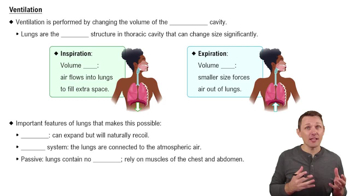
Gas pressure decreases as volume increases and vice versa; during inhalation, thoracic volume increases, lowering pressure and drawing air in.
Thoracic volume increases, alveolar volume increases, intrapulmonary pressure drops below atmospheric pressure, causing air to flow into lungs.
Inhalation: diaphragm (phrenic nerve) and external intercostals (intercostal nerves).
Exhalation: passive relaxation of these muscles.
Inspiration: scalene, serratus anterior/posterior, pectoralis minor/major, sternocleidomastoid.
Expiration: internal intercostals, transversus thoracis, abdominal muscles.
Bucket handle: ribs swing outward increasing transverse diameter.
Pump handle: ribs raise increasing anteroposterior diameter.
Sympathetic (T1–T5): dilates bronchioles.
Parasympathetic (vagus nerve): constricts bronchioles.
Pseudostratified ciliated columnar epithelium with goblet cells producing mucus to trap particles.