What are the main functions of the nose in the respiratory system?
The nose provides an airway for respiration; moistens, warms, filters, and cleans incoming air; provides a resonance chamber for speech; and houses olfactory receptors.
What structures form the upper respiratory system?
The upper respiratory system includes the nose, nasal cavity, paranasal sinuses, pharynx, and larynx.
What is the role of nasal conchae in the nasal cavity?
Nasal conchae increase the mucosal surface area to filter, heat, and moisten incoming air.
Describe the three regions of the pharynx and their functions.
Nasopharynx: air passageway with pharyngeal tonsil; Oropharynx: air and food passageway with palatine and lingual tonsils; Laryngopharynx: air and food passageway continuous with esophagus.
What are the main functions of the larynx?
The larynx provides an open airway, routes food and air into proper passageways, and produces sound via vocal cords.
What cartilage types compose the larynx?
The larynx consists of hyaline cartilages (thyroid, cricoid, arytenoid, corniculate, cuneiform) and elastic cartilage (epiglottis).
How does the epiglottis protect the airway during swallowing?
The epiglottis closes off the larynx during swallowing to prevent food or liquids from entering the airways.
What is the structure and function of the trachea?
The trachea is a tube supported by C-shaped cartilaginous rings, lined with ciliated pseudostratified epithelium to propel mucus upward, and connects the larynx to the primary bronchi.
How do the bronchi branch and change structurally as they become smaller?
Primary bronchi branch into secondary and tertiary bronchi, then bronchioles; cartilage decreases, epithelium changes from pseudostratified columnar to cuboidal, and smooth muscle increases.
What defines the respiratory zone of the respiratory system?
The respiratory zone begins at respiratory bronchioles, leading to alveolar ducts and alveolar sacs where gas exchange occurs.
What is the respiratory membrane composed of?
The respiratory membrane consists of type I alveolar cells, their basal lamina, and pulmonary capillary endothelium, allowing gas exchange.
What is the function of type II alveolar cells?
Type II alveolar cells secrete surfactant, which reduces alveolar surface tension.
What are the pleurae and their functions?
The pleurae are double-layered serous membranes; the parietal pleura lines the thoracic cavity, the visceral pleura covers the lungs, and pleural fluid lubricates to allow friction-free lung movement.
Explain Boyle's law in relation to pulmonary ventilation.
Boyle's law states that pressure of a gas varies inversely with volume; during inspiration, thoracic volume increases, pressure decreases, and air flows into lungs.
What muscles are involved in quiet inspiration?
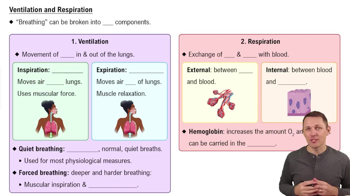
The diaphragm and external intercostal muscles contract to increase thoracic volume during quiet inspiration.
How does forced expiration differ from quiet expiration?
Forced expiration is active, using abdominal muscles to increase intra-abdominal pressure, while quiet expiration is passive, relying on lung elastic recoil.
What factors influence airway resistance?
Airway resistance is influenced by airway diameter and length; resistance is usually low due to large upper airways and numerous smaller airways.
Define lung compliance and factors that reduce it.
Lung compliance is the ease of lung expansion; it is reduced by decreased tissue elasticity, scar tissue, inflammation, or low surfactant levels.
What are tidal volume and vital capacity?
Tidal volume is the air moved during quiet breathing (~500 ml); vital capacity is the total exchangeable air, sum of tidal volume, inspiratory reserve, and expiratory reserve volumes.
How is oxygen transported in the blood?
About 1.5% of oxygen is dissolved in plasma; 98.5% is bound reversibly to hemoglobin in red blood cells.
What factors affect hemoglobin's affinity for oxygen?
Increased temperature, CO2 partial pressure, H+ concentration, and BPG decrease hemoglobin's oxygen affinity, promoting oxygen release to tissues.
Describe the three ways carbon dioxide is transported in blood.
CO2 is transported dissolved in plasma (7–10%), bound to hemoglobin (20%), and as bicarbonate ions (70%).
What is the Haldane effect?
The Haldane effect describes how deoxygenated hemoglobin binds more CO2, facilitating CO2 transport from tissues to lungs.
What are the main respiratory centers in the brainstem?
The ventral respiratory group (VRG) generates rhythm; the dorsal respiratory group (DRG) integrates sensory input; the pontine respiratory group modulates rhythm.
How do central and peripheral chemoreceptors regulate breathing?
Central chemoreceptors respond to increased H+ from CO2 in cerebrospinal fluid; peripheral chemoreceptors in carotid and aortic bodies respond to low O2, high CO2, and pH changes.
What is the Hering-Breuer reflex?
A protective reflex activated by lung stretch receptors that inhibits inspiration to prevent lung overexpansion.
How does exercise affect respiration?
Exercise causes hyperpnea—deeper, faster breathing—to meet oxygen demand, driven by neural factors rather than changes in blood gases.
What changes occur during acclimatization to high altitude?
Increased ventilation rate, lower hemoglobin saturation, and increased erythropoietin production to improve oxygen delivery.
What characterizes chronic obstructive pulmonary diseases (COPD)?
COPD includes emphysema and chronic bronchitis, causing airflow obstruction, dyspnea, coughing, and frequent infections.
 Back
Back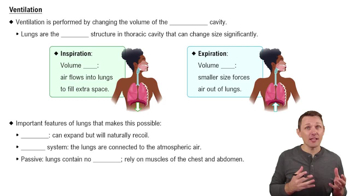
 4:28
4:28