Back

Respiratory System - Anatomy & Physiology

Control buttons has been changed to "navigation" mode.
1/31
  • Primary function of the respiratory system

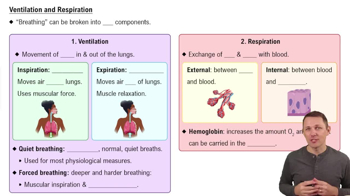
    To bring oxygen into the body and remove carbon dioxide through ventilation, external respiration, blood gas transport, and internal respiration.
  • Ventilation

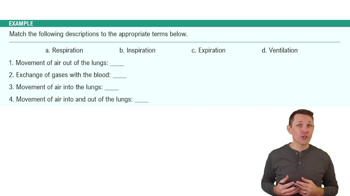
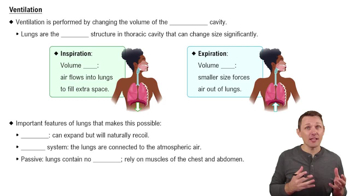
    The mechanical process of moving air into (inspiration) and out of (expiration) the lungs.
  • External respiration

    Diffusion of gases between alveolar air and pulmonary blood.
  • Internal respiration

    Diffusion of gases between tissue capillaries and interstitial fluid.
  • Conducting passages

    Airways that carry air into and out of the body but do not participate in gas exchange; include nose, pharynx, trachea, larynx, bronchi, bronchioles, and terminal bronchioles.
  • Respiratory passages

    Airways involved in gas exchange; include respiratory bronchioles, alveoli, and alveolar ducts.
  • Structure of the respiratory membrane

    Consists of alveolar epithelium, fused basal lamina, and capillary endothelium, all composed of simple squamous cells.
  • Factors governing rate of diffusion

    Solubility of gas, surface area, thickness of respiratory membrane, distance of diffusion, and size of gas molecule.
  • Boyle's Law

    Gas pressure is inversely related to the volume of the space it occupies, expressed as \(P_1V_1 = P_2V_2\).
  • Neural control of ventilation

    Autonomic nervous system controls smooth muscle in airways; somatic nervous system controls skeletal muscles for breathing.
  • Role of diaphragm in breathing

    The respiratory diaphragm accounts for about 75% of air movement during breathing by contracting to increase thoracic volume.
  • Air flow equation in respiratory system

    Air Flow = (Pressure1 - Pressure2) / Resistance; air moves from high to low pressure encountering resistance.
  • Dalton's Law of Partial Pressures

    Total pressure of a gas mixture equals the sum of the partial pressures of individual gases.
  • Henry's Law

    The amount of gas dissolved in a liquid is proportional to its partial pressure above the liquid.
  • Oxygen transport in blood

    About 1.5% dissolved in plasma; 98.5% bound to hemoglobin in red blood cells.
  • Hemoglobin oxygen saturation

    Determined by the number of O2 molecules bound per hemoglobin molecule; saturation is a percentage.
  • Bohr Effect

    Low pH decreases hemoglobin's affinity for oxygen, promoting oxygen release to tissues.
  • Factors favoring Hb-O2 dissociation

    High temperature, low pO2, high pCO2, low blood pH, and high BPG in RBCs.
  • Carbon dioxide transport in blood

    7-10% dissolved in plasma, 20-30% bound to hemoglobin as carbaminohemoglobin, 60-70% converted to bicarbonate ions.
  • Haldane Effect

    Reduced hemoglobin binds more CO2; lower O2 saturation increases CO2 carrying capacity.
  • Ventilation-perfusion coupling

    Alveoli with high CO2 cause vasoconstriction (decreased blood flow) and bronchodilation (increased airflow) to optimize gas exchange.
  • Respiratory centers in the brainstem

    Dorsal Respiratory Group integrates sensory input; Ventral Respiratory Group sets basic ventilation rhythm.
  • Pontine respiratory centers

    Modify basic breathing rhythm during activities like speech, sleep, and exercise.
  • Peripheral chemoreceptors response to pCO2 and pO2

    Increased pCO2 stimulates hyperventilation; decreased pO2 (<60 mmHg) also stimulates hyperventilation.
  • Effect of blood pH on ventilation

    Decreased pH (acidosis) causes hyperventilation; increased pH (alkalosis) causes hypoventilation.
  • Common respiratory terms

    • Eupnea: normal quiet breathing
    • Apnea: cessation of breathing
    • Hyperpnea: deep, vigorous breathing
    • Dyspnea: difficult breathing
    • Tachypnea: rapid breathing
  • Emphysema characteristics

    Permanent enlargement of alveoli and bronchioles, destruction of alveolar walls, loss of lung elasticity, often linked to smoking and chronic bronchitis.
  • Infant respiratory distress syndrome cause

    Premature birth leading to insufficient surfactant production, causing alveolar collapse and low lung compliance.
  • Asthma characteristics

    Chronic airway inflammation and hyper-responsiveness causing dyspnea, coughing, wheezing, and mucus secretion.
  • Tuberculosis characteristics

    Infection by Mycobacterium tuberculosis causing chest pain, bloody sputum, granulomas, and possible spread to other organs.
  • Cystic fibrosis cause and effects

    Defective chloride transporter gene causing mucus accumulation, chronic lung infections, and digestive issues.