 Back
BackRespiratory System Anatomy & Physiology
 4:28
4:28
Terms in this set (27)
Provides extensive gas exchange surface area, moves air to/from lungs, protects respiratory surfaces, produces sounds, and participates in olfaction.
Upper respiratory system (above larynx) and lower respiratory system (below larynx).
Conducting portion: nasal cavity to terminal bronchioles; respiratory portion: respiratory bronchioles and alveoli where gas exchange occurs.
Pseudostratified ciliated columnar epithelium with mucous cells in nasal cavity and upper respiratory tract; stratified squamous epithelium in inferior pharynx; cuboidal epithelium in smaller bronchioles.
Mucosa lines conducting portion; lamina propria supports epithelium, contains mucous glands in upper tract and smooth muscle in lower bronchioles.
Mucous cells/glands produce mucus, cilia move mucus to pharynx, nasal cavity filters large particles, alveolar macrophages engulf small particles.
Air enters through nostrils, nasal hairs filter particles, nasal cavity warms, humidifies, and traps particles via mucosa and meatuses.
Nasopharynx (upper, contains pharyngeal tonsils), oropharynx (middle, communicates with oral cavity), laryngopharynx (lower, leads to larynx and esophagus).
Three large unpaired: thyroid, cricoid, epiglottis; three pairs of smaller hyaline cartilages: arytenoid, corniculate, cuneiform.
Support and protect glottis and trachea entrance; during swallowing, larynx elevates and epiglottis folds to prevent food entry.
Air passing through glottis vibrates vocal folds (vocal cords); sound varies by tension on vocal folds controlled by intrinsic muscles.
Windpipe extending from cricoid cartilage to bronchi; supported by 15-20 C-shaped tracheal cartilages; submucosa contains mucous glands.
Right bronchus is larger and steeper; primary bronchi branch into secondary (lobar) bronchi, then tertiary (segmental) bronchi supplying bronchopulmonary segments.
Bronchioles lack cartilage, dominated by smooth muscle; diameter controlled by autonomic nervous system affecting airflow and resistance.
Each terminal bronchiole supplies a pulmonary lobule containing respiratory bronchioles and alveoli where gas exchange occurs.
Type I pneumocytes: thin squamous cells for gas exchange; Type II pneumocytes: produce surfactant to reduce surface tension; alveolar macrophages patrol alveoli.
Consists of alveolar epithelium, fused basement membranes, and capillary endothelium; thin for rapid gas diffusion.
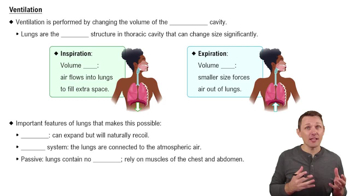
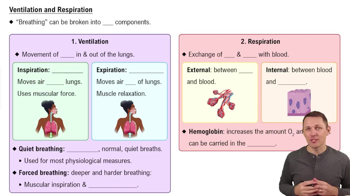
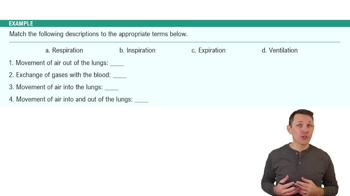
Air moves due to pressure differences; inhalation increases thoracic volume via diaphragm and external intercostals; exhalation decreases volume, can be passive or active.
Primary: diaphragm and external intercostals; accessory muscles assist during forced breathing; internal intercostals and abdominal muscles aid forced exhalation.
Medulla oblongata contains dorsal (DRG) and ventral (VRG) respiratory groups; pons contains apneustic and pneumotaxic centers regulating rate and depth.
Peripheral chemoreceptors in carotid and aortic bodies respond to blood pH, PO2; central chemoreceptors in medulla respond to CSF pH and PCO2 to adjust breathing.
Oxygen transported bound to hemoglobin; carbon dioxide transported as bicarbonate, bound to hemoglobin, or dissolved in plasma.
PO2, blood pH (Bohr effect), temperature, and 2,3-BPG levels influence hemoglobin's oxygen affinity and release.
Includes tidal volume, inspiratory/expiratory reserve volumes, residual volume; capacities include vital capacity, inspiratory capacity, functional residual capacity, and total lung capacity.
Compliance is lung expandability; affected by connective tissue, surfactant levels, and thoracic cage mobility; low compliance requires more force to breathe.
Triggered by irritants causing sneezing, coughing, laryngeal spasm to protect airways from harmful substances.
Elastic tissue deterioration, arthritic changes limiting chest movement, and emphysema reduce lung function and respiratory capacity.