 Back
Respiratory System - Anatomy & Physiology Study Guide
 4:28

Terms in this set (27)
Includes gas exchange (oxygen in, carbon dioxide out), regulation of blood pH, voice production, olfaction, and protection against pathogens.
Pulmonary ventilation (breathing), external respiration (gas exchange in lungs), transport of gases in blood, and internal respiration (gas exchange at tissues).
Upper tract: nose, nasal cavity, pharynx. Lower tract: larynx, trachea, bronchi, lungs.
Conducting zone: air passageways that filter, warm, and moisten air (nose to terminal bronchioles). Respiratory zone: sites of gas exchange (respiratory bronchioles, alveolar ducts, alveoli).
Nose → nasal cavity → pharynx → larynx → trachea → bronchi → bronchioles → alveoli.
Warm, moisten, and filter air; enhance voice resonance; reduce skull weight.
Passageway for air and food; divided into nasopharynx, oropharynx, and laryngopharynx.
Voice production, airway protection during swallowing, and air passage.
Rigid tube with C-shaped cartilage rings; conducts air to bronchi and filters particles via ciliated mucosa.
Bronchi branch into lungs; lungs contain bronchioles and alveoli for gas exchange.
Serous membranes that reduce friction and create pressure gradients to keep lungs inflated.
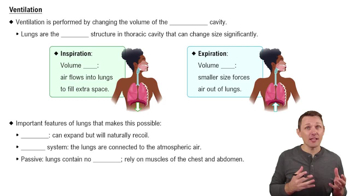
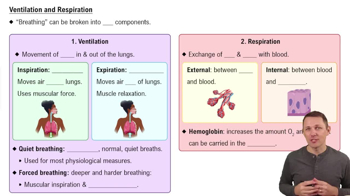
Movement of air into and out of the lungs (breathing).
Diaphragm and external intercostal muscles.
At constant temperature, pressure is inversely proportional to volume; lung volume changes cause pressure changes driving air flow.
Resistance increases with bronchoconstriction; ventilation decreases as \(F=\frac{P}{R}\).
Reduces alveolar surface tension to prevent collapse and maintain lung compliance.
TV: tidal volume; IRV: inspiratory reserve volume; ERV: expiratory reserve volume; RV: residual volume.
Total pressure of a gas mixture equals the sum of partial pressures of individual gases.
Gas dissolves in liquid proportional to its partial pressure; affects oxygen and CO2 dissolved in plasma.
Matching of alveolar ventilation and pulmonary blood flow; decreased ventilation causes vasoconstriction, decreased blood flow causes bronchodilation.
Mostly bound to hemoglobin; temperature, pH, and PCO2 affect oxygen loading/unloading.
Right/down shift (↑temp, ↓pH, ↑PCO2) increases oxygen unloading; left/up shift facilitates oxygen loading in lungs.
Medullary rhythmicity center and pontine respiratory group regulate breathing rate and depth.
CO2, O2, and pH levels detected by chemoreceptors influence respiratory centers.
Hyperventilation: increased breathing rate/depth; hypoventilation: decreased ventilation; eupnea: normal breathing.
Increased ventilation to compensate for lower oxygen partial pressure.
Destruction of alveoli reduces surface area, impairing gas exchange and lung elasticity.