 Back
BackSensory System and Mechanisms - Anatomy & Physiology
 2:47
2:47
Terms in this set (21)
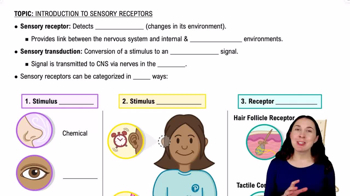
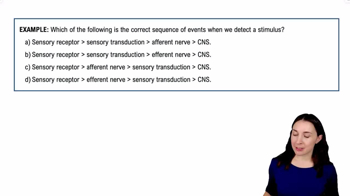
Sensory receptors detect stimuli from the environment and convert them into nerve impulses for the nervous system to process.
The skin contains various sensory receptors like mechanoreceptors, thermoreceptors, and nociceptors that detect touch, temperature, and pain.
The olfactory organs in the nasal cavity detect odors; signals travel via the olfactory nerve to the olfactory bulb and then to the cerebrum for perception.
Odor molecules bind to receptors on olfactory neurons, triggering impulses that are processed in the olfactory bulb and interpreted in the brain.
Gustatory organs are taste buds located mainly on the tongue, responsible for detecting taste stimuli.
Taste buds detect chemicals; impulses travel via cranial nerves to the gustatory cortex for taste perception.
The external ear collects sound; the middle ear transmits vibrations via ossicles; the inner ear contains cochlea and vestibular apparatus for hearing and balance.
Hair cells detect head movements and position changes, contributing to balance and equilibrium.
The organ of Corti in the cochlea contains hair cells that convert sound vibrations into nerve impulses for hearing.
Pitch depends on sound wave frequency; volume depends on wave amplitude, both processed by the cochlea and auditory pathways.
Signals from the inner ear travel via the vestibulocochlear nerve to the brainstem and then to the cerebrum and cerebellum for processing.
Includes eyelids, eyelashes, lacrimal glands, and conjunctiva; they protect the eye and maintain moisture.
The eye wall has three layers: sclera, choroid, and retina. The eye contains anterior and posterior cavities filled with aqueous humor and vitreous body.
Light passes through the cornea, lens, and vitreous humor, focusing on the fovea centralis for sharp central vision.
The lens changes shape via accommodation to focus light rays precisely on the retina for clear images.
The retina has layers of neurons and photoreceptors: rods for low light and peripheral vision, cones for color and sharp central vision.
Photoreceptors contain visual pigments activated by light; cones have different pigments allowing color perception.
The vestibular apparatus includes semicircular canals, utricle, and saccule; it detects head position and movement to maintain balance.
Visual signals travel from the retina via the optic nerve to the optic chiasm, then to the visual cortex for image processing.
Problems include myopia, hyperopia, astigmatism, and presbyopia caused by cornea, lens, or eye shape abnormalities.
Includes reduced smell and taste sensitivity, presbyopia, balance issues, and hearing loss due to aging changes in sensory organs.