Back

Serous Membranes in Anatomy & Physiology

Control buttons has been changed to "navigation" mode.
1/16
  • What are serous membranes?

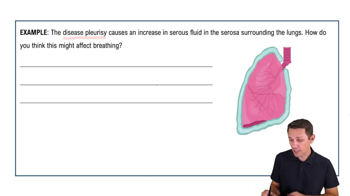
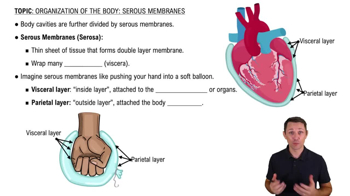
    Serous membranes are thin sheets of tissue that fold over themselves to enclose a single cavity filled with serous fluid,

  • What is serous fluid 's function?


    To lubricate organs to reduce friction during movement.

  • How is a serous membrane structured?

    A serous membrane is a single continuous layer of tissue folded to form two layers: the visceral layer contacting the organ and the parietal layer attaching to surrounding structures.
  • What is the visceral layer of a serous membrane?

    The visceral layer is the inner part of the serous membrane that directly contacts and covers the organ.
  • What is the parietal layer of a serous membrane?

    The parietal layer is the outer part of the serous membrane that attaches to surrounding body structures.
  • Name the three main serous membranes in the body.

    The three main serous membranes are the pleural membranes (lungs), pericardial membranes (heart), and peritoneal membranes (abdominal organs).
  • What are the pleural membranes?

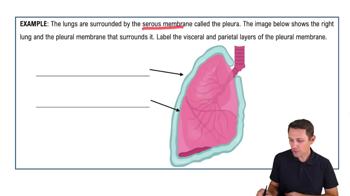
    Pleural membranes surround the lungs and consist of the parietal pleura (thoracic wall) and visceral pleura (lung surfaces), enclosing the pleural cavities.
  • What is the pericardial membrane?

    The pericardial membrane surrounds the heart and includes the parietal pericardium (outer layer) and visceral pericardium (attached to heart muscle), enclosing the pericardial cavity.
  • What are the peritoneal membranes?

    Peritoneal membranes surround some abdominal organs and consist of the parietal peritoneum and visceral peritoneum, enclosing the peritoneal cavity.
  • What is the peritoneal cavity?

    The peritoneal cavity is the space between the parietal and visceral peritoneal membranes, larger than pleural or pericardial cavities, enveloping several abdominal organs.
  • What does 'intraperitoneal' mean?

    Intraperitoneal refers to organs that are located within and enveloped by the peritoneal cavity.
  • What does 'retroperitoneal' mean?

    Retroperitoneal describes organs located behind the parietal peritoneum, outside the peritoneal cavity, such as the kidneys.
  • Where is the pericardial cavity located?

    The pericardial cavity is the space between the parietal and visceral pericardium surrounding the heart.
  • Where are the pleural cavities located?

    Pleural cavities are the thin spaces enclosed by the pleural membranes around each lung.
  • What is the role of the parietal pleura?

    The parietal pleura is the outer layer of the pleural membrane that lines the thoracic wall.
  • What is the role of the visceral pleura?

    The visceral pleura is the inner layer of the pleural membrane that covers the lung surfaces.