 Back
Skeletal System and Pelvic Girdle - Anatomy & Physiology
 4:50

Terms in this set (20)
The skeletal system provides support, protection, movement, mineral storage, blood cell production, and fat storage.
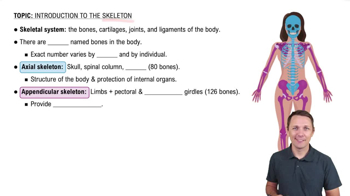
The axial skeleton includes the skull, vertebral column, rib cage, and sternum.
The appendicular skeleton consists of the pectoral girdle, upper limbs, pelvic girdle, and lower limbs.
The pelvic girdle is formed by two hip bones (coxal bones), each made of the ilium, ischium, and pubis.
The pelvic girdle supports the weight of the upper body, protects pelvic organs, and provides attachment points for lower limbs.
The ilium is the largest, uppermost part of the hip bone, featuring the iliac crest for muscle attachment.
The ischium forms the lower and back part of the hip bone and supports body weight when sitting.
The pubis is the anterior part of the hip bone; the two pubic bones meet at the pubic symphysis.
The pubic symphysis is a cartilaginous joint uniting the two pubic bones at the front of the pelvis.
The acetabulum is the deep socket on the lateral pelvis where the head of the femur articulates to form the hip joint.
Female pelvis is wider, shallower, and has a larger pelvic inlet and outlet to facilitate childbirth compared to the male pelvis.
The hip joint is a ball-and-socket synovial joint allowing multi-directional movement and stability.
The three main regions are the diaphysis (shaft), epiphyses (ends), and metaphysis (growth plate area).
The iliac crest serves as an attachment site for abdominal and thigh muscles and protects internal organs.
The pelvic inlet is formed by the sacral promontory, arcuate lines of the ilium, and the pubic symphysis.
The sacrum connects the spine to the pelvic girdle via the sacroiliac joints, providing stability and support.
The true pelvis lies below the pelvic brim and contains pelvic organs; the false pelvis lies above and supports abdominal organs.
The pelvic girdle is mainly composed of compact bone on the outside and spongy bone inside.
The obturator foramen is a large opening in the hip bone allowing passage of nerves and blood vessels to the thigh.
It transmits forces from the lower limbs to the axial skeleton and provides attachment points for muscles involved in walking and running.