 Back
BackSkull Bones and Their Functions
 2:12
2:12
Terms in this set (15)
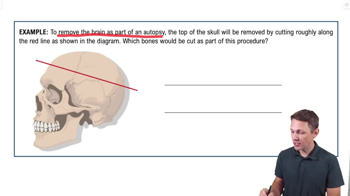
Forms the forehead and upper part of the eye sockets; protects the front of the brain.
Two bones forming the sides and roof of the cranial cavity; protect the upper sides of the brain.
Two bones located at the sides and base of the skull; house structures for hearing and balance.
Forms the back and base of the skull; contains the foramen magnum where the spinal cord passes through.
Located at the base of the skull in front of the temporals; helps form the floor of the cranium and supports the brain.
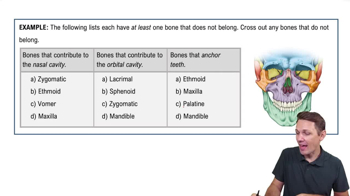
Located between the eyes; forms part of the nasal cavity and orbits, and supports the nose.
Two bones forming the upper jaw and part of the eye sockets and nasal cavity; hold the upper teeth.
Two bones forming the cheekbones and part of the eye sockets.
Two bones forming the bridge of the nose.
Two small bones forming part of the inner eye socket; contain the tear ducts.
Two bones forming the back part of the hard palate and part of the nasal cavity and eye sockets.
Two bones forming part of the side walls of the nasal cavity.
Forms the lower part of the nasal septum.
The lower jawbone; the only movable bone of the skull, holds the lower teeth.
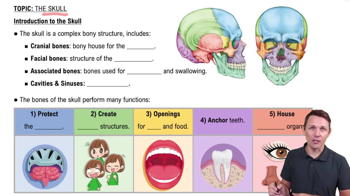
Protect the brain, support facial structure and features, enable chewing and speech, and house sensory organs (eyes, ears, nose).