 Back
BackSpecial Senses in Anatomy & Physiology
 5:05
5:05
Terms in this set (27)
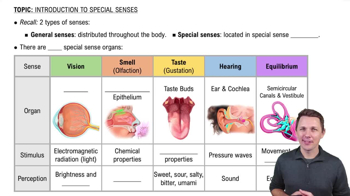
Smell, taste, hearing, equilibrium, and sight.
Olfactory receptors, supporting cells, and olfactory organs.
Taste buds are found on the tongue and contain taste receptors for gustation.
Sweet, sour, salty, bitter, and umami.
A thin membrane that covers the front of the eye and lines the inside of the eyelids.
It controls eyelid closure, enabling blinking and squinting.
It raises the upper eyelid.
They secrete an oily substance that lubricates the eyelids and prevents them from sticking together.
Lacrimal gland, canaliculi, lacrimal sac, and nasolacrimal duct.
Superior rectus, inferior rectus, medial rectus, lateral rectus, superior oblique, inferior oblique, and levator palpebrae superioris.
Cornea and sclera.
Choroid coat, ciliary body, and iris.
The inner (nervous) tunic containing the macula lutea, fovea centralis, and optic disc.
Aqueous humor fills the anterior chamber; vitreous humor fills the posterior chamber.
It focuses light onto the retina.
The iris adjusts pupil size to regulate light entering the eye.
Photoreceptor cells in the retina; cones detect color, rods detect light intensity.
Auricle, external acoustic meatus, and tympanic membrane.
Malleus, incus, and stapes.
The oval window transmits vibrations to the inner ear; the round window allows fluid movement within the cochlea.
It equalizes pressure between the middle ear and the throat.
Osseous and membranous labyrinths, semicircular canals, vestibule, cochlea.
Utricle and saccule with macula sensory receptors.
Static equilibrium detects head position at rest; dynamic equilibrium detects motion and acceleration.
Three fluid-filled chambers within the cochlea involved in hearing.
The sensory organ in the cochlea containing hair cells that detect sound vibrations.
Specialized sensory cells with stereocilia that convert mechanical sound waves into nerve signals.