Skip to main content
Anatomy & Physiology
My Course
Learn
Exam Prep
AI Tutor
Study Guides
Textbook Solutions
Flashcards
Explore
Try the app
My Course
Learn
Exam Prep
AI Tutor
Study Guides
Textbook Solutions
Flashcards
Explore
Try the app
Back
Spinal Cord and Spinal Nerves - Anatomy & Physiology
You can tap to flip the card.
What are the protective coverings of the spinal cord?
You can tap to flip the card.
👆
What are the protective coverings of the spinal cord?
The spinal cord is protected by the vertebral column, meninges (dura mater, arachnoid, pia mater), cerebrospinal fluid, and vertebral ligaments.
Track progress
Control buttons has been changed to "navigation" mode.
1/29
Recommended videos
Guided course
0:50
Introduction to the Central Nervous System Example 1
14092
views
263
rank
2
comments
Guided course
2:41
White & Gray Matter
14080
views
256
rank
Guided course
3:34
CNS Development
14686
views
295
rank
2
comments
Terms in this set (29)
Hide definitions
What are the protective coverings of the spinal cord?
The spinal cord is protected by the vertebral column, meninges (dura mater, arachnoid, pia mater), cerebrospinal fluid, and vertebral ligaments.
Name the three meninges layers surrounding the spinal cord.
The meninges are dura mater (outermost), arachnoid (middle), and pia mater (innermost, adheres to spinal cord surface).
What is meningitis?
Meningitis is the inflammation of the meninges.
Where does the spinal cord begin and end in adults?
The spinal cord begins as a continuation of the medulla and ends near the second lumbar vertebra.
What are the cervical and lumbar enlargements of the spinal cord?
They are widened regions of the spinal cord that serve as origins for nerves to the upper and lower extremities.
What is the conus medullaris?
The conus medullaris is the tapered distal end of the spinal cord.
What structures arise from the conus medullaris?
The filum terminale (pia mater extension anchoring the cord) and the cauda equina (nerve roots) arise from it.
How is the spinal cord divided externally?
It is partially divided into right and left sides by the anterior median fissure and posterior median sulcus.
What is a spinal tap (lumbar puncture)?
It is the removal of cerebrospinal fluid from the subarachnoid space.
Describe the internal gray matter of the spinal cord.
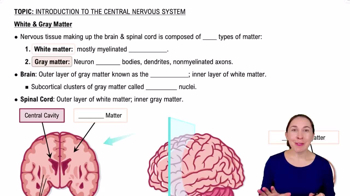
Gray matter is H-shaped or butterfly-shaped, divided into ventral, dorsal, and lateral horns.
What surrounds the gray matter in the spinal cord?
White matter surrounds the gray matter and is divided into anterior, posterior, and lateral columns.
What is the central canal of the spinal cord?
A fluid-filled channel running the length of the spinal cord containing cerebrospinal fluid.
What is the gray commissure?
It connects the left and right halves of the gray matter and contains nerve fibers crossing laterally.
What is the function of ascending and descending tracts in the spinal cord?
Ascending tracts carry sensory information to the brain; descending tracts carry motor commands from the brain.
Define a reflex.
A reflex is a fast, predictable, automatic response to stimuli that helps maintain homeostasis.
What are the five components of a reflex arc?
Receptor, sensory neuron, integrating center, motor neuron, and effector.
What is the difference between monosynaptic and polysynaptic reflex arcs?
Monosynaptic arcs have one sensory and one motor neuron (e.g., stretch reflex); polysynaptic arcs include an association neuron (e.g., tendon reflex).
How many pairs of spinal nerves are there and how are they named?
There are 31 pairs, named by region: 8 cervical, 12 thoracic, 5 lumbar, 5 sacral, and 1 coccygeal.
What is the function of the dorsal and ventral roots of spinal nerves?
Dorsal roots carry sensory fibers into the spinal cord; ventral roots carry motor fibers out to the periphery.
What are the coverings of spinal nerves?
Spinal nerves are covered by endoneurium, perineurium, and epineurium.
What are the branches of a spinal nerve after it passes through the intervertebral foramen?
Branches include the dorsal ramus, ventral ramus, and meningeal branch.
What is a nerve plexus?
A network of intersecting ventral rami of spinal nerves, except T2-T12, forming named nerves.
What areas does the cervical plexus supply?
It supplies the skin and muscles of the head, neck, upper shoulders, and the diaphragm.
What is the significance of the phrenic nerve (C3-C5)?
It controls the diaphragm; damage above C3-C5 causes respiratory arrest.
Which spinal nerves form the brachial plexus and what does it supply?
C5-T1; it supplies neck, shoulder muscles, and upper extremities including musculocutaneous, median, and ulnar nerves.
What does the lumbar plexus supply and what is its largest nerve?
It supplies the anterolateral abdominal wall, external genitals, and part of the lower extremities; largest nerve is the femoral nerve.
What does the sacral plexus supply and what is its largest nerve?
It supplies the buttocks, perineum, and part of the lower extremities; largest nerve is the sciatic nerve.
What are intercostal nerves?
Ventral rami of T2-T12 that do not form plexuses and supply structures in the intercostal spaces.
What are dermatomes?
Specific, constant skin segments innervated by spinal nerves (except C1) carrying somatic sensory impulses.
 BackBack
 0:50