Back

The Brain and Cranial Nerves - Anatomy & Physiology
Control buttons has been changed to "navigation" mode.
1/78
  • What percentage of the body's nervous tissue does the adult human brain contain?

    The adult human brain contains almost 97 percent of the body's nervous tissue.
  • Name the four main regions of the brain.

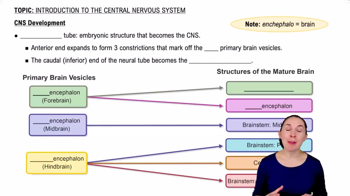
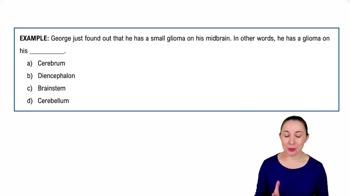
    Cerebrum, Cerebellum, Diencephalon, and Brainstem.
  • What are the primary functions of the cerebrum?

    Controls conscious thought processes, intellectual functions, memory storage and processing, and regulation of skeletal muscle contractions.
  • What is the main role of the cerebellum?

    Coordinates complex somatic motor patterns and adjusts output of other somatic motor centers.
  • What are the two major parts of the diencephalon and their functions?

    Thalamus: relays and processes sensory information. Hypothalamus: controls emotions, autonomic functions, and hormone production.
  • What are the three parts of the brainstem and their key functions?

    Midbrain: processes visual and auditory data, maintains consciousness. Pons: relays sensory info to cerebellum and thalamus, controls somatic and visceral motor centers. Medulla oblongata: relays sensory info, regulates autonomic functions like heart rate and digestion.
  • What are the three layers of the cranial meninges?

    Dura mater, Arachnoid mater, and Pia mater.
  • What is the function of cerebrospinal fluid (CSF)?

    CSF cushions the brain, supports it, transports nutrients, chemical messengers, and wastes.
  • Where is CSF produced and how much is secreted daily?

    Produced by the choroid plexus, specialized ependymal cells surrounding capillaries, secreting about 500 mL per day.
  • What is the blood-brain barrier (BBB) and its function?

    A network of tight junctions between astrocytes and capillary endothelial cells that isolates the CNS from general circulation, allowing only lipid-soluble compounds to pass.
  • Name the three largest dural folds and their function.

    Falx cerebri, Tentorium cerebelli, and Falx cerebelli; they stabilize and support the brain.
  • What autonomic functions are regulated by the medulla oblongata?

    Heart rate, blood pressure, and digestion.
  • What are the main nuclei groups in the medulla oblongata?

    Cardiovascular centers, respiratory rhythmicity centers, sensory and motor nuclei of cranial nerves, relay stations like gracile and cuneate nuclei.
  • What is the role of the pons in brain function?

    Relays sensory information to cerebellum and thalamus, contains nuclei for somatic and visceral motor control, and regulates respiration.
  • What are the key structures of the midbrain and their functions?

    Tectum (superior and inferior colliculi for visual and auditory processing), tegmentum (red nucleus and substantia nigra), and cerebral peduncles (motor command fibers).
  • Describe the cerebellum's main functions.

    Adjusts postural muscles and programs and fine-tunes conscious and subconscious movements.
  • What is ataxia and what causes it?

    A disturbance in muscular coordination caused by trauma, stroke, or intoxication.
  • List eight functions of the hypothalamus.

    Secretes ADH and oxytocin, regulates body temperature, controls autonomic functions, coordinates nervous and endocrine systems, regulates circadian rhythms, controls subconscious skeletal muscle, produces emotions and behavioral drives.
  • What components make up the limbic system?

    Limbic lobe, cingulate gyrus, dentate gyrus, parahippocampal gyrus, hippocampus, amygdaloid body, fornix, anterior thalamic nuclei, and reticular formation.
  • What are the main functions of the limbic system?

    Establishes emotional states, links conscious functions with autonomic functions, and facilitates memory storage and retrieval.
  • What are the major lobes of the cerebrum and their primary functions?

    Frontal lobe: voluntary motor control. Parietal lobe: somatosensory processing. Occipital lobe: visual perception. Temporal lobe: auditory and olfactory processing.
  • What are the three types of white matter fibers in the cerebrum?

    Association fibers: connect areas within one hemisphere. Commissural fibers: connect two hemispheres. Projection fibers: link cortex with lower brain regions and spinal cord.
  • What is the function of basal nuclei in the cerebrum?

    Subconscious adjustment of voluntary motor commands and control of skeletal muscle tone.
  • What is the role of the primary motor cortex and where is it located?

    Controls voluntary skeletal muscle movements; located in the precentral gyrus of the frontal lobe.
  • What are the special sensory cortices and their functions?

    Visual cortex (occipital lobe) processes visual info, auditory cortex (temporal lobe) processes hearing, olfactory cortex (temporal lobe) processes smell, gustatory cortex (insula and frontal lobe) processes taste.
  • What is the function of Wernicke's area?

    Language comprehension and coordination of access to visual and auditory memories.
  • What is the function of Broca's area?

    Speech production and regulation of breathing and vocalization patterns.
  • What is hemispheric lateralization?

    Functional differences between left and right cerebral hemispheres, where each performs certain unique functions.
  • What are the classifications of cranial nerves?

    Primarily sensory, special sensory, motor, mixed, and autonomic functions.
  • What is Bell's palsy and which cranial nerve does it affect?

    A disorder caused by inflammation of the facial nerve (CN VII), resulting in paralysis of facial muscles and loss of taste on the anterior two-thirds of the tongue.
  • Strokes are caused by


    Blockage or Leak

  • What regulates blood brain barrier by releasing chemicals that control permeability of endothelium


    Astrocytes

  • What is formed by specialized ependymal cells connected by tight junctions that surround capillaries of choroid plexus


    Blood Brain Barrier

  • What controls visceral functions, sensory/motor nuclei, relay stations for communication between brain and spinal cord


    Medulla oblongata

  • What controls the reticular formation (autonomic functions), cardiovascular centers and respiratory rhythmicity centers?


    Reflex Center

  • Apneustic center and pneumotaxic centers are in what part of the brain stem?


    Pons

  • What fibers link nuclei of pons with opposite cerebellar hemisphere?


    Transverse Pontine Fibers

  • Is the Pons made of connective tissue or axons?


    Axons

  • Even though sight is mostly processed in the Thalamus, what sensory nuclei is in the midbrain for survival instincts?


    Superior colliculi

  • Even though sight is mostly processed in the Thalamus, what auditory nuclei is in the midbrain for survival instincts?


    Inferior colliculi

  • What cell layer consists of large, branched neuron cell bodies in the cerebellar cortex that receives input from up to 200,000 synapses


    Purkinje

  • What is the tree of life called


    Arbor vitae

  • What adjusts postural muscles, program and fine-tune conscious and subconscious movements?


    Cerebellum

  • What is a disturbance in muscular coordination caused by damage from trauma, stroke, or intoxication


    Ataxia

  • What secretes melatonin what sets your day and night cycles


    Pineal gland (tool controlled by the Hypothalamus)

  • Where is the bulk of sensory information processed where information is relayed between basal nuclei and cerebral cortex?


    Thalamus

  • What Mammillary bodies control reflex eating in with the infundibulum (narrow stalk) connected to pituaritary gland


    Hypothalamus

  • What is the main function of the Hypothalamus?


    Controls autonomic function

  • Oxytocin and ADH (antidiuretic hormone - anti urination) are hormones released from what part of the brain?


    Hypothalamus

  • Which system is made up of nuclei centered in multiple parts of the mid brain and works with your emotional state, memory, and retrieval of memory


    Limbic system

  • What connection between nuclei assists with alertness, excitement, lethargy, sleep, and habituation


    Reticular Formation

  • What is the largest part of the brain that controls all conscious thoughts, cognitive skills, and intellectual function?


    Cerebrum

  • What is deep to the cerebral cortex and and around basal nuclei, that's made up of myelinated axons?


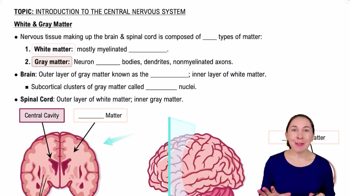
    White matter

  • Where are somatic sensory and motor information processed?


    Cerebrum

  • What forms ipsilateral connections with one hemisphere of the cerebrum?


    Association Fibers

  • What are short fibers that connect one gyrus to another in the cerebrum?


    Arcurate Fibers

  • What are longer bundles that connect frontal lobe to other lobes in same, ipsilateral hemisphere?


    Longitudinal fasciculi

  • What bands of fibers connect two hemispheres left and right?


    Commissural Fibers

  • What links cerebral cortex to diencephalon, brainstem, cerebellum, and spinal cord in the white matter of the cerebrum?


    Projection Fibers

  • Masses of gray matter deep and centered in the cerebrum, embedded in white matter with the caudate nucleus and lentiform nucleus that knows what you want to do and modifies the skeletal system to adapt


    Casal nuclei

  • Increased activity of basal nuclei causes what disease?


    Parkinson's Disease

  • What regulates basal nuclei (tones down activity)


    Dopamine

  • Where is voluntary initiation of skeletal muscle activity


    Primary Motor Cortex located within the Precentral Gyrus

  • Trained activities you do often come from what part of the brain (knows what muscles need to be involved)?


    Association area in the Premotor Cortex

  • Where is the visual cortex (sight)?


    Occipital bone

  • Where is the auditory cortex (hearing) and olfactory cortex (smell)?


    Temporal Bone

  • Where is the gustatory cortex (taste receptors) located


    Insula & frontal lobe

  • Where does language comprehension take place (left cerebral hemisphere)?


    Wernicke's Area

  • Where is speech production take place (left cerebral hemisphere)?


    Broca's area

  • Abstract intellectual functions take place where


    Prefrontal cortex?

  • Reading, writing, math, speech, language, and decision making take place in the...


    Left hemisphere of the brain

  • Touch, smell, sight, taste, recognition of faces and voice inflections take place in the...


    Right hemisphere of the brain

  • What are seen in healthy, awake adults at rest with eyes closed


    Alpha waves

  • What are seen in adults who are concentrating or mentally stressed?


    Beta waves (higher frequency)

  • What are seen in children and in intensely frustrated adults or may indicate a brain disorder in adults?


    Theta waves

  • What are seen in sleeping individuals or an awake individual with brain damage


    Delta waves (large amplitude, low frequency)

  • What is a temporary cerebral disorder, accompanied by changes in electrical activity of the overfiring of neurons


    Seizure

  • How many pairs of cranial pairs are there?


    12