Skip to main content
Anatomy & Physiology
My Course
Learn
Exam Prep
AI Tutor
Study Guides
Textbook Solutions
Flashcards
Explore
Try the app
My Course
Learn
Exam Prep
AI Tutor
Study Guides
Textbook Solutions
Flashcards
Explore
Try the app
Back
The Skeleton - Anatomy & Physiology
You can tap to flip the card.
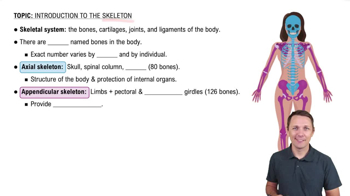
What is the axial skeleton and its main function?
You can tap to flip the card.
👆
What is the axial skeleton and its main function?
The
axial skeleton
is found along the vertical axis of the body and protects organs of the head, neck, and trunk.
Track progress
Control buttons has been changed to "navigation" mode.
1/20
Recommended videos
Guided course
4:50
Skeletal System
16669
views
570
rank
1
comments
Terms in this set (20)
Hide definitions
What is the axial skeleton and its main function?
The
axial skeleton
is found along the vertical axis of the body and protects organs of the head, neck, and trunk.
Name the main components of the axial skeleton.
The axial skeleton includes the
skull
,
auditory ossicles
,
hyoid
,
vertebral column
, and
rib cage
.
What are the two main parts of the skull?
The skull consists of
cranial bones
that protect the brain and serve as muscle attachment sites, and
facial bones
.
What is the function of cranial bones?
Cranial bones protect the brain, provide attachment sites for head and neck muscles, and are firmly united by fibrous sutures.
List the regions of the vertebral column.
The vertebral column has five regions:
cervical
,
thoracic
,
lumbar
,
sacrum
, and
coccyx
.
What bones make up the rib cage?
The rib cage consists of the
sternum
and
costals
(ribs).
What is the appendicular skeleton?
The appendicular skeleton includes the
upper and lower limbs
and the
girdles
that attach them, functioning as movement levers.
What bones form the pectoral girdle?
The pectoral girdle is formed by the
clavicle
and
scapula
, providing attachment for upper extremity muscles.
Name the bones of the upper limb.
The upper limb bones include the
humerus
,
radius
,
ulna
,
carpals
,
metacarpals
, and
phalanges
.
What bones make up the pelvic girdle?
The pelvic girdle consists of the
sacrum
and
os coxae
, providing attachment for lower extremity muscles and protecting lower organs.
List the bones of the lower limb.
The lower limb includes the
femur
,
patella
,
tibia
,
fibula
,
tarsals
,
metatarsals
, and
phalanges
.
Which bones are included in the tarsals of the foot?
The tarsals include the
calcaneous
,
talus
,
navicular
,
cuboid
, and
cuneiforms
.
What is the function of the appendicular skeleton?
The appendicular skeleton facilitates
movement
by serving as levers and provides attachment sites for muscles.
What is the role of the hyoid bone?
The hyoid bone supports the tongue and is associated with swallowing and speech.
How are cranial bones connected?
Cranial bones are firmly united by
fibrous sutures
.
What bones protect the brain?
The
cranial bones
protect the brain.
Which bones protect the lower organs in the pelvic region?
The
pelvic girdle
, especially the
os coxae
and
sacrum
, protect lower organs.
What bones form the wrist and hand?
The wrist is formed by
carpals
, the hand by
metacarpals
, and the fingers by
phalanges
.
What bones form the ankle and foot?
The ankle is formed by
tarsals
, the foot by
metatarsals
, and the toes by
phalanges
.
Which bone is known as the kneecap?
The
patella
is the kneecap bone.
 BackBack
 4:50
