 Back
BackUrinary System Anatomy & Physiology

 0:54
0:54
Terms in this set (25)
Maintain homeostasis by controlling blood volume, composition, and pH through buffer systems and breathing.
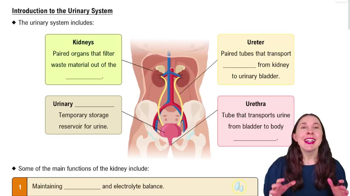
2 kidneys, 2 ureters, 1 bladder, and 1 urethra.
Retroperitoneal in the posterior superior abdominal cavity, partially protected by the 11th and 12th ribs; right kidney is slightly lower than left.
1. Renal Fascia (outer fibrous connective tissue)
2. Adipose Capsule (fatty tissue for protection)
3. Renal Capsule (innermost thick fibrous membrane)
Cortex, medulla with pyramids, minor and major calyces, renal pelvis, and ureter.
The nephron, consisting of a renal tubule and vascular components, with about 1 million nephrons per kidney.
Blood filtered through glomerulus enters Bowman’s capsule as filtrate, not blood, and flows through the tubular system.
Cortical nephron (majority, shorter loop of Henle, less concentrated urine) and Juxtamedullary nephron (longer loop, highly concentrated urine).
Renal artery → segmental arteries → interlobar arteries → arcuate arteries → interlobular arteries → afferent arteriole → glomerulus → efferent arteriole → venous return.
Capillaries surrounding juxtamedullary nephrons that return reabsorbed filtrate to blood and help concentrate urine via countercurrent exchange.
Delicate capsule surrounding glomerulus; filters water and solutes from blood into nephron tubule.
Specialized cells with foot-like projections (pedicles) that wrap around glomerular capillaries to form filtration slits.
Juxtaglomerular cells (secrete renin) and macula densa cells (sense filtrate concentration) regulate blood pressure and filtration.
Blood pressure forces plasma components through glomerular membrane into Bowman’s capsule, forming filtrate.
Capsular hydrostatic pressure and blood osmotic pressure resist filtrate formation.
Amount of filtrate formed per unit time; about 50 gallons/day with 1500 mL urine output.
60-70% of filtrate volume reabsorbed; nearly 100% glucose and amino acids reabsorbed; active transport of ions and water follows osmotic gradients.
Descending limb permeable to water but not solutes; ascending limb impermeable to water but actively transports NaCl out.
NaCl pumped out of ascending limb increases osmotic gradient, pulling water from descending limb, concentrating medullary interstitium.
Increases collecting duct permeability to water by inserting aquaporins, allowing water reabsorption and urine concentration.
Increases Na-K pump activity in distal tubule, promoting Na reabsorption and K excretion; water follows Na, reducing urine volume.
Active transport of harmful substances from blood into tubule, bypassing filtration, to be excreted in urine.
Hollow muscular organ with mucosa (transitional epithelium), submucosa, detrusor muscle (3 layers), and serosa (peritoneum).
Bladder fills to 200-400 mL, triggering parasympathetic contraction of detrusor muscle and relaxation of internal sphincter; external sphincter under voluntary control.
Female urethra is ~1.5 inches with 3 layers; male urethra is ~8 inches with 2 layers and lacks smooth muscle, affecting urine control and infection risk.