 Back
BackUrinary System - Anatomy & Physiology

 0:54
0:54
Terms in this set (23)
Excretion of metabolic wastes, maintenance of water, salt, and electrolyte balance, acid-base balance, hormone secretion, activation of vitamin D, and gluconeogenesis during prolonged fasting.
Retroperitoneal, between T12 and L3 vertebrae, about 4 inches long, 3 inches wide, 1 inch thick, and weighing approximately 5 ounces each.
Renal capsule, adipose capsule, and renal fascia.
Cortical nephrons with short loops of Henle and juxtamedullary nephrons with long loops of Henle near the cortex-medulla junction.
Renal corpuscle (glomerulus and glomerular capsule) and renal tubule (proximal convoluted tubule, loop of Henle, distal convoluted tubule).
Regulates filtrate formation and blood pressure by releasing renin and monitoring sodium concentration.
Glomerular filtration, tubular reabsorption, and tubular secretion.
Passive process where hydrostatic pressure forces fluids and solutes through the filtration membrane into the glomerular capsule.
Fenestrated endothelium of glomerular capillaries, basement membrane, and podocyte foot processes with filtration slits.
Sum of glomerular hydrostatic pressure (55 mm Hg), capsular hydrostatic pressure (15 mm Hg), and blood colloid osmotic pressure (30 mm Hg) determining filtrate formation.
Volume of filtrate formed per minute by both kidneys; normally 125 ml/min in men and 105 ml/min in women.
Transcellular route (through tubular cells) and paracellular route (between tubular cells).
Creates electrochemical gradient for sodium movement, driving reabsorption of water and other solutes by secondary active transport.
Maximum rate at which a substance can be reabsorbed due to limited carrier proteins; excess is excreted in urine.
Loop of Henle creates an osmotic gradient from 300 to 1200 mOsm to regulate urine concentration.
Vasa recta preserves the osmotic gradient by removing reabsorbed water and preventing washout of salts.
ADH increases water reabsorption in collecting ducts, producing concentrated urine via facultative water movement.
Chemicals that increase urine output by inhibiting ADH, sodium reabsorption, or medullary gradient formation.
Volume of plasma cleared of a substance per minute; used to measure GFR with substances like inulin.
Approximately 95% water and 5% solutes including Na+, K+, phosphate, sulfate, calcium, magnesium, bicarbonate, and nitrogenous wastes like urea, uric acid, and creatinine.
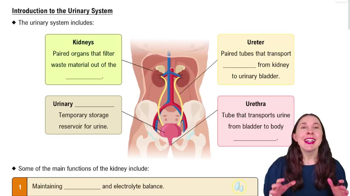
Collecting duct → minor calyx → major calyx → renal pelvis → ureter → urinary bladder → urethra.
Male urethra is about 8 inches, transports urine and semen, and is encircled by the prostate; female urethra is about 1.5 inches and transports only urine.
Involuntary emptying of the urinary bladder controlled by parasympathetic nervous system and voluntary control of external urethral sphincter.