 Back
BackUrinary System Anatomy & Physiology

 0:54
0:54
Terms in this set (20)
Remove urea and excess water from the blood, regulate solute concentrations, maintain acid-base balance, produce erythropoietin, activate vitamin D, and perform gluconeogenesis during fasting.
Bean-shaped organs located retroperitoneally between T12 and L3 vertebrae, with a convex lateral surface and a concave medial surface containing the renal hilum.
Renal fascia, perirenal fat capsule, and fibrous capsule.
Renal cortex, renal medulla (containing renal pyramids), and renal pelvis.
Nephron, which filters blood, reabsorbs needed substances, and secretes wastes into urine.
Renal corpuscle (glomerulus and Bowman's capsule), proximal convoluted tubule, nephron loop (Henle's loop), and distal convoluted tubule.
Cortical nephrons and juxtamedullary nephrons, differing in location and length of nephron loop.
Glomerular filtration, tubular reabsorption, and tubular secretion.
Passive process where plasma-like filtrate is formed by filtering blood through fenestrated endothelium, basement membrane, and podocyte foot processes.
Outward pressures: hydrostatic pressure in glomerular capillaries and colloid osmotic pressure in capsular space; inward pressures: hydrostatic pressure in capsular space and colloid osmotic pressure in glomerular capillaries.
Volume of filtrate formed per minute by all nephrons combined, regulated by intrinsic and extrinsic mechanisms.
Process of reclaiming useful substances like sodium, nutrients, water, and ions from filtrate back into the blood, via active or passive transport.
Active process adding wastes, excess K+, and substances controlling blood pH from blood into the filtrate for elimination.
Measurement of kidney's ability to clear a substance from blood, calculated as \(C=\frac{UV}{P}\), where U=urine concentration, V=urine flow rate, P=plasma concentration.
Approximately 95% water and 5% solutes including urea, uric acid, creatinine, and other nitrogenous wastes.
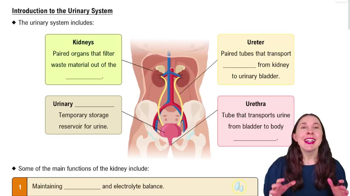
Includes kidneys, ureters, urinary bladder, and urethra, which transport, store, and eliminate urine.
Active transport of urine from kidneys to urinary bladder via peristalsis.
Smooth, collapsible muscular sac with trigone region and detrusor muscle; stores urine and allows distension.
Urination requiring contraction of detrusor muscle, opening of internal urethral sphincter, and voluntary relaxation of external urethral sphincter.
Includes pyelonephritis, hematuria, anuria, chronic renal disease, renal calculi, urinary incontinence, urinary retention, urinary tract infection, cystitis, dysuria, horseshoe kidney, hypospadias, and polycystic kidney disease.