 Back
BackAbdominal Quadrants, Abdominopelvic Regions, and Organ Systems
Study Guide - Smart Notes
 Tailored notes based on your materials, expanded with key definitions, examples, and context.
Abdominal Quadrants and Abdominopelvic Regions
Overview
The abdomen is divided into specific regions and quadrants to help describe the location of organs, pain, or pathology. These divisions are essential for clinical assessment and anatomical study.
Abdominal Quadrants: The abdomen is divided into four quadrants by a vertical and a horizontal line intersecting at the umbilicus (navel).
Right Upper Quadrant (RUQ): Contains the liver, gallbladder, right kidney, portions of the stomach, small and large intestines.
Left Upper Quadrant (LUQ): Contains the stomach, spleen, left kidney, pancreas, and portions of the large intestine.
Right Lower Quadrant (RLQ): Contains the appendix, cecum, portions of the small intestine, right reproductive organs, and right ureter.
Left Lower Quadrant (LLQ): Contains most of the small intestine, portions of the large intestine, left reproductive organs, and left ureter.
Abdominopelvic Regions: For more precise localization, the abdominopelvic cavity is divided into nine regions using two vertical and two horizontal planes.
Right Hypochondriac Region: Right of the epigastric region, contains parts of the liver and gallbladder.
Epigastric Region: Superior to the umbilical region, contains parts of the stomach and liver.
Left Hypochondriac Region: Left of the epigastric region, contains the spleen and part of the stomach.
Right Lumbar Region: Right of the umbilical region, contains parts of the large intestine and right kidney.
Umbilical Region: Center region, contains the navel, parts of the small intestine, and transverse colon.
Left Lumbar Region: Left of the umbilical region, contains parts of the large intestine and left kidney.
Right Iliac (Inguinal) Region: Right of the hypogastric region, contains the appendix and cecum.
Hypogastric (Pubic) Region: Inferior to the umbilical region, contains the urinary bladder and portions of the small intestine.
Left Iliac (Inguinal) Region: Left of the hypogastric region, contains parts of the sigmoid colon.
Quadrant | Main Organs |
|---|---|
Right Upper Quadrant (RUQ) | Liver, Gallbladder, Right Kidney, Portions of Stomach, Intestines |
Left Upper Quadrant (LUQ) | Stomach, Spleen, Left Kidney, Pancreas, Large Intestine |
Right Lower Quadrant (RLQ) | Appendix, Cecum, Small Intestine, Right Reproductive Organs |
Left Lower Quadrant (LLQ) | Small Intestine, Large Intestine, Left Reproductive Organs |
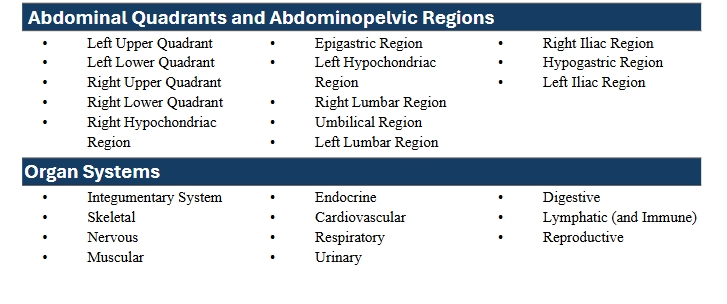
Organ Systems of the Human Body
Overview
The human body is organized into several organ systems, each with specific functions essential for maintaining homeostasis and overall health.
Integumentary System: Protects the body, regulates temperature, and provides sensory information. Includes skin, hair, and nails.
Skeletal System: Provides support, protects organs, stores minerals, and produces blood cells. Includes bones and joints.
Muscular System: Allows movement, maintains posture, and produces heat. Includes skeletal muscles.
Nervous System: Controls body activities with electrical signals, processes sensory information, and coordinates responses. Includes brain, spinal cord, and nerves.
Endocrine System: Regulates body functions through hormones. Includes glands such as the pituitary, thyroid, and adrenal glands.
Cardiovascular System: Transports nutrients, gases, hormones, and wastes. Includes heart and blood vessels.
Lymphatic (and Immune) System: Defends against infection, returns tissue fluids to the bloodstream. Includes lymph nodes, lymphatic vessels, and spleen.
Respiratory System: Facilitates gas exchange (oxygen and carbon dioxide). Includes lungs and airways.
Digestive System: Breaks down food, absorbs nutrients, and eliminates waste. Includes mouth, esophagus, stomach, intestines, liver, and pancreas.
Urinary System: Removes waste from blood, regulates water and electrolyte balance. Includes kidneys, ureters, bladder, and urethra.
Reproductive System: Produces gametes, enables fertilization, and supports fetal development. Includes testes, ovaries, and associated structures.
Organ System | Main Functions | Major Organs |
|---|---|---|
Integumentary | Protection, temperature regulation, sensation | Skin, hair, nails |
Skeletal | Support, movement, blood cell production | Bones, joints |
Muscular | Movement, posture, heat production | Skeletal muscles |
Nervous | Control, coordination, response to stimuli | Brain, spinal cord, nerves |
Endocrine | Hormone production, regulation of metabolism | Pituitary, thyroid, adrenal glands |
Cardiovascular | Transport of substances, immune response | Heart, blood vessels |
Lymphatic (Immune) | Defense, fluid balance | Lymph nodes, spleen, lymphatic vessels |
Respiratory | Gas exchange | Lungs, trachea, bronchi |
Digestive | Breakdown and absorption of nutrients | Mouth, stomach, intestines, liver, pancreas |
Urinary | Waste elimination, water balance | Kidneys, bladder, urethra |
Reproductive | Production of offspring | Testes, ovaries, uterus |
Example: Clinical Application
When a patient presents with abdominal pain, identifying the specific quadrant or region helps narrow down the possible causes. For example, pain in the Right Lower Quadrant (RLQ) may suggest appendicitis, while pain in the Left Upper Quadrant (LUQ) could indicate a problem with the spleen or stomach.
