 Back
BackAcid-Base Balance in Human Physiology: Mechanisms, Disorders, and Clinical Applications
Study Guide - Smart Notes
 Tailored notes based on your materials, expanded with key definitions, examples, and context.
Acid-Base Balance
Introduction to Acid-Base Balance
The maintenance of acid-base balance is essential for normal cellular function and overall homeostasis. The body regulates the concentration of hydrogen ions (H+) in its fluids to keep the pH within a narrow range, ensuring optimal enzyme activity and metabolic processes.
pH of Body Fluids
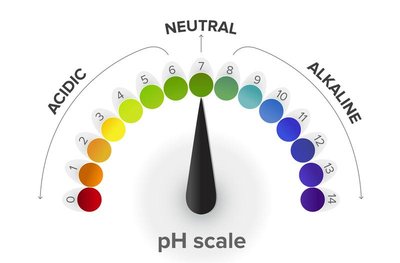
pH Definition: pH is a numerical value that indicates the relative concentration of hydrogen ions (H+) compared to hydroxide ions (OH−) in a solution.
pH Scale: Ranges from 0 (most acidic) to 14 (most alkaline), with 7 being neutral.
Normal Blood pH: The normal range for blood pH is approximately 7.35 to 7.45. Arterial blood is about 7.45, while venous blood is about 7.35.
Logarithmic Nature: Each unit change in pH represents a tenfold change in H+ concentration.
Mechanisms That Control pH of Body Fluids
Three coordinated homeostatic mechanisms maintain the normal pH of body fluids and prevent large swings when excess acids or bases are present:
Chemical (Buffer) Mechanism: Acts immediately to resist changes in pH by neutralizing added acids or bases.
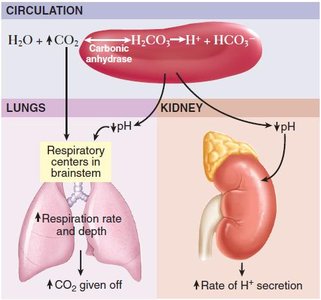
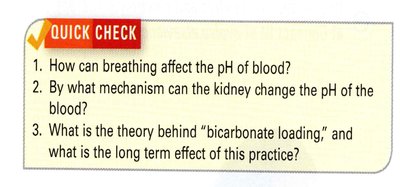
Respiratory Mechanism: Regulates pH by altering the rate and depth of breathing, which changes the amount of CO2 (and thus carbonic acid) in the blood. Acts within minutes.
Urinary Mechanism: The kidneys regulate blood pH by excreting hydrogen ions and reabsorbing bicarbonate. Acts within hours and is the most effective long-term regulator.
Chemical Buffer Systems
Definition and Function of Buffers
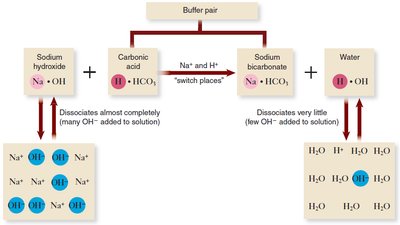
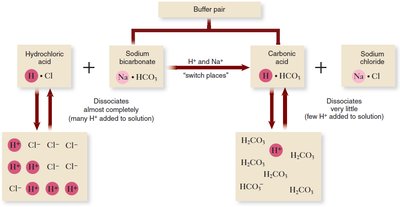
Buffers are substances that prevent sharp changes in the pH of a fluid when an acid or base is added. They do this by chemically binding H+ ions or releasing them as needed.
"Fixed" acids produced by metabolism are mainly buffered by sodium bicarbonate (NaHCO3).
Buffer salts weaken strong acids and bases, minimizing pH changes.
Buffer Pairs: The Bicarbonate-Carbonic Acid System
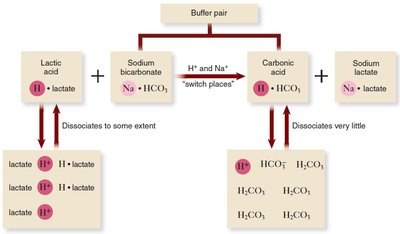
The main buffer system in the blood consists of sodium bicarbonate (NaHCO3) and carbonic acid (H2CO3), typically in a 20:1 ratio. This system helps maintain blood pH within the normal range.
When acids are added, NaHCO3 neutralizes them, forming H2CO3.
When bases are added, H2CO3 neutralizes them, forming NaHCO3.
Physiological Mechanisms of pH Control
Respiratory Mechanism
The respiratory system helps regulate blood pH by controlling the amount of CO2 exhaled. CO2 combines with water to form carbonic acid, which dissociates into H+ and HCO3−. Increased respiration removes more CO2, reducing acidity, while decreased respiration retains CO2, increasing acidity.
Respiratory centers in the brainstem detect changes in pH and adjust breathing accordingly.
Holding your breath increases CO2 and lowers pH (acidosis); hyperventilation decreases CO2 and raises pH (alkalosis).
Urinary Mechanism
The kidneys are the body's most effective regulator of blood pH. They secrete hydrogen ions and ammonia into the urine and reabsorb bicarbonate into the blood, thus adjusting the acid-base balance over hours to days.
Urine is usually acidified by the distal tubules of the nephron.
Blood levels of NaHCO3 are regulated by the kidneys, while H2CO3 levels are regulated by the lungs.
pH Imbalances: Acidosis and Alkalosis
Definitions and Causes
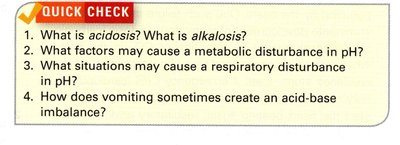
Acidosis: Condition where blood pH falls below 7.35 due to excess acid or loss of base.
Alkalosis: Condition where blood pH rises above 7.45 due to excess base or loss of acid.
Imbalances can be classified as metabolic or respiratory, depending on their origin.
Metabolic Disturbances
Metabolic Acidosis: Caused by a deficit of bicarbonate (NaHCO3), often due to diarrhea, renal failure, or diabetic ketoacidosis.
Metabolic Alkalosis: Caused by an excess of bicarbonate, often due to severe vomiting or excessive antacid use.
Respiratory Disturbances
Respiratory Acidosis: Caused by an excess of carbonic acid (H2CO3), usually from hypoventilation or respiratory failure.
Respiratory Alkalosis: Caused by a deficit of carbonic acid, usually from hyperventilation.
Compensation Mechanisms
In uncompensated metabolic acidosis, the normal 20:1 ratio of NaHCO3 to H2CO3 is altered.
In compensated metabolic acidosis, the ratio remains at 20:1, but the absolute amounts of both components are changed.
Clinical Applications
Diabetic Ketoacidosis
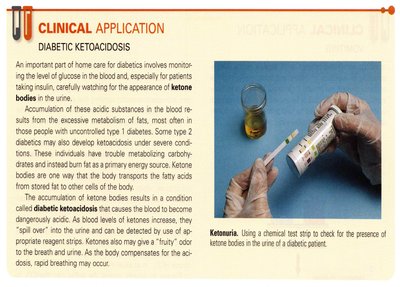
In diabetes, the accumulation of ketone bodies from fat metabolism can lead to metabolic acidosis. Ketone bodies can be detected in urine (ketonuria) using chemical test strips. Symptoms include fruity breath odor and rapid breathing as the body compensates for acidosis.
Vomiting and Acid-Base Imbalance
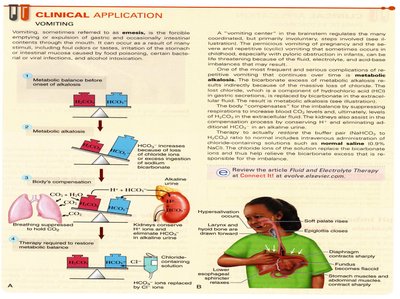
Severe vomiting can cause metabolic alkalosis by loss of gastric acid (HCl), leading to a relative excess of bicarbonate in the blood. The body may compensate through hypoventilation to retain CO2 and restore acid-base balance.
Cardiac Arrest and Respiratory Acidosis
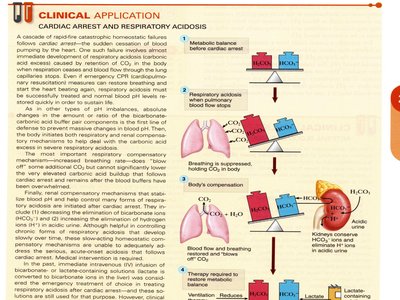
During cardiac arrest, respiratory failure leads to accumulation of CO2 and metabolic acids, resulting in respiratory and metabolic acidosis. Immediate intervention is required to restore ventilation and circulation.
Arterial Blood Gas (ABG) Analysis
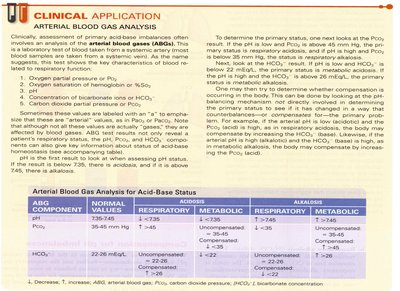
ABG analysis is used to assess acid-base status in clinical settings. It measures pH, partial pressure of CO2 (PCO2), and bicarbonate (HCO3−) levels to distinguish between respiratory and metabolic disturbances.
ABG Component | Normal Value | Acidosis (Respiratory) | Acidosis (Metabolic) | Alkalosis (Respiratory) | Alkalosis (Metabolic) |
|---|---|---|---|---|---|
pH | 7.35–7.45 | <7.35 | <7.35 | >7.45 | >7.45 |
PCO2 (mm Hg) | 35–45 | >45 | Normal or <35 (compensated) | <35 | Normal or >45 (compensated) |
HCO3− (mEq/L) | 22–26 | Normal or >26 (compensated) | <22 | Normal or <22 (compensated) | >26 |
Review Questions and Quick Checks
What are the three mechanisms for regulating the pH of the body’s fluids? (Buffer, respiratory, urinary)
What enzyme converts water and carbon dioxide into carbonic acid? (Carbonic anhydrase)
What are buffers? (Substances that prevent sharp changes in pH)
What is the most abundant acid in body fluids? (Carbonic acid)
What happens with decreased respirations? (Acidosis)
What characterizes respiratory acidosis? (Increase in carbonic acid)
What is the normal ratio of sodium bicarbonate to carbonic acid in the blood? (20:1)
Summary Table: Key Acid-Base Disorders
Disorder | Primary Disturbance | Compensation | Common Causes |
|---|---|---|---|
Metabolic Acidosis | ↓ HCO3− | Hyperventilation (↓ CO2) | Diabetic ketoacidosis, diarrhea, renal failure |
Metabolic Alkalosis | ↑ HCO3− | Hypoventilation (↑ CO2) | Vomiting, excessive antacids |
Respiratory Acidosis | ↑ CO2 (↑ H2CO3) | Renal retention of HCO3− | Respiratory failure, hypoventilation |
Respiratory Alkalosis | ↓ CO2 (↓ H2CO3) | Renal excretion of HCO3− | Hyperventilation, anxiety |
Key Equations
Formation of carbonic acid:
Dissociation of carbonic acid:
Additional info:
Homeostasis of pH is vital for enzyme function and metabolic reactions.
Clinical assessment of acid-base status is crucial in critical care and emergency medicine.
