 Back
BackAcid-Base Balance: Mechanisms and Clinical Implications
Study Guide - Smart Notes
 Tailored notes based on your materials, expanded with key definitions, examples, and context.
Acid-Base Balance
Definition and Importance
Acid-base balance refers to the regulation of hydrogen ion (H+) concentration in body fluids to maintain a stable pH, which is essential for normal physiological function. The body uses several mechanisms to prevent harmful fluctuations in pH, ensuring optimal conditions for cellular processes.
Acid-base balance: The maintenance of a stable pH in body fluids.
pH: A numerical value indicating the relative concentration of hydrogen ions (H+) compared to hydroxide ions (OH−).
Normal blood pH: 7.35–7.45; arterial blood is slightly more alkaline than venous blood.
Acid: A substance that releases H+ ions in solution.
Base: A substance that releases OH− ions or accepts H+ ions.
The pH Scale
The pH scale is a logarithmic scale ranging from 1 to 14, where each unit represents a tenfold change in H+ concentration. A pH of 7 is neutral, values below 7 are acidic, and values above 7 are alkaline.
pH 7: Neutral (equal H+ and OH− ions)
pH < 7: Acidic (higher H+ concentration)
pH > 7: Alkaline (higher OH− concentration)
Blood pH: Arterial (7.45), Venous (7.35)
Each pH unit: Tenfold change in H+ concentration
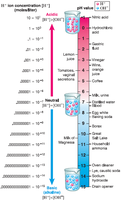
Mechanisms That Control pH of Body Fluids
Three main mechanisms maintain pH homeostasis in body fluids: chemical/buffer, respiratory, and urinary mechanisms. These systems work together to prevent large swings in pH when excess acids or bases are present.
Chemical/buffer mechanism: Acts immediately to stabilize pH.
Respiratory mechanism: Acts within minutes by adjusting CO2 removal.
Urinary mechanism: Acts within hours by excreting acids or bases.
Chemical and Physiological Control Mechanisms
Chemical buffers in blood and body fluids provide rapid pH stabilization. Physiological mechanisms (respiratory and renal) provide longer-term regulation by adjusting CO2 and acid/base excretion.
Chemical buffers: Immediate response to pH changes.
Respiratory control: Adjusts breathing rate to regulate CO2 and pH.
Renal control: Adjusts acid/base excretion to regulate pH.
Buffers and Buffer Pairs
Buffers are substances that prevent sharp changes in pH when acids or bases are added. Buffer pairs consist of a weak acid and its corresponding base, such as sodium bicarbonate (NaHCO3) and carbonic acid (H2CO3), which maintain a normal ratio of 20:1 in blood.
Buffer: Prevents drastic pH changes.
Buffer pair: Two substances (e.g., NaHCO3 and H2CO3) working together.
Normal ratio: 20:1 (NaHCO3 : H2CO3)
Fixed acids: Buffered mainly by sodium bicarbonate.
Buffering Action of Carbonic Acid
Carbonic acid buffers decrease the number of OH− ions in the system, helping to stabilize pH.
Buffering Action of Sodium Bicarbonate
Sodium bicarbonate buffers decrease the number of H+ ions in the system, preventing excessive acidity.
Lactic Acid Buffered by Sodium Bicarbonate
Lactic acid, a common fixed acid, is buffered by sodium bicarbonate to prevent acidosis during intense exercise or metabolic activity.
Respiratory Mechanism of pH Control
The respiratory system regulates blood pH by removing CO2 through increased respiration. This decreases carbonic acid (H2CO3) and H+ concentration, raising blood pH.
Increased respiration: Removes CO2, decreases H2CO3, increases pH.
Decreased respiration: Retains CO2, increases H2CO3, decreases pH.
Brainstem control: Adjusts breathing in response to pH changes.
Urinary Mechanism of pH Control
The kidneys are the most effective regulators of blood pH. They secrete hydrogen ions and ammonia into urine and reabsorb sodium bicarbonate into blood, usually acidifying urine.
Kidneys: Excrete acids or bases as needed.
Distal tubules: Secrete H+ and NH3 into urine.
Reabsorption: NaHCO3 reabsorbed into blood.
pH Imbalances: Acidosis and Alkalosis
Acidosis and alkalosis are disturbances in acid-base balance, resulting from changes in the relative quantities of sodium bicarbonate and carbonic acid in blood.
Acidosis: Blood pH falls below normal (increased H+ or loss of bases).
Alkalosis: Blood pH rises above normal (decreased H+ or excess bases).
Compensatory mechanisms: Body attempts to restore pH to healthy levels.
Metabolic and Respiratory Disturbances
Both metabolic and respiratory disturbances can alter the normal 20:1 ratio of NaHCO3 to H2CO3 in blood, leading to acidosis or alkalosis.
Metabolic acidosis: Bicarbonate deficit (e.g., renal disease, diabetes, diarrhea).
Metabolic alkalosis: Bicarbonate excess (e.g., vomiting, diuretic therapy, Cushing syndrome).
Respiratory acidosis: Carbonic acid excess (e.g., drug-induced respiratory depression, pulmonary disease).
Respiratory alkalosis: Carbonic acid deficit (e.g., hyperventilation, ventilator overinflation).
Summary Table: Types of Acid-Base Disturbances
Type | Cause | Effect on pH | Compensation |
|---|---|---|---|
Metabolic Acidosis | Bicarbonate deficit | Decreased pH | Respiratory rate increases |
Metabolic Alkalosis | Bicarbonate excess | Increased pH | Respiratory rate decreases |
Respiratory Acidosis | Carbonic acid excess | Decreased pH | Renal excretion of H+ increases |
Respiratory Alkalosis | Carbonic acid deficit | Increased pH | Renal excretion of HCO3 increases |
Key Equations
The relationship between pH and hydrogen ion concentration is given by:
Buffer system equation:
Example
During intense exercise, lactic acid production increases. Sodium bicarbonate buffers this acid, preventing a dangerous drop in blood pH.
Additional info: The body’s ability to compensate for acid-base disturbances is crucial for survival, especially during metabolic or respiratory challenges.
