 Back
BackAction Potentials and Synaptic Transmission in Neurons
Study Guide - Smart Notes
 Tailored notes based on your materials, expanded with key definitions, examples, and context.
CH 11 PT 3 - Action Potentials in Neurons
Local Anesthetic Drugs
Local anesthetics, such as Lidocaine, are widely used to induce temporary numbness during surgical or dental procedures. These drugs function by blocking voltage-gated sodium ion channels in neurons, preventing the generation and propagation of action potentials. As a result, pain signals are not transmitted to the central nervous system (CNS). However, sodium ion channels in muscle cells may also be affected, leading to temporary muscle weakness or paralysis in the treated area.
Events of an Action Potential
An action potential is a rapid change in membrane potential that allows neurons to transmit electrical signals. The process involves three main phases: depolarization, repolarization, and hyperpolarization, each resulting from the selective opening and closing of voltage-gated ion channels.
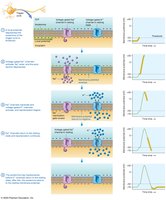
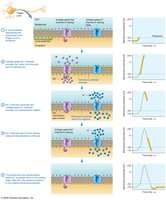
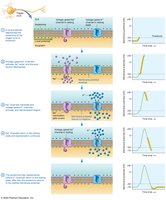
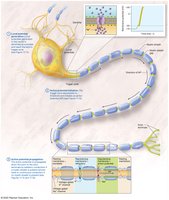
Depolarization: A local potential depolarizes the axolemma of the trigger zone to threshold (−55 mV), activating voltage-gated sodium ion channels.
Activation of Sodium Channels: Sodium ions enter the axon, causing further depolarization to about +30 mV.
Inactivation of Sodium Channels and Activation of Potassium Channels: Sodium channels inactivate at +30 mV, and potassium channels open, initiating repolarization.
Repolarization: Potassium ions exit the cell, returning the membrane potential toward resting values.
Hyperpolarization: The axolemma may briefly hyperpolarize before returning to the resting membrane potential, which is re-established by potassium leak channels and pumps.
The Refractory Period
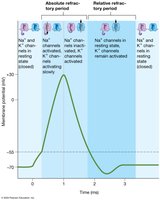
The refractory period is the brief interval after an action potential during which the neuron cannot fire another action potential. It consists of two phases:
Absolute Refractory Period: No additional stimulus can produce another action potential; sodium channels are either activated or inactivated.
Relative Refractory Period: A stronger-than-normal stimulus can trigger an action potential while the membrane is repolarizing due to potassium ion movement.
Comparison of Local and Action Potentials
Local and action potentials differ in their properties:
Local Potentials: Graded, reversible, and decremental (strength diminishes with distance).
Action Potentials: All-or-none, nondecremental (strength does not diminish), and irreversible once initiated.
Propagation of Action Potentials
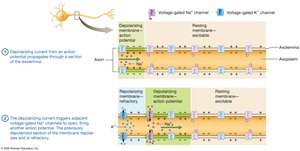
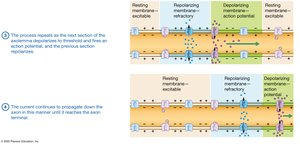
Action potentials are propagated along the axon as a method of long-distance signaling. Each action potential triggers the next, moving in one direction from the trigger zone to the axon terminals due to the refractory period in the preceding membrane section.
Depolarizing Current: Propagates through a section of the axolemma, triggering adjacent voltage-gated sodium channels.
Repolarization: The previously depolarized section repolarizes and becomes refractory, preventing backward flow.
Propagation Continues: The process repeats until the action potential reaches the axon terminal.
Conduction Speed and Types of Conduction
The speed of action potential propagation depends on axon diameter and the presence of a myelin sheath:
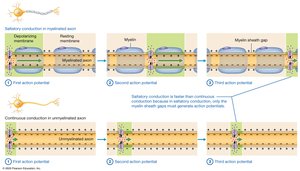
Continuous Conduction: Occurs in unmyelinated axons; each section must be depolarized to threshold.
Saltatory Conduction: Occurs in myelinated axons; action potentials "jump" between gaps in the myelin sheath (nodes of Ranvier), increasing speed.
Myelin Insulation and Propagation Speed
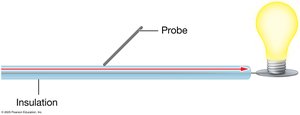
Myelin acts as an insulator, preventing current leakage and enabling rapid saltatory conduction. In unmyelinated axons, current leaks out, requiring continuous regeneration of the signal. In myelinated axons, the signal propagates efficiently without constant regeneration.
Multiple Sclerosis
Multiple Sclerosis (MS) is an autoimmune disease in which the immune system attacks the myelin sheath in the CNS. Loss of myelin results in decreased current retention and impaired neuronal signaling, leading to sensory changes, cognitive alterations, and motor dysfunction, including paralysis.

Classification of Axons by Conduction Speed
Type | Diameter | Myelination | Speed | Function |
|---|---|---|---|---|
Type A | 5–20 µm | All myelinated | ~120 m/s | Sensory axons from joints/muscles; motor axons to skeletal muscles |
Type B | 2–3 µm | Most myelinated | ~15 m/s | Sensory axons from organs; efferent fibers of ANS |
Type C | 0.5–1.5 µm | Unmyelinated | 0.5–2 m/s | Sensory axons for pain, temperature, pressure; efferent fibers of ANS |
The Big Picture of Action Potentials
Action potentials are essential for rapid communication within the nervous system, enabling sensation, movement, and cognition. The interplay of ion channels, refractory periods, and myelination ensures efficient and directional signal transmission.
Neuronal Synapses
Overview of Neuronal Synapses
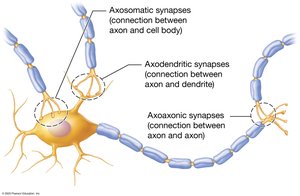
A synapse is the junction where a neuron meets its target cell. Neuronal synapses occur between two neurons and are classified based on the connection site:
Axodendritic: Axon to dendrite
Axosomatic: Axon to cell body
Axoaxonic: Axon to axon
The presynaptic neuron sends the message, while the postsynaptic neuron receives it. Synaptic transmission can be chemical or electrical, enabling complex processes such as voluntary movement, cognition, sensation, and emotion. Each presynaptic neuron can form synapses with about 1,000 postsynaptic neurons, and a postsynaptic neuron can receive input from up to 10,000 presynaptic neurons.
Electrical Synapses
Electrical synapses occur between cells electrically coupled via gap junctions. The axolemmas are closely aligned, allowing direct flow of electric current from one neuron to the next. Transmission is bidirectional, meaning either neuron can act as presynaptic or postsynaptic.
Key Equations
Resting Membrane Potential
The resting membrane potential is determined by the distribution of ions across the membrane and their relative permeabilities:
Threshold for Action Potential
The threshold is typically around −55 mV, at which voltage-gated sodium channels activate.
Summary Table: Action Potential Phases
Phase | Ion Channel Activity | Membrane Potential |
|---|---|---|
Depolarization | Na+ channels open | −55 mV to +30 mV |
Repolarization | Na+ channels inactivate, K+ channels open | +30 mV to −70 mV |
Hyperpolarization | K+ channels remain open | Below −70 mV |
Study Strategies
Compare and contrast muscular and neuronal action potentials for deeper understanding.
Use flashcards and diagrams to visualize similarities and differences.
Practice quiz questions on both concepts simultaneously.
