 Back
Active Membrane Transport and Cell-Environment Interactions: Study Notes for Human Anatomy & Physiology
Study Guide - Smart Notes
 Tailored notes based on your materials, expanded with key definitions, examples, and context.
Active Membrane Transport
Overview of Active Membrane Transport
Active membrane transport is essential for moving substances across the plasma membrane when they cannot passively diffuse. This process requires energy, typically in the form of ATP, and is necessary when solutes are too large, not lipid-soluble, or unable to move down their concentration gradient.
Active transport: Uses carrier proteins to move substances against their concentration gradient.
Vesicular transport: Moves large particles and macromolecules via vesicles.
Active Transport Mechanisms
Active transport involves carrier proteins (solute pumps) that bind specifically and reversibly to the substances being transported. There are two main types:
Primary active transport: Energy is derived directly from ATP hydrolysis.
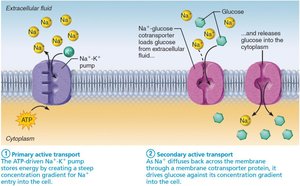
Secondary active transport: Energy is derived indirectly from ionic gradients established by primary active transport.
Primary Active Transport
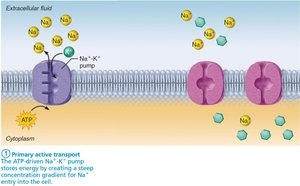
In primary active transport, ATP hydrolysis causes a conformational change in the transport protein, allowing solutes to be pumped across the membrane. The sodium-potassium (Na+-K+) pump is a key example, maintaining essential electrochemical gradients in excitable cells such as nerves and muscles.
Na+-K+ ATPase: Pumps 3 Na+ ions out and 2 K+ ions into the cell per ATP molecule hydrolyzed.
Maintains resting membrane potential and cell volume.
Secondary Active Transport
Secondary active transport uses the energy stored in ionic gradients created by primary active transport. For example, the Na+ gradient established by the Na+-K+ pump drives the cotransport of other molecules such as glucose into the cell via symporters.
Symporters: Move two substances in the same direction.
Antiporters: Move substances in opposite directions.
Vesicular Transport
Overview of Vesicular Transport
Vesicular transport is responsible for moving large particles, macromolecules, and fluids across the plasma membrane in vesicles. This process requires ATP and includes several mechanisms:
Endocytosis: Transport into the cell.
Exocytosis: Transport out of the cell.
Transcytosis: Transport into, across, and out of the cell.
Vesicular trafficking: Movement within the cell.
Endocytosis
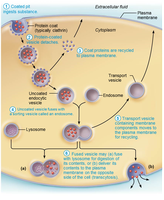
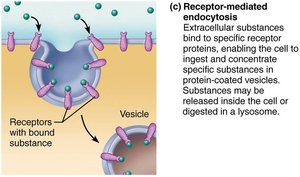
Endocytosis involves the formation of protein-coated vesicles, often mediated by receptors, making the process selective. The vesicle may fuse with a lysosome for digestion or undergo transcytosis.
Types of Endocytosis
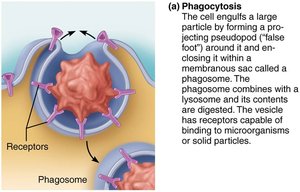
Phagocytosis: "Cell eating"; the cell engulfs large particles using pseudopods, forming a phagosome. Used by macrophages and some white blood cells.
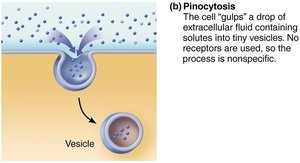
Pinocytosis: "Cell drinking"; the cell engulfs extracellular fluid and dissolved solutes in small vesicles. Important for nutrient absorption in the small intestine.
Receptor-mediated endocytosis: Specific molecules bind to receptors in clathrin-coated pits, allowing selective uptake of substances such as enzymes, LDL, and hormones.
Type | Description | Example |
|---|---|---|
Phagocytosis | Engulfment of large particles by pseudopods | Macrophages ingesting bacteria |
Pinocytosis | Non-specific uptake of extracellular fluid | Absorption in small intestine |
Receptor-mediated | Selective uptake via receptor binding | LDL uptake by cells |
Exocytosis
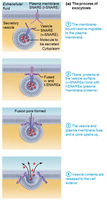
Exocytosis is the process by which cells expel materials. A vesicle containing the substance to be released migrates to the plasma membrane, where proteins called SNAREs facilitate fusion and release of the contents.
Used for secretion of hormones, neurotransmitters, and waste products.
Triggered by cell-surface signals or changes in membrane voltage.
Membrane Potential
Resting Membrane Potential (RMP)
The resting membrane potential is the electrical potential energy resulting from the separation of oppositely charged particles across the plasma membrane. Most cells have an RMP between –50 and –100 mV, with the inside of the cell being more negative than the outside.
K+ is the primary ion responsible for establishing RMP due to its movement through leakage channels.
Na+ also contributes, but the membrane is less permeable to Na+.
The Na+-K+ pump maintains the gradients necessary for RMP.
Equation for Nernst Potential (for K+):
Additional info: R = gas constant, T = temperature, z = charge, F = Faraday's constant, [K+]out and [K+]in are the extracellular and intracellular potassium concentrations, respectively.
Cell-Environment Interactions
Cell Adhesion Molecules (CAMs)
CAMs are glycoproteins on the cell surface that mediate interactions with the extracellular matrix and other cells. They play roles in cell anchoring, movement, immune response, and signaling.
Anchor cells to each other and the extracellular matrix.
Assist in cell migration and tissue development.
Attract immune cells to sites of injury or infection.
Plasma Membrane Receptors
Membrane receptors are proteins that bind chemical signals (ligands) and initiate cellular responses. They are involved in contact signaling (cell recognition) and chemical signaling (response to neurotransmitters, hormones, etc.).
Ligand binding can activate enzymes or open ion channels.
G protein–coupled receptors activate intracellular signaling cascades via second messengers such as cyclic AMP or calcium.
Additional info: The specificity of cellular responses depends on the receptor type and the signaling pathway activated.
