 Back
BackAdaptive Immunity: Antibody-Mediated (Humoral) Immunity
Study Guide - Smart Notes
 Tailored notes based on your materials, expanded with key definitions, examples, and context.
Adaptive Immunity: Antibody-Mediated (Humoral) Immunity
Overview of Antibody-Mediated Immunity
Antibody-mediated immunity, also known as humoral immunity, is a critical component of the adaptive immune system. It involves B cells and the antibodies they produce, which target and neutralize pathogens in body fluids. This process is essential for defending the body against extracellular microbes and toxins.
B cells possess B cell receptors (BCRs) that are structurally similar to antibodies.
Immunity occurs in three phases: antigen recognition, antibody secretion, and memory formation.
Phases of Antibody-Mediated Immunity
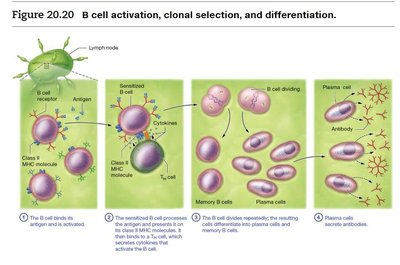
Phase 1: B Cell Activation, Clonal Selection, and Differentiation
B cells originate from the lymphoid lineage and mature in the bone marrow. Only a small percentage complete maturation, with self-reactive B cells eliminated to prevent autoimmunity. Upon encountering their specific antigen, B cells undergo activation and differentiation.
The B cell clone binds its antigen and becomes sensitized.
The sensitized B cell processes the antigen and presents it on a Class II MHC molecule, interacting with a helper T cell (Th cell) that secretes cytokines to activate the B cell.
The B cell divides repeatedly, differentiating into plasma cells (which secrete antibodies) and memory B cells (which respond to future exposures).
Phase 2: Antibodies and Their Effects
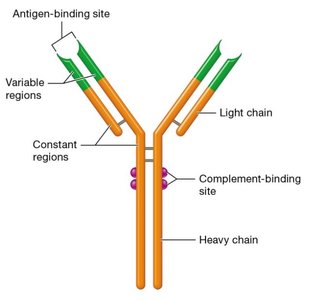
Antibodies are Y-shaped proteins composed of two heavy and two light peptide chains. Each chain contains a constant region (responsible for antibody effects) and a variable region (responsible for antigen recognition). The basic antibody unit has two antigen-binding sites.
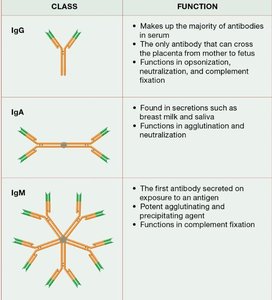
Monomer: Single antibody unit
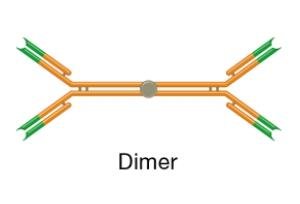
Dimer: Two antibody units joined together
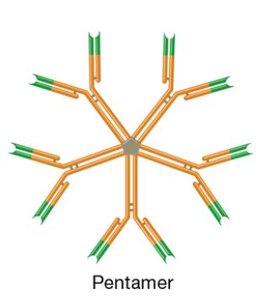
Pentamer: Five antibody units joined together
Five Classes of Antibody (Immunoglobulins)
Antibodies are classified based on their constant region, denoted as Ig (immunoglobulin) followed by a letter. Each class has distinct functions and structural features.
Class | Structure | Function |
|---|---|---|
IgG | Monomer | Makes up the majority of antibodies in serum; only antibody to cross placenta; functions in opsonization, neutralization, and complement fixation. |
IgA | Dimer | Found in secretions (breast milk, saliva); functions in agglutination and neutralization. |
IgM | Pentamer | First antibody secreted; potent agglutinating and precipitating agent; functions in complement fixation. |
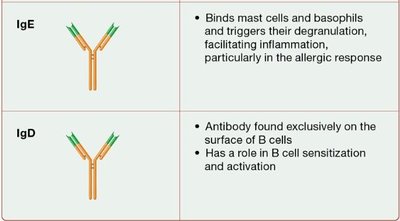
IgE | Monomer | Binds mast cells and basophils; triggers inflammation, especially in allergic responses. |
IgD | Monomer | Found exclusively on B cell surfaces; role in B cell sensitization and activation. |
Functions of Secreted Antibodies
Agglutination: Clumping of whole cells, mainly by IgM.
Precipitation: Clumping of soluble antigens, mainly by IgM.
Opsonization: Coating pathogens to enhance phagocytosis, mainly by IgG.
Neutralization: Binding and inactivating toxins or pathogens, mainly by IgG and IgA.
Complement activation: Triggering complement proteins, mainly by IgM and IgG.
Stimulation of inflammation: Initiating release of inflammatory mediators, mainly by IgE.
Immunological Memory
Primary and Secondary Immune Responses
Immunological memory is mediated by memory B cells. The primary immune response occurs upon first exposure to an antigen, while the secondary response is faster and stronger due to memory cells.
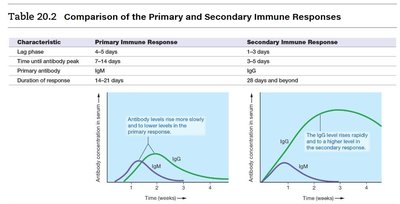
Primary Response: Lag phase of 4-5 days; antibody levels peak at 7-14 days; mainly IgM produced.
Secondary Response: Shorter lag phase (1-3 days); antibody levels peak at 3-5 days; higher peak (100-1000x); mainly IgG produced with higher affinity.
Characteristic | Primary Immune Response | Secondary Immune Response |
|---|---|---|
Lag phase | 4-5 days | 1-3 days |
Time until antibody peak | 7-14 days | 3-5 days |
Primary antibody | IgM | IgG |
Duration of response | 14-21 days | 28 days and beyond |
Vaccines and Immunization
Vaccines are designed to stimulate a primary immune response and generate memory cells without causing disease. Types include live attenuated, inactivated, subunit, toxoid, and mRNA vaccines. Vaccines are not associated with autism, and misinformation can have serious public health consequences.
Live, attenuated vaccines: Weakened pathogens; not recommended for immunocompromised individuals.
Inactivated vaccines: Pathogens unable to divide; require boosters.
Subunit vaccines: Contain parts of pathogens; require boosters.
Toxoid vaccines: Inactivated toxins.
mRNA vaccines: mRNA translated into protein, recognized as foreign.
Active and Passive Antibody-Mediated Immunity
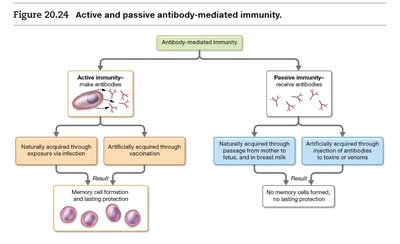
Immunity can be acquired actively or passively. Active immunity involves the body's own response to an antigen, resulting in memory cell formation and long-lasting protection. Passive immunity involves receiving antibodies from another source, providing temporary protection.
Active immunity: Acquired naturally (exposure) or artificially (vaccination); results in memory cells and lasting protection.
Passive immunity: Acquired naturally (mother to fetus) or artificially (antibody injections); no memory cells formed, temporary protection.
Autoimmunity and B Cell Regulation
Autoimmunity occurs when B cells recognize self-antigens as foreign, producing autoantibodies. Most self-reactive B cells are eliminated during maturation, but failures in this process can lead to autoimmune diseases.
Autoantibodies: Antibodies that bind to self-antigens, causing tissue damage.
B cell regulation: Ensures only non-self-reactive B cells survive and mature.
Summary Table: Antibody Classes and Functions
Class | Structure | Main Functions |
|---|---|---|
IgG | Monomer | Opsonization, neutralization, complement activation, crosses placenta |
IgA | Dimer | Agglutination, neutralization, found in secretions |
IgM | Pentamer | First antibody produced, agglutination, complement activation |
IgE | Monomer | Triggers inflammation, allergic responses |
IgD | Monomer | B cell receptor, activation |
Key Equations and Concepts
Antibody Structure:
Antigen Binding:
Additional info: Academic context was added to clarify the phases of immunity, antibody structure, and vaccine types. Tables were recreated and expanded for clarity.
