 Back
BackAdrenal Glands: Structure, Hormones, and Stress Response
Study Guide - Smart Notes
 Tailored notes based on your materials, expanded with key definitions, examples, and context.
The Adrenal Glands
Structure and Location
The adrenal glands are paired, pyramid-shaped organs located atop the kidneys. Each gland is composed of two distinct regions: the adrenal cortex and the adrenal medulla. The cortex is derived from embryonic mesoderm and is glandular, while the medulla is composed of nervous tissue and is part of the sympathetic nervous system.
Adrenal Cortex: Produces steroid hormones called corticosteroids.
Adrenal Medulla: Produces catecholamines (epinephrine and norepinephrine).
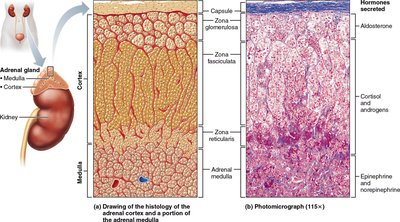
Histological Zones of the Adrenal Cortex
The adrenal cortex is organized into three distinct zones, each responsible for producing specific hormones:
Zona glomerulosa: Produces mineralocorticoids (e.g., aldosterone).
Zona fasciculata: Produces glucocorticoids (e.g., cortisol).
Zona reticularis: Produces gonadocorticoids (e.g., androgens).
Adrenal Cortex Hormones
Mineralocorticoids
Mineralocorticoids regulate electrolyte concentrations in extracellular fluids, especially sodium (Na+) and potassium (K+).
Aldosterone: The most potent mineralocorticoid, essential for life.
Functions:
Stimulates Na+ reabsorption in kidney tubules, increasing blood volume and pressure.
Promotes K+ secretion for elimination.
Can alter acid-base balance by increasing H+ excretion.
Regulation of Aldosterone Secretion
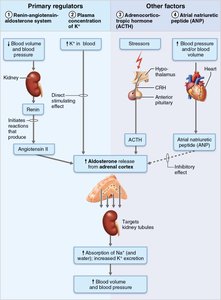
Renin-angiotensin-aldosterone system: Activated by decreased blood volume/pressure; renin from kidneys initiates angiotensin II formation, stimulating aldosterone release.
Plasma K+ concentration: Increased K+ stimulates, decreased K+ inhibits aldosterone release.
ACTH: Stress increases ACTH, slightly increasing aldosterone.
Atrial natriuretic peptide (ANP): Inhibits aldosterone and renin, decreasing blood pressure.
Clinical Imbalances
Aldosteronism: Hypersecretion causes hypertension, edema, and excessive K+ loss, leading to muscle weakness and paralysis.
Addison's disease: Hyposecretion results in weight loss, low plasma glucose and sodium, high potassium, dehydration, and hypotension.
Glucocorticoids
Glucocorticoids, primarily cortisol, influence energy metabolism and help resist stressors.
Functions:
Maintain blood glucose levels and blood pressure.
Promote gluconeogenesis (formation of glucose from fats and proteins).
Mobilize fatty acids for energy.
Break down proteins for repair and enzyme synthesis.
Enhance vasoconstriction to maintain blood pressure.
Regulation: Negative feedback via hypothalamic CRH and pituitary ACTH.
Clinical Imbalances
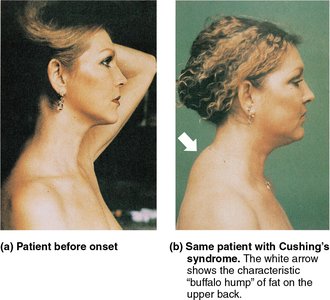
Cushing's syndrome: Hypersecretion causes elevated blood glucose, muscle and bone loss, hypertension, edema, and characteristic fat redistribution ("moon face," "buffalo hump").
Addison's disease: Hyposecretion leads to weight loss, low glucose and sodium, high potassium, dehydration, and skin bronzing.
Gonadocorticoids (Adrenal Sex Hormones)
Gonadocorticoids are weak androgens (e.g., DHEA, androstenedione) that are converted to testosterone or estrogens in tissues.
Functions:
Contribute to axillary and pubic hair development.
In females, contribute to sex drive and estrogen production post-menopause.
Regulation: Stimulated by ACTH; feedback inhibition is not well understood.
Clinical Imbalances
Adrenogenital syndrome: Hypersecretion causes masculinization, early puberty in boys, and development of male characteristics in females.
Adrenal Medulla Hormones
Catecholamines: Epinephrine and Norepinephrine
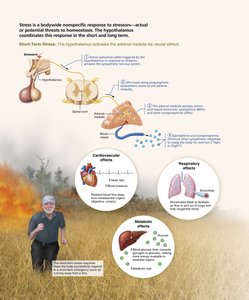
The adrenal medulla produces catecholamines, which reinforce the sympathetic nervous system's fight-or-flight response.
Functions:
Increase heart rate and blood pressure.
Divert blood to heart and skeletal muscles.
Increase blood glucose levels.
Regulation: Stimulated by preganglionic sympathetic neurons.
Clinical Imbalances
Pheochromocytoma: Hypersecretion causes uncontrolled sympathetic activity (rapid heartbeat, hypertension, nervousness, sweating).
Hyposecretion: Not clinically significant.
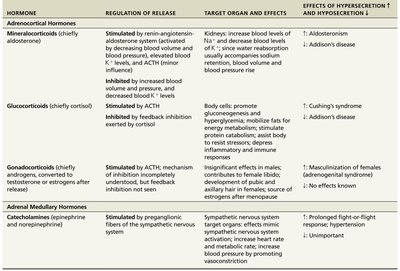
Summary Table: Adrenal Hormones
Hormone | Regulation of Release | Target Organ and Effects | Effects of Hypersecretion & Hyposecretion |
|---|---|---|---|
Mineralocorticoids (chiefly aldosterone) | Stimulated by renin-angiotensin-aldosterone system, increased K+, ACTH, inhibited by ANP | Kidneys: increase blood levels of Na+, decrease blood levels of K+, water retention, blood volume and pressure rise | ↑: Aldosteronism ↓: Addison's disease |
Glucocorticoids (chiefly cortisol) | Stimulated by ACTH, inhibited by feedback inhibition exerted by cortisol | Body cells: promote gluconeogenesis, mobilize fats for energy, stimulate protein catabolism, resist stressors, depress immune response | ↑: Cushing's syndrome ↓: Addison's disease |
Gonadocorticoids (chiefly androgens) | Stimulated by ACTH, mechanism not fully understood | Insignificant in males; females: contribute to sex drive, estrogen production after menopause | ↑: Masculinization of females (adrenogenital syndrome) ↓: No effects known |
Catecholamines (epinephrine and norepinephrine) | Stimulated by preganglionic fibers of the sympathetic nervous system | Sympathetic nervous system target organs: increase heart rate, metabolic rate, blood pressure by promoting vasoconstriction | ↑: Prolonged fight-or-flight response ↓: Unimportant |
The Stress Response
Stages of Stress Response
The stress response, or general adaptation syndrome, is a nonspecific reaction to stressors coordinated by the hypothalamus.
Short-term stress: Activates fight-or-flight response via adrenal medulla (catecholamines).
Long-term stress: Activates resistance reaction via adrenal cortex (corticosteroids).
Exhaustion: Prolonged stress disrupts homeostasis.
Key Terms and Concepts
Corticosteroids: Steroid hormones produced by the adrenal cortex.
Gluconeogenesis: Formation of glucose from non-carbohydrate sources.
ACTH: Adrenocorticotropic hormone, stimulates adrenal cortex.
Renin-angiotensin-aldosterone system: Regulates blood pressure and volume.
Adrenogenital syndrome: Excess adrenal androgens cause masculinization.
Pheochromocytoma: Tumor causing excess catecholamine secretion.
Relevant Equations
Renin-Angiotensin-Aldosterone Pathway:
Gluconeogenesis:
Summary
The adrenal glands play a crucial role in regulating electrolyte balance, metabolism, and the body's response to stress. Their hormones are essential for maintaining homeostasis, and imbalances can lead to significant clinical disorders such as Cushing's syndrome, Addison's disease, and adrenogenital syndrome. Additional info: Academic context was added to clarify hormone functions, regulatory mechanisms, and clinical disorders for completeness.
