 Back
BackAfferent Division: Sensory Physiology – Study Notes
Study Guide - Smart Notes
 Tailored notes based on your materials, expanded with key definitions, examples, and context.
Chapter 10: Afferent Division – Sensory Physiology
Overview of Sensory Physiology
Sensory physiology explores how the nervous system detects, processes, and interprets information from the environment and the body. The afferent division of the nervous system is responsible for transmitting sensory information to the central nervous system (CNS), where it is integrated and perceived.
Somatic and Special Senses
Classification of Senses
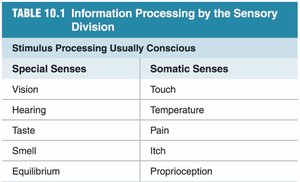
Sensory information is categorized into special senses and somatic senses. Special senses are associated with specialized organs, while somatic senses are distributed throughout the body.
Special Senses | Somatic Senses |
|---|---|
Vision | Touch |
Hearing | Temperature |
Taste | Pain |
Smell | Itch |
Equilibrium | Proprioception |
Conscious and Subconscious Sensory Processing
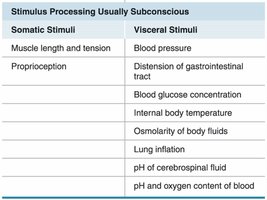
Some sensory information is processed consciously, while other types are processed subconsciously to maintain homeostasis.
Somatic Stimuli | Visceral Stimuli |
|---|---|
Muscle length and tension | Blood pressure |
Proprioception | Distension of gastrointestinal tract |
Blood glucose concentration | |
Internal body temperature | |
Osmolarity of body fluids | |
Lung inflation | |
pH of cerebrospinal fluid | |
pH and oxygen content of blood |
Types of Sensory Receptors
Classification by Stimulus Type
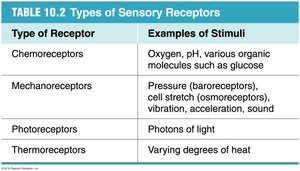
Sensory receptors are specialized to detect specific types of stimuli. They can be classified as follows:
Type of Receptor | Examples of Stimuli |
|---|---|
Chemoreceptors | Oxygen, pH, organic molecules (e.g., glucose) |
Mechanoreceptors | Pressure, cell stretch, vibration, acceleration, sound |
Photoreceptors | Photons of light |
Thermoreceptors | Varying degrees of heat |
Neural vs. Non-neural Receptors
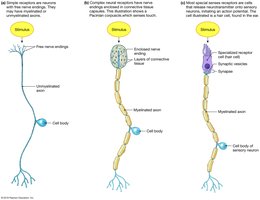
Receptors can be the sensory neurons themselves (neural receptors) or specialized cells that synapse onto sensory neurons (non-neural receptors). Neural receptors may have free nerve endings or be encapsulated by connective tissue, while non-neural receptors are often found in special senses.
Sensory Transduction
Conversion of Stimuli to Electrical Signals
Sensory transduction is the process by which sensory receptors convert physical or chemical stimuli into graded electrical signals called receptor potentials. If the receptor potential reaches threshold, it triggers action potentials in the sensory neuron.
Threshold: The minimum stimulus intensity required to generate a receptor potential.
Direct transduction: Stimulus directly changes membrane potential.
Indirect transduction: Stimulus activates second messenger systems, leading to membrane potential changes.
Receptive Fields and Sensory Discrimination
Receptive Fields
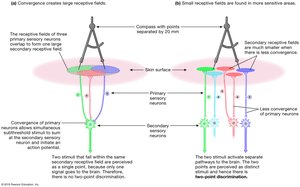
A receptive field is the specific physical area where a stimulus leads to activation of a particular sensory neuron. Receptive fields can overlap and converge, affecting the ability to discriminate between two points of stimulation (two-point discrimination).
Large receptive fields: Low two-point discrimination (less sensitive areas).
Small receptive fields: High two-point discrimination (more sensitive areas, e.g., fingertips).
Sensory Pathways
Transmission to the CNS
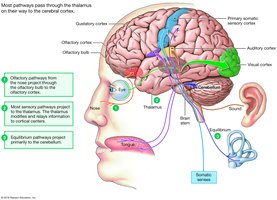
Sensory information travels to the CNS via spinal or cranial nerves. Most sensory pathways project to the thalamus, which relays information to the appropriate cortical areas for processing. Some pathways, such as those for equilibrium, project directly to the cerebellum.
Dermatomes
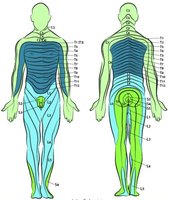
Dermatomes are regions of skin innervated by specific spinal nerves. Mapping dermatomes helps in diagnosing nerve or spinal cord injuries.
Stimulus Properties and Coding
How the CNS Discriminates Stimuli
Although all action potentials are identical, the CNS distinguishes different stimuli by preserving four key properties:
Modality: The type of stimulus (e.g., heat, pain, sound).
Location: The site of the stimulus on the body.
Intensity: The strength of the stimulus.
Duration: How long the stimulus lasts.
Modality
Labeled line coding refers to the 1:1 relationship between a receptor and the sensation it produces. Any activation of a receptor is perceived as its specific modality, regardless of the actual cause (e.g., a blow to the head causing "flashes of light").
Location
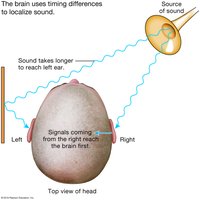
The nervous system maintains topographic maps of sensory input, preserving spatial relationships from the periphery to the CNS. Sound localization is an exception, relying on timing differences between ears.
Intensity
Stimulus intensity is encoded by:
Population coding: The number of receptors activated. Low-threshold receptors respond to weak stimuli, while high-threshold receptors respond to stronger stimuli.
Frequency coding: The frequency of action potentials. Stronger stimuli produce higher frequencies of action potentials.
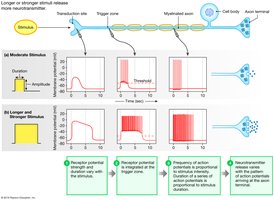
Duration
The duration of a stimulus is encoded by the duration of action potential firing in the sensory neuron. Adaptation occurs when receptors decrease their response to a sustained stimulus.
Adaptation and Types of Receptors
Tonic vs. Phasic Receptors
Receptors adapt to continuous stimulation in different ways:
Tonic receptors: Slowly adapting; continue to fire as long as the stimulus is present. Useful for monitoring parameters that must be constantly evaluated (e.g., baroreceptors for blood pressure, nociceptors for pain).
Phasic receptors: Rapidly adapting; stop firing if the stimulus remains constant. Useful for detecting changes in the environment (e.g., olfactory receptors, Pacinian corpuscles).
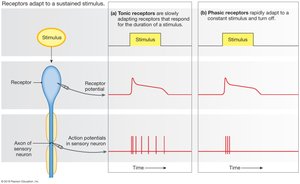
Summary Table: Tonic vs. Phasic Receptors
Receptor Type | Adaptation | Example |
|---|---|---|
Tonic | Slowly adapting | Baroreceptors, nociceptors |
Phasic | Rapidly adapting | Olfactory receptors, Pacinian corpuscles |
Additional info: Understanding sensory physiology is essential for interpreting how the body interacts with its environment and maintains homeostasis. Disorders of sensory processing can lead to significant clinical symptoms, highlighting the importance of these mechanisms in health and disease.
