 Back
Anatomical Orientation, Terminology, and Body Cavities: Study Notes for ANP College Students
Study Guide - Smart Notes
 Tailored notes based on your materials, expanded with key definitions, examples, and context.
The Human Body: An Orientation
Anatomical Position and Directional Terms
The anatomical position is a standardized posture used as a reference in anatomy to ensure consistency when describing locations and directions on the human body. Directional terms are essential for accurately communicating the relationship between different body structures.
Anatomical Position: Body is erect, feet slightly apart, palms facing forward, thumbs pointing away from the body.
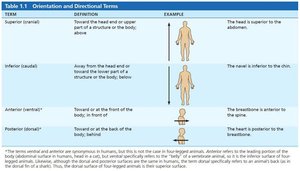
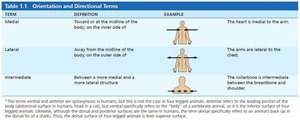
Directional Terms: Used to describe the location of one body part relative to another. Always based on the anatomical position, not the observer's perspective.
Right and Left: Refer to the subject's right and left, not the observer's.
Regional Terms
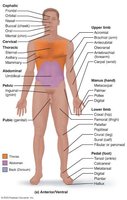
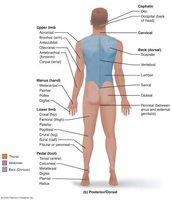
Regional terms specify distinct areas of the body and are divided into two major regions: axial and appendicular. These terms are fundamental for identifying precise locations during anatomical study and clinical practice.
Axial Region: Includes the head, neck, and trunk.
Appendicular Region: Includes the limbs (arms and legs).
Regional Terms: Designate specific areas within these divisions, such as brachial (arm), femoral (thigh), and abdominal (abdomen).
Body Planes and Sections
Body Planes
Body planes are imaginary lines used to divide the body for anatomical study. Understanding these planes is crucial for interpreting medical imaging and describing locations of injuries or pathologies.
Sagittal Plane: Divides the body into right and left parts.
Midsagittal (Median) Plane: Divides the body exactly at the midline.
Parasagittal Plane: Divides the body off-center from the midline.
Frontal (Coronal) Plane: Divides the body into anterior (front) and posterior (back) parts.
Transverse (Horizontal) Plane: Divides the body into superior (top) and inferior (bottom) parts.
Oblique Section: A cut made at an angle other than 90° to the vertical plane.
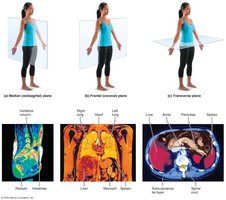
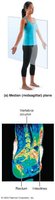
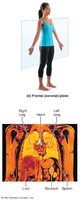
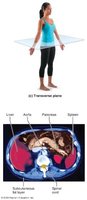
Body Cavities and Membranes
Body Cavities
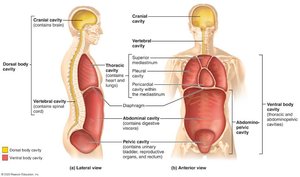
The body contains internal cavities that protect organs and allow for their movement and function. These cavities are classified into two main sets: dorsal and ventral.
Dorsal Body Cavity: Protects the nervous system; includes the cranial cavity (brain) and vertebral cavity (spinal cord).
Ventral Body Cavity: Houses internal organs (viscera); subdivided into thoracic and abdominopelvic cavities, separated by the diaphragm.
Thoracic Cavity: Contains pleural cavities (lungs), mediastinum (pericardial cavity and other thoracic organs), and pericardial cavity (heart).
Abdominopelvic Cavity: Contains abdominal cavity (digestive organs) and pelvic cavity (urinary bladder, reproductive organs, rectum).
Membranes in the Ventral Body Cavity
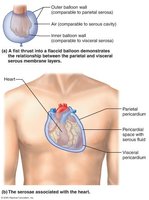
Serous membranes (serosa) are thin, double-layered membranes that cover surfaces in the ventral body cavity. They provide lubrication and protection for internal organs.
Parietal Serosa: Lines internal body cavity walls.
Visceral Serosa: Covers internal organs.
Serous Fluid: Secreted by both layers, fills the space between them, reducing friction.
Specific Names: Pericardium (heart), pleurae (lungs), peritoneum (abdominopelvic cavity).
Abdominopelvic Quadrants and Regions
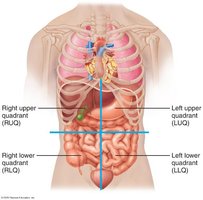
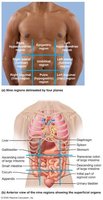
The abdominopelvic area is divided into quadrants and regions for clinical and anatomical reference. Quadrants are used by medical personnel, while regions are used by anatomists for more precise localization.
Quadrants: Right upper quadrant (RUQ), left upper quadrant (LUQ), right lower quadrant (RLQ), left lower quadrant (LLQ).
Regions: Nine regions resembling a tic-tac-toe grid: right hypochondriac, epigastric, left hypochondriac, right lumbar, umbilical, left lumbar, right iliac (inguinal), hypogastric, left iliac (inguinal).
Other Body Cavities
In addition to the main body cavities, there are several smaller cavities exposed to the environment, such as oral, nasal, orbital, and middle ear cavities. Synovial cavities (joint cavities) are not exposed to the environment.
Oral and Digestive Cavities: Mouth and digestive tract.
Nasal Cavity: Within the nose.
Orbital Cavities: Eyes.
Middle Ear Cavities: Contain tiny bones for hearing.
Synovial Cavities: Found in joints, not exposed to the environment.
Clinical Relevance and Homeostatic Imbalances
Understanding anatomical terminology and body cavities is critical for clinical practice. Errors in terminology can lead to serious medical mistakes, such as wrong-site surgery. Homeostatic imbalances, such as hiatal hernia or inflammation of serous membranes (pleurisy, peritonitis), highlight the importance of anatomical knowledge in diagnosis and treatment.
Hiatal Hernia: Stomach protrudes through the diaphragm into the thoracic cavity, causing heartburn.
Pleurisy/Peritonitis: Inflammation of serous membranes, causing pain and potential complications.
Wrong Site Surgery: Critical errors due to confusion about anatomical terminology.
