 Back
Anatomical, Physiological, and Metabolic Changes During Pregnancy
Study Guide - Smart Notes
 Tailored notes based on your materials, expanded with key definitions, examples, and context.
Pregnancy: Anatomical, Physiological, and Metabolic Changes
Anatomical Changes During Pregnancy
Pregnancy induces profound anatomical adaptations in the female body to support fetal development and prepare for childbirth and lactation.
Vascular Changes: The reproductive organs become more vascular and engorged with blood. The vagina develops a purplish hue, known as Chadwick’s sign.
Breast Changes: Rising estrogen and progesterone levels cause the breasts to enlarge, the areolae to darken, and mammary glands to prepare for lactation.
Skin Pigmentation: Increased pigmentation may occur on the face (chloasma or "mask of pregnancy").
Uterine Enlargement: The uterus grows from a fist-sized organ to fill most of the pelvic and then abdominal cavity, pushing against the diaphragm and abdominal organs.
Postural Changes: The center of gravity shifts, often resulting in lordosis (accentuated lumbar curvature) and backaches. The hormone relaxin increases pelvic flexibility, aiding childbirth but causing a waddling gait.
Weight Gain: Typical weight gain is due to fetal and placental growth, increased size of reproductive organs and breasts, and greater blood volume. Good nutrition, especially protein, calcium, iron, and folic acid, is essential.
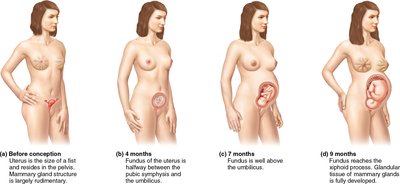
Example: By 9 months, the uterus reaches the xiphoid process of the sternum, and the mammary glands are fully developed for lactation.
Metabolic Changes During Pregnancy
Metabolic adaptations ensure adequate nutrient supply for the fetus and prepare the mother for lactation.
Placental Hormones: The placenta secretes hormones that alter maternal metabolism:
Placental Growth Hormone: Replaces maternal growth hormone, stimulates lipolysis and gluconeogenesis to increase nutrient availability for the fetus.
Human Placental Lactogen (hPL): Stimulates breast maturation, promotes fetal growth, and causes a glucose-sparing effect (maternal cells use more fatty acids, sparing glucose for the fetus). Reduces insulin sensitivity, which can lead to gestational diabetes mellitus in some pregnancies.
Corticotropin-Releasing Hormone (CRH): Levels rise toward the end of pregnancy, increasing maternal ACTH and cortisol, which may help with stress and promote fetal lung maturation.
Vitamin D: Plasma levels of activated vitamin D rise, increasing calcium absorption for fetal bone mineralization.
Physiological Changes in Body Systems
Multiple organ systems adapt to meet the demands of pregnancy.
Gastrointestinal System
Morning Sickness: Nausea and vomiting are common in early pregnancy due to elevated hCG, estrogen, and progesterone.
Heartburn: Caused by displacement of the esophagus and stomach crowding.
Constipation: Reduced motility of the digestive tract.
Urinary System
Increased Urine Production: Due to higher metabolic rate, blood volume, and fetal waste disposal.
Bladder Compression: Leads to frequent, urgent urination and sometimes stress incontinence.
Respiratory System
Nasal Changes: Estrogen causes nasal mucosa to become edematous and congested, leading to stuffiness and nosebleeds.
Increased Tidal Volume: To meet higher oxygen demands and increased CO2 production; respiratory rate remains relatively unchanged, but residual volume decreases.
Dyspnea: Difficult breathing is common in late pregnancy as the diaphragm is pushed upward.
Cardiovascular System
Blood Volume: Increases by up to 40% to accommodate fetal needs and protect against blood loss during birth.
Blood Pressure: Typically decreases mid-pregnancy, then returns to normal by the third trimester.
Cardiac Output: Increases by 35–40% to circulate the greater blood volume.
Venous Return: Uterine pressure on pelvic vessels may cause varicose veins and leg edema.
Clinical Considerations
Teratogens: Substances that cause congenital anomalies or fetal death (e.g., alcohol, nicotine, certain drugs, infections). Example: Alcohol can cause fetal alcohol syndrome (FAS), characterized by microcephaly, intellectual disability, and abnormal growth.
Preeclampsia: A complication marked by hypertension and proteinuria, leading to edema and potentially fatal eclampsia (seizures). The only cure is delivery of the baby.
Summary Table: Key Hormonal and Physiological Changes in Pregnancy
System/Hormone | Main Change | Purpose/Effect |
|---|---|---|
Placental Growth Hormone | Replaces maternal GH | Increases nutrient supply for fetus |
hPL | Breast maturation, glucose sparing | Prepares for lactation, spares glucose for fetus |
CRH | Increases ACTH, cortisol | Stress protection, fetal lung maturation |
Vitamin D | Increases absorption | Ensures fetal bone mineralization |
Cardiovascular | ↑ Blood volume, ↑ cardiac output | Supports fetal needs, protects against blood loss |
Respiratory | ↑ Tidal volume, ↓ residual volume | Meets increased O2 demand |
Urinary | ↑ Urine production | Removes fetal wastes |
Additional info: The above notes integrate textbook-level explanations and clinical context for a comprehensive understanding of pregnancy-related changes, suitable for ANP college students.
