 Back
BackAnatomical Position and Regional Terms: Orientation to the Human Body
Study Guide - Smart Notes
 Tailored notes based on your materials, expanded with key definitions, examples, and context.
The Human Body: An Orientation
Anatomical Position
The anatomical position is a universally accepted standard reference used by anatomists and healthcare professionals to describe the location and relation of body parts. In this position, the body stands erect, feet slightly apart, head and toes pointing forward, and arms at the sides with palms facing forward. This orientation ensures clear and consistent communication about body regions and directions.
Body Erect: The individual stands upright.
Feet Slightly Apart: Provides stability and a standard reference.
Head and Toes Forward: Ensures clarity in directional terms.
Arms at Sides, Palms Forward: Palms face anteriorly (forward), which is not the natural relaxed position but is used for consistency.
Left and Right: Always refer to the subject's left and right, not the observer's.
Example: When describing a wound on the left arm, it refers to the patient's left, not the person facing them.
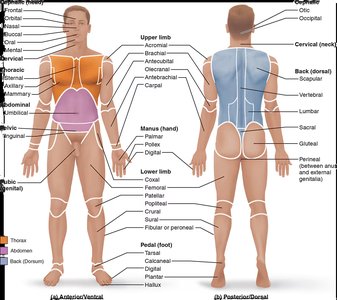
Regional Terms of the Human Body
Regional terms are used to specify distinct areas of the body, making it easier to locate injuries, describe procedures, or discuss anatomy. These terms are divided into two main categories: axial (head, neck, trunk) and appendicular (limbs and their attachments).
Axial Region: Includes the head, neck, and trunk (thorax, abdomen, pelvis).
Appendicular Region: Includes the limbs (arms and legs) and their attachments to the axis.
Common regional terms include:
Cephalic: Head region
Cervical: Neck region
Thoracic: Chest region
Abdominal: Stomach area
Brachial: Arm
Femoral: Thigh
Pedal: Foot
Manual: Hand
Example: The term "lumbar" refers to the lower back region, while "inguinal" refers to the groin area.
Importance of Standardized Anatomical Position
Using the anatomical position as a reference eliminates confusion when describing locations or directions on the body. It is especially important in clinical and anatomical settings to avoid errors in diagnosis, treatment, or communication.
Consistency: Ensures all professionals refer to the same orientation.
Clarity: Reduces ambiguity in medical records and anatomical descriptions.
Additional info: The anatomical position is also the basis for directional terms (anterior, posterior, superior, inferior, etc.), which are covered in detail in subsequent sections of anatomy courses.
