 Back
BackAnatomical Terminology and Body Organization
Study Guide - Smart Notes
 Tailored notes based on your materials, expanded with key definitions, examples, and context.
Anatomical Terminology and Body Organization
Anatomical Position and Directional Terms
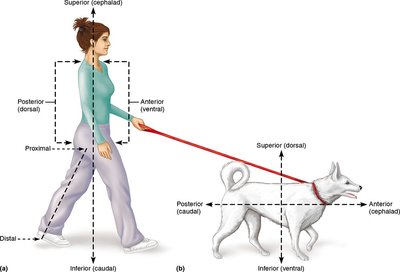
The anatomical position is the standard reference posture for describing the location and orientation of body parts. In humans, this position is defined as the body standing erect, feet slightly apart, arms at the sides with palms facing forward, and thumbs pointing away from the body. Directional terms are used to describe the locations of structures relative to other structures or locations in the body, always assuming the body is in anatomical position.
Superior (cranial)/Inferior (caudal): Toward the head/away from the head (or toward the lower part of the body).
Anterior (ventral)/Posterior (dorsal): Toward the front/toward the back of the body.
Medial/Lateral: Toward the midline/away from the midline of the body.
Proximal/Distal: Closer to/farther from the trunk or point of attachment (mainly used for limbs).
Superficial/Deep: Toward or at the body surface/away from the body surface.
Some terms differ in meaning between humans (bipeds) and four-legged animals (quadrupeds). For example, in quadrupeds, dorsal refers to the back (superior in humans), and ventral refers to the belly side (inferior in humans).
Body Planes and Sections
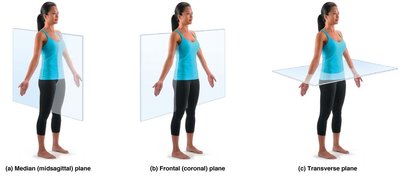
To study the internal structures of the body, anatomists use imaginary flat surfaces called planes to make sections. The three primary planes are:
Sagittal Plane: Divides the body into right and left parts. If exactly in the midline, it is called the midsagittal or median plane.
Frontal (Coronal) Plane: Divides the body into anterior (front) and posterior (back) parts.
Transverse Plane: Divides the body into superior (upper) and inferior (lower) parts; also called a cross-section.
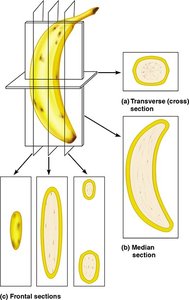
Sections of organs or objects (such as a banana) look different depending on the plane of the cut, which is important for interpreting anatomical images.
Body Cavities
The body contains internal cavities that protect organs and allow for changes in organ shape and size. The two main body cavities are:
Dorsal Body Cavity: Includes the cranial cavity (encases the brain) and vertebral (spinal) cavity (encloses the spinal cord).
Ventral Body Cavity: Subdivided into the thoracic cavity (contains heart and lungs, protected by the rib cage) and the abdominopelvic cavity (contains digestive, urinary, and reproductive organs).
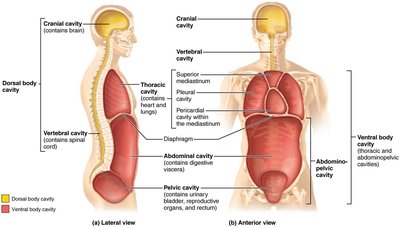
The diaphragm separates the thoracic and abdominopelvic cavities.
Serous Membranes of the Ventral Body Cavity
The ventral body cavity and its organs are lined by serous membranes (serosae), which are double-layered and produce lubricating fluid to reduce friction. The parietal serosa lines the cavity walls, while the visceral serosa covers the organs. Specific names include:
Peritoneum: Lines the abdominal cavity and covers abdominal organs.
Pleura: Encloses the lungs.
Pericardium: Surrounds the heart.
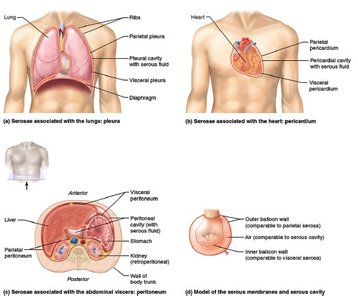
Abdominopelvic Quadrants and Regions
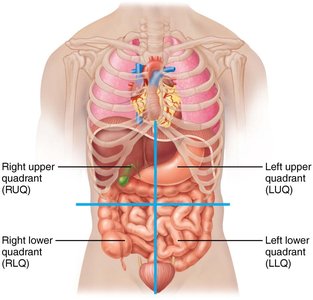
For clinical and anatomical reference, the abdominopelvic cavity is divided into quadrants and regions:
Quadrants: Right upper (RUQ), right lower (RLQ), left upper (LUQ), left lower (LLQ).
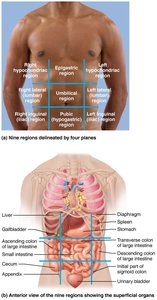
Nine Regions: Used for more precise localization. These are: right/left hypochondriac, epigastric, right/left lumbar, umbilical, right/left iliac (inguinal), and hypogastric (pubic) regions.
Other Body Cavities
In addition to the main body cavities, there are several smaller cavities, especially in the head:
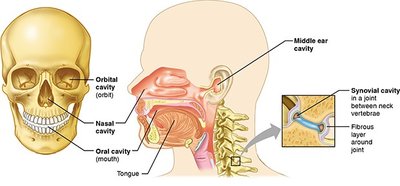
Oral cavity: Mouth, contains teeth and tongue.
Nasal cavity: Part of the respiratory system, located behind the nose.
Orbital cavities: House the eyes.
Middle ear cavities: Contain bones that transmit sound vibrations.
Synovial cavities: Found in freely movable joints, such as the knee and shoulder.
Regional Anatomy
The body is divided into two main regions:
Axial region: Head, neck, and trunk (central axis of the body).
Appendicular region: Limbs (appendages or extremities).
Each region is further subdivided into specific areas, each with its own anatomical term. The following figures and table summarize these regions:
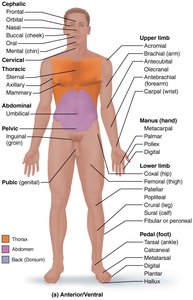
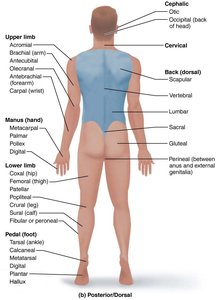
Region | Description | Region | Description |
|---|---|---|---|
Abdominal | Located below the ribs and above the hips | Nasal | Nose |
Acromial | Point of the shoulder | Occipital | Back of the head |
Antebrachial | Forearm | Olecranal | Back of the elbow |
Axillary | Armpit | Oral | Mouth |
Brachial | Arm (upper portion of the upper limb) | Orbital | Bony eye socket |
Buccal | Cheek | Palmar | Palm of the hand |
Calcaneal | Heel of the foot | Patellar | Kneecap |
Carpal | Wrist | Pedal | Foot |
Cephalic | Head | Pelvic | Pelvis |
Cervical | Neck | Perineal | Between anus and external genitalia |
Coxal | Hip | Plantar | Sole of the foot |
Crural | Leg | Popliteal | Back of the knee |
Digital | Fingers or toes | Pubic | Genital region |
Femoral | Thigh | Scapular | Shoulder blade |
Fibular (peroneal) | Side of the leg | Sternal | Breastbone |
Frontal | Forehead | Tarsal | Ankle |
Gluteal | Buttocks | Thoracic | Chest |
Hallux | Great toe | Umbilical | Navel |
Mammary | Breast | Vertebral | Spine |
Manus | Hand | ||
Mental | Chin |
