Back
BackAnatomical Terminology: Surface Anatomy and Regional Terms
Study Guide - Smart Notes
 Tailored notes based on your materials, expanded with key definitions, examples, and context.
Surface Anatomy and Regional Terminology
Introduction to Anatomical Terms
Understanding anatomical terminology is essential for accurately describing locations and regions of the human body. These terms provide a standardized language for healthcare professionals and students to communicate about body structures and their relationships.
Surface anatomy refers to the study of external features of the body and their relation to deeper structures.
Regional terms are specific names given to particular areas of the body, often derived from Latin or Greek roots.
Major Body Regions and Their Terms
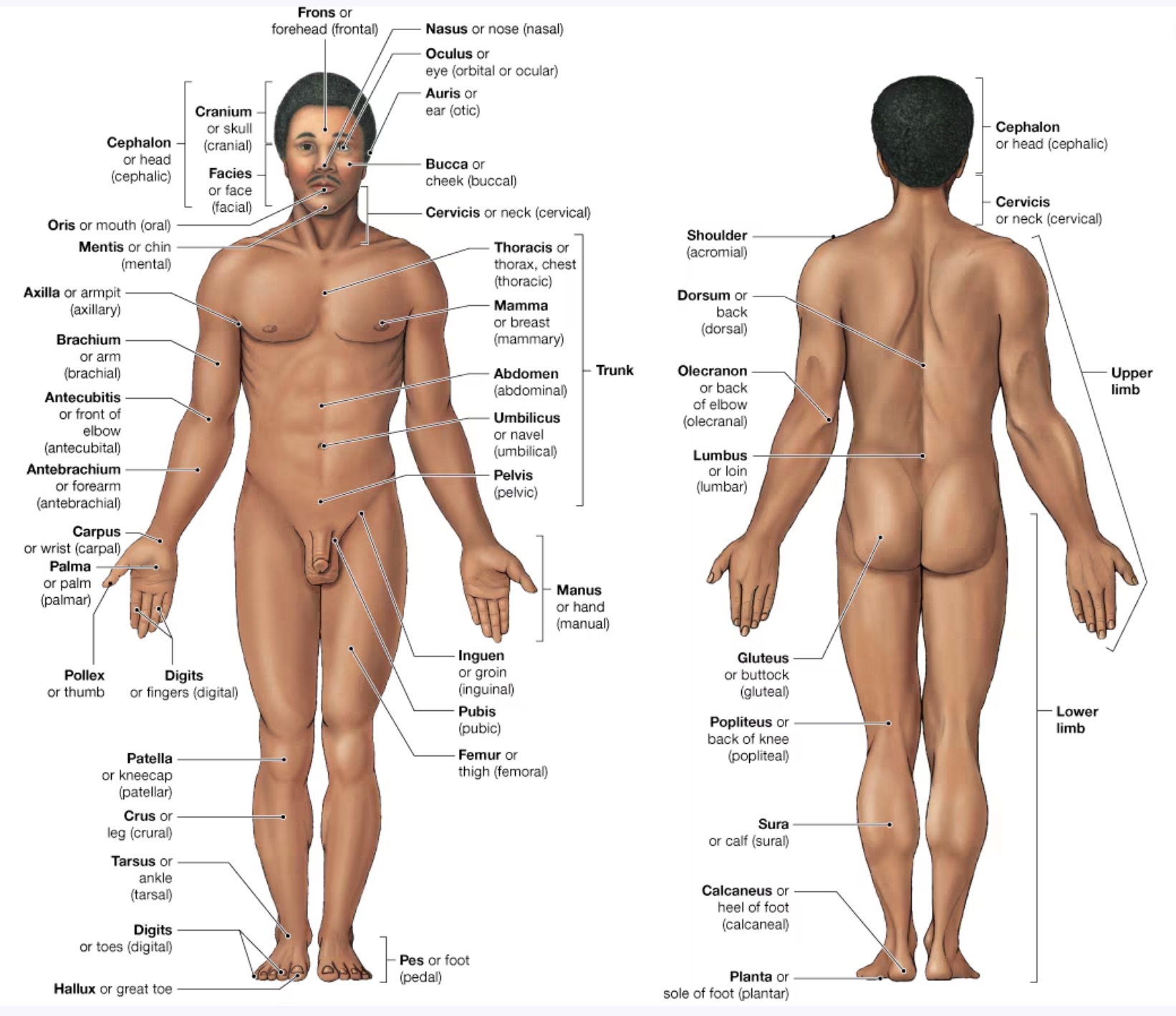
The body is divided into several main regions, each with its own set of anatomical terms. These terms are used to describe both the anterior (front) and posterior (back) aspects of the body.
Cephalon (Cephalic): Refers to the head region.
Cervicis (Cervical): Refers to the neck.
Trunk: Includes the thoracic (chest), mammary (breast), abdominal, umbilical (navel), and pelvic regions.
Upper limb: Includes the brachium (arm), antebrachium (forearm), carpus (wrist), palma (palm), pollex (thumb), and digital (fingers).
Lower limb: Includes the femur (thigh), patella (kneecap), crus (leg), tarsus (ankle), pes (foot), hallux (great toe), and digital (toes).
Anterior (Front) Body Regions
Frons (Frontal): Forehead
Nasus (Nasal): Nose
Oculus (Orbital/Ocular): Eye
Auris (Otic): Ear
Bucca (Buccal): Cheek
Oris (Oral): Mouth
Mentis (Mental): Chin
Axilla (Axillary): Armpit
Brachium (Brachial): Arm
Antecubitis (Antecubital): Front of elbow
Antebrachium (Antebrachial): Forearm
Carpus (Carpal): Wrist
Palma (Palmar): Palm
Pollex: Thumb
Digits (Digital): Fingers or toes
Patella (Patellar): Kneecap
Femur (Femoral): Thigh
Crus (Crural): Leg
Tarsus (Tarsal): Ankle
Pes (Pedal): Foot
Hallux: Great toe
Posterior (Back) Body Regions
Acromion (Acromial): Shoulder
Dorsum (Dorsal): Back
Olecranon (Olecranal): Back of elbow
Lumbus (Lumbar): Loin (lower back)
Gluteus (Gluteal): Buttock
Popliteus (Popliteal): Back of knee
Sura (Sural): Calf
Calcaneus (Calcaneal): Heel of foot
Planta (Plantar): Sole of foot
Table: Common Anatomical Terms and Their Locations
Term | Region | Location |
|---|---|---|
Cephalon (Cephalic) | Head | Entire head region |
Cervicis (Cervical) | Neck | Neck area |
Thoracis (Thoracic) | Chest | Upper trunk |
Brachium (Brachial) | Arm | Upper arm |
Antebrachium (Antebrachial) | Forearm | Lower arm |
Femur (Femoral) | Thigh | Upper leg |
Crus (Crural) | Leg | Lower leg |
Pes (Pedal) | Foot | Entire foot |
Importance of Anatomical Terminology
Facilitates clear and precise communication among healthcare professionals.
Helps in accurately describing the location of injuries, diseases, or procedures.
Forms the foundation for further study in anatomy, physiology, and clinical practice.