 Back
BackAnatomical Terms, Body Planes, and Body Cavities: Foundations of Human Anatomy
Study Guide - Smart Notes
 Tailored notes based on your materials, expanded with key definitions, examples, and context.
Anatomical Terms and the Language of Anatomy
Standard Anatomical Position
The anatomical position is the universally accepted starting point for describing locations and directions on the human body. In this position, the body stands erect, feet slightly apart, arms at the sides, and palms facing forward with thumbs pointing away from the body. This orientation ensures consistency in anatomical terminology, regardless of the observer's perspective.
Right and left always refer to the subject's right and left, not the observer's.
This position is the reference for all directional terms and regional descriptions.
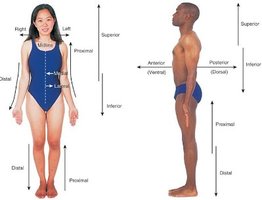
Directional Terms
Directional terms are used to describe the locations of structures relative to other structures or locations in the body. These terms are essential for clear and precise communication in anatomy.
Superior (cranial): Toward the head or upper part of a structure.
Inferior (caudal): Away from the head or toward the lower part of a structure.
Anterior (ventral): Toward the front of the body.
Posterior (dorsal): Toward the back of the body.
Medial: Toward the midline of the body.
Lateral: Away from the midline of the body.
Intermediate: Between a more medial and a more lateral structure.
Proximal: Closer to the origin of the body part or the point of attachment of a limb to the body trunk.
Distal: Farther from the origin of a body part or the point of attachment of a limb to the body trunk.
Superficial (external): Toward or at the body surface.
Deep (internal): Away from the body surface; more internal.
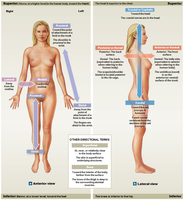
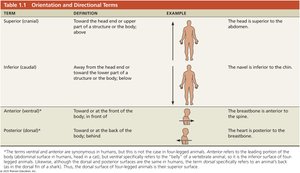
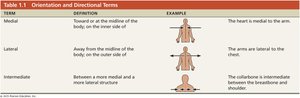
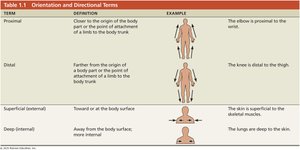
Example: The eyes are superior to the mouth; the thumb is lateral to the pinkie.
Regional Terms of the Human Body
Axial and Appendicular Divisions
The body is divided into two main regions for anatomical reference:
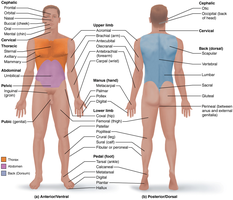
Axial region: Includes the head, neck, and trunk.
Appendicular region: Consists of the limbs (arms and legs) attached to the axis.
Regional terms specify particular areas within these divisions, such as brachial (arm), femoral (thigh), and cervical (neck).
Anatomical Planes and Sections
Body Planes
Body planes are imaginary flat surfaces that divide the body into sections. They are used to describe views or cuts through the body or its organs.
Sagittal plane: Divides the body into right and left parts. A midsagittal (median) plane divides the body into equal right and left halves; a parasagittal plane divides it into unequal parts.
Frontal (coronal) plane: Divides the body into anterior (front) and posterior (back) parts.
Transverse (horizontal) plane: Divides the body into superior (upper) and inferior (lower) parts; also called a cross-section.

Example: A transverse section through the abdomen can reveal the arrangement of abdominal organs.
Body Cavities and Membranes
Major Body Cavities
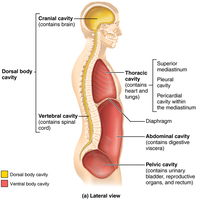
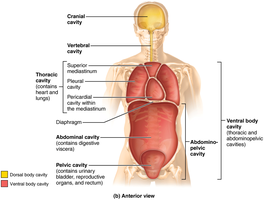
The body contains several major cavities that house and protect vital organs. These are divided into dorsal and ventral body cavities:
Dorsal body cavity:
Cranial cavity: Encloses the brain within the skull.
Vertebral (spinal) cavity: Encloses the spinal cord within the vertebral column.
Ventral body cavity:
Thoracic cavity: Contains the heart and lungs; subdivided into pleural cavities (lungs) and the mediastinum (including the pericardial cavity for the heart).
Abdominopelvic cavity: Subdivided into the abdominal cavity (stomach, intestines, spleen, liver) and the pelvic cavity (bladder, reproductive organs, rectum).
Serous Membranes (Serosa)
Serous membranes are thin, double-layered membranes that cover the walls of the ventral body cavity and the outer surfaces of the organs within it. They secrete serous fluid to reduce friction between moving organs.
Parietal serosa: Lines the internal body cavity walls.
Visceral serosa: Covers the organs within the cavity.
Examples include the pericardium (heart), pleurae (lungs), and peritoneum (abdominopelvic cavity).
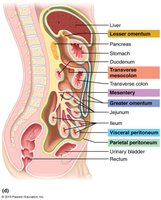
Abdominopelvic Regions and Quadrants
Quadrants
The abdominopelvic cavity is divided into four quadrants by a transverse and a median plane intersecting at the umbilicus. These quadrants are:
Right Upper Quadrant (RUQ)
Left Upper Quadrant (LUQ)
Right Lower Quadrant (RLQ)
Left Lower Quadrant (LLQ)
This division is commonly used in clinical settings to localize pain or abnormalities.
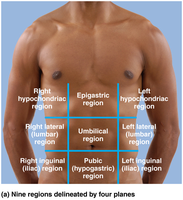
Nine Abdominopelvic Regions
Anatomists often use a more detailed division of the abdominopelvic cavity into nine regions, delineated by four planes. These regions help in describing the locations of organs more precisely:
Right hypochondriac region
Epigastric region
Left hypochondriac region
Right lumbar (lateral) region
Umbilical region
Left lumbar (lateral) region
Right iliac (inguinal) region
Hypogastric (pubic) region
Left iliac (inguinal) region
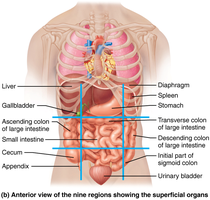
Example: The appendix is typically located in the right iliac region, while the stomach is primarily in the epigastric region.
Summary Table: Orientation and Directional Terms
Term | Definition | Example |
|---|---|---|
Superior (cranial) | Toward the head or upper part of a structure | The head is superior to the abdomen. |
Inferior (caudal) | Away from the head or toward the lower part of a structure | The navel is inferior to the chin. |
Anterior (ventral) | Toward or at the front of the body | The breastbone is anterior to the spine. |
Posterior (dorsal) | Toward or at the back of the body | The heart is posterior to the breastbone. |
Medial | Toward or at the midline of the body | The heart is medial to the arm. |
Lateral | Away from the midline of the body | The arms are lateral to the chest. |
Intermediate | Between a more medial and a more lateral structure | The collarbone is intermediate between the breastbone and shoulder. |
Proximal | Closer to the origin of the body part or point of attachment | The elbow is proximal to the wrist. |
Distal | Farther from the origin of a body part or point of attachment | The knee is distal to the thigh. |
Superficial (external) | Toward or at the body surface | The skin is superficial to the muscles. |
Deep (internal) | Away from the body surface; more internal | The lungs are deep to the skin. |
Additional info: Directional terms are also adapted for four-legged animals, where dorsal refers to the back, ventral to the belly, cranial to the head, and caudal to the tail.
