 Back
Anatomical Terms, Body Planes, and Body Cavities: Foundations of Human Anatomy
Study Guide - Smart Notes
 Tailored notes based on your materials, expanded with key definitions, examples, and context.
Anatomical Terms and the Language of Anatomy
Introduction to Anatomical Terminology
Understanding anatomical terms is essential for accurately describing the locations and relationships of body parts. The language of anatomy provides a standardized way to communicate about the human body, minimizing confusion and ambiguity.
Anatomical Position: The standard reference position for the body is standing erect, feet slightly apart, arms at the sides, and palms facing forward with thumbs pointing away from the body.
Right and Left: Always refer to the patient's or cadaver's right and left, not the observer's.
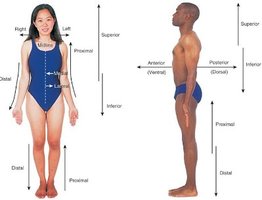
Objectives of Anatomical Terminology
Describe the anatomical position.
Relate anatomical names to common names for body regions.
Define anatomical planes, sections, and directional terms.
Describe major body cavities and the organs they contain.
Anatomical Orientation and Directional Terms
Key Directional Terms
Directional terms are used to explain where one body structure is in relation to another. These terms are essential for clear communication in anatomy and medicine.
Superior (Cranial): Toward the head or upper part of a structure.
Inferior (Caudal): Away from the head or toward the lower part of a structure.
Anterior (Ventral): Toward or at the front of the body.
Posterior (Dorsal): Toward or at the back of the body.
Medial: Toward the midline of the body.
Lateral: Away from the midline of the body.
Proximal: Closer to the origin of the body part or the point of attachment.
Distal: Farther from the origin of a body part or the point of attachment.
Superficial (External): Toward or at the body surface.
Deep (Internal): Away from the body surface; more internal.
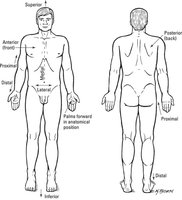
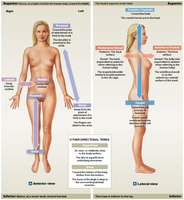
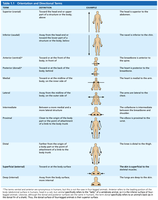
Table: Orientation and Directional Terms
The following table summarizes the main directional terms used in human anatomy:
Term | Definition | Example |
|---|---|---|
Superior (Cranial) | Toward the head end or upper part of a structure | The head is superior to the abdomen |
Inferior (Caudal) | Away from the head end or toward the lower part of a structure | The navel is inferior to the chin |
Anterior (Ventral) | Toward or at the front of the body | The breastbone is anterior to the spine |
Posterior (Dorsal) | Toward or at the back of the body | The heart is posterior to the breastbone |
Medial | Toward the midline of the body | The heart is medial to the arm |
Lateral | Away from the midline of the body | The arms are lateral to the chest |
Proximal | Closer to the origin of the body part | The elbow is proximal to the wrist |
Distal | Farther from the origin of a body part | The knee is distal to the thigh |
Superficial (External) | Toward or at the body surface | The skin is superficial to the skeletal muscles |
Deep (Internal) | Away from the body surface; more internal | The lungs are deep to the skin |
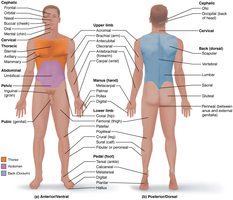
Regional Terms of the Human Body
Axial and Appendicular Divisions
Regional terms specify particular areas within the two main body divisions:
Axial Division: Includes the head, neck, and trunk.
Appendicular Division: Consists of the limbs (appendages) attached to the axis.
Each region has a specific anatomical name, which is important for precise communication in clinical and academic settings.
Body Planes and Sections
Major Anatomical Planes
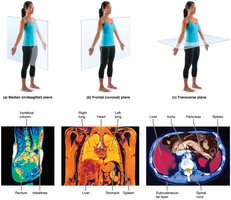
Body planes are imaginary lines used to divide the body into sections for anatomical study and medical imaging. The three main planes are:
Sagittal Plane: A vertical plane dividing the body into right and left parts. If it divides the body into equal halves, it is called the midsagittal (median) plane; if unequal, it is a parasagittal plane.
Frontal (Coronal) Plane: A vertical plane dividing the body into anterior (front) and posterior (back) parts.
Transverse (Horizontal) Plane: A horizontal plane dividing the body into superior (upper) and inferior (lower) parts; also called a cross-section.
Oblique Section: A cut made diagonally between the horizontal and vertical planes.
Body Cavities and Membranes
Major Body Cavities
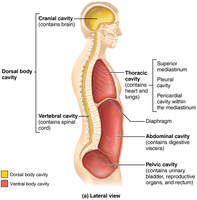
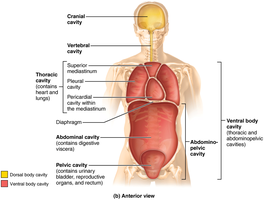
The body contains several cavities that house and protect vital organs. These are divided into dorsal and ventral body cavities:
Dorsal Body Cavity:
Cranial Cavity: Enclosed by the skull; contains the brain.
Vertebral (Spinal) Cavity: Enclosed by the vertebral column; contains the spinal cord.
Ventral Body Cavity:
Thoracic Cavity: Superior portion; subdivided into two pleural cavities (each housing a lung) and the mediastinum (containing the pericardial cavity, which encloses the heart).
Abdominopelvic Cavity: Inferior portion; subdivided into the abdominal cavity (stomach, intestines, spleen, liver) and the pelvic cavity (bladder, some reproductive organs, rectum).
Serous Membranes of the Ventral Body Cavity
Serous membranes (serosa) are thin, double-layered membranes that cover surfaces in the ventral body cavity:
Parietal Serosa: Lines the internal body cavity walls.
Visceral Serosa: Covers the internal organs (viscera).
The two layers are separated by a slit-like cavity filled with serous fluid, which reduces friction.
Specific names include: Pericardium (heart), Pleurae (lungs), and Peritoneum (abdominopelvic cavity).
Abdominopelvic Regions and Quadrants
Quadrants and Nine-Region Division
The abdominopelvic cavity can be divided for clinical and anatomical purposes:
Quadrants: The transverse and median planes intersect at the umbilicus, creating four quadrants (right upper, left upper, right lower, left lower).
Nine Regions: Used primarily by anatomists, this method divides the cavity into nine regions for more precise localization of organs.
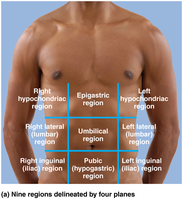
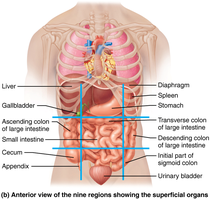
Examples of Regions:
Right hypochondriac region
Epigastric region
Left hypochondriac region
Right lumbar region
Umbilical region
Left lumbar region
Right iliac (inguinal) region
Hypogastric (pubic) region
Left iliac (inguinal) region
Example: The appendix is typically located in the right iliac (inguinal) region, while the stomach is primarily in the epigastric region.
Additional info: Mastery of anatomical terminology is foundational for all further study in anatomy and physiology, as it enables precise communication and understanding of the human body's structure and function.
