 Back
BackAnatomy 35 – Chapter 1: Foundations: An Introduction to Anatomy
Study Guide - Smart Notes
 Tailored notes based on your materials, expanded with key definitions, examples, and context.
Introduction to Anatomy
Definition of Anatomy
Anatomy is the scientific study of the structure of living organisms, particularly the human body. It provides the foundational knowledge necessary to understand how the body is organized and how its parts interact.
Anatomy: The study of body structure, including the size, shape, and location of various body parts.
Physiology: The study of body function, focusing on how anatomical structures work together to sustain life.
Rule #1: Structure determines function; understanding anatomy is essential for understanding physiology.
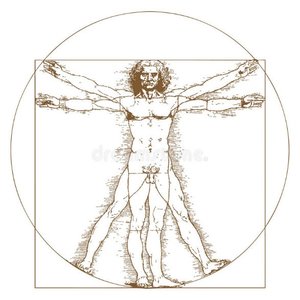
Leonardo da Vinci’s Vitruvian Man illustrates the proportions and symmetry of the human body, highlighting the importance of anatomical study.
Structural Organization of the Human Body
Levels of Organization
The human body is organized into hierarchical levels, each building upon the previous. This organization is essential for understanding how complex functions arise from simple structures.
Chemical Level: Atoms combine to form molecules.
Cellular Level: Molecules form cells, the basic unit of life.
Tissue Level: Groups of similar cells form tissues.
Organ Level: Different tissues combine to form organs.
Organ System Level: Organs work together in systems.
Organismal Level: All organ systems together make up the organism.
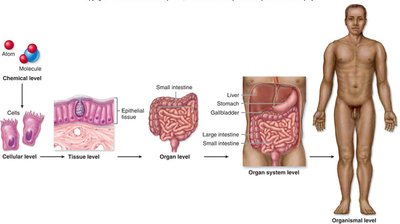
Example: The cardiovascular system consists of the heart and blood vessels, which are made up of tissues and cells, all originating from molecules.
Introduction to Organ Systems
Organ systems are groups of organs that work together to perform complex functions necessary for survival. Each system has specific roles and interacts with other systems.
Muscular System: Produces movement and generates heat.
Cardiovascular System: Transports blood, nutrients, and waste.
Digestive System: Breaks down food and absorbs nutrients.
Skeletal System: Provides support and protection.
Nervous System: Controls and coordinates body activities.
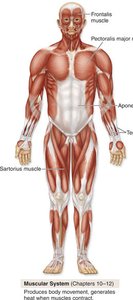
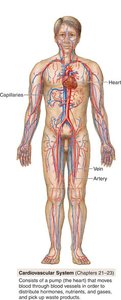
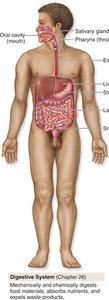
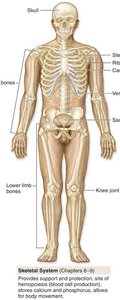
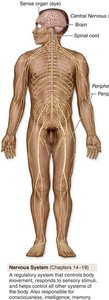
Additional info: Each system is covered in detail in later chapters, but understanding their basic functions is essential for foundational anatomy.
Summary Table: Organ Systems
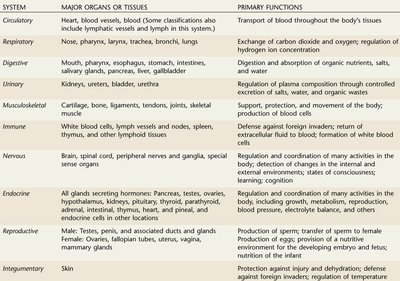
The following table summarizes the major organ systems, their primary organs or tissues, and their main functions.
System | Major Organs or Tissues | Primary Functions |
|---|---|---|
Circulatory | Heart, blood vessels, blood | Transport of blood throughout the body’s tissues |
Respiratory | Nose, pharynx, larynx, trachea, bronchi, lungs | Exchange of carbon dioxide and oxygen |
Digestive | Mouth, pharynx, esophagus, stomach, intestines | Digestion and absorption of nutrients |
Urinary | Kidneys, ureters, bladder, urethra | Regulation of plasma composition |
Musculoskeletal | Cartilage, bones, ligaments, tendons, joints, skeletal muscle | Support, protection, movement |
Immune | White blood cells, lymph vessels and nodes, spleen | Defense against foreign invaders |
Nervous | Brain, spinal cord, peripheral nerves | Regulation and coordination of body activities |
Endocrine | All glands secreting hormones | Regulation of many activities by hormones |
Reproductive | Male: Testes, penis; Female: Ovaries, uterus, vagina | Production of offspring |
Integumentary | Skin | Protection against injury and dehydration |
Language of Anatomy
Anatomical Position
The anatomical position is a standardized posture used as a reference in anatomy. It ensures consistency when describing locations and directions on the body.
Definition: The body stands upright, facing forward, arms at the sides, palms facing forward, feet together.
Purpose: Provides a universal frame of reference for anatomical terminology.
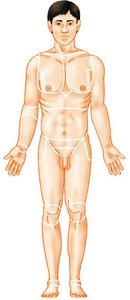
Directional Terms
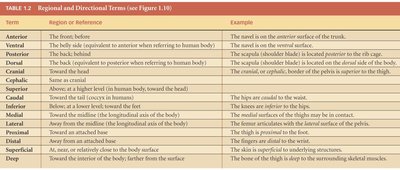
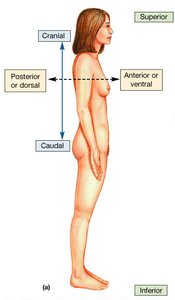
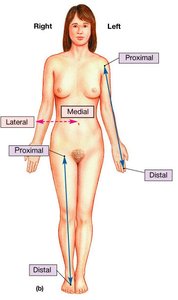
Directional terms are used to describe the locations of structures relative to other structures or locations in the body.
Anterior (ventral): Toward the front of the body.
Posterior (dorsal): Toward the back of the body.
Superior (cranial): Toward the head.
Inferior (caudal): Toward the feet.
Medial: Toward the midline.
Lateral: Away from the midline.
Proximal: Closer to the point of attachment.
Distal: Farther from the point of attachment.
Superficial: Near the surface.
Deep: Away from the surface.
Term | Region or Reference | Example |
|---|---|---|
Anterior | The front body | The navel is on the anterior surface of the trunk. |
Posterior | The back behind | The scapula is located posterior to the rib cage. |
Superior | Above, at a higher level | The hips are superior to the knees. |
Inferior | Below, at a lower level | The knees are inferior to the hips. |
Medial | Toward the midline | The nose is medial to the eyes. |
Lateral | Away from the midline | The ears are lateral to the nose. |
Proximal | Toward an attached base | The thigh is proximal to the foot. |
Distal | Away from an attached base | The fingers are distal to the wrist. |
Superficial | Near the body surface | The skin is superficial to underlying structures. |
Deep | Toward the interior of the body | The bone of the thigh is deep to the surrounding muscles. |
Regional Terms
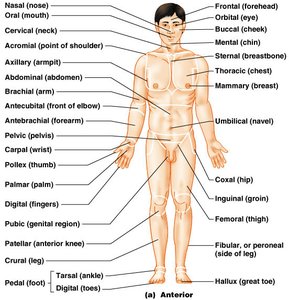
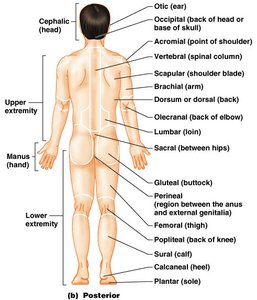
Regional terms specify distinct areas of the body, aiding in precise communication about location and function.
Examples: Brachial (arm), Femoral (thigh), Abdominal (abdomen), Cephalic (head).
Study regional terms to match them with common body parts.
Anatomical Quadrants and Regions
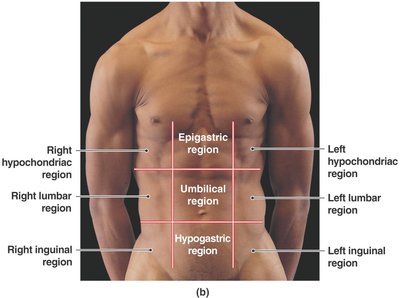
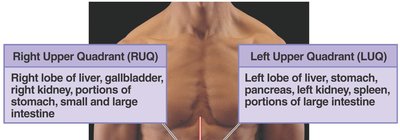
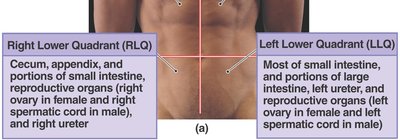
The abdomen is divided into quadrants and regions to facilitate description of location and diagnosis.
Quadrants: Right Upper Quadrant (RUQ), Left Upper Quadrant (LUQ), Right Lower Quadrant (RLQ), Left Lower Quadrant (LLQ).
Regions: Epigastric, Umbilical, Hypogastric, and others.
Body Planes and Sections
Body Planes
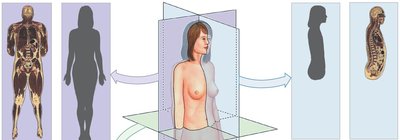
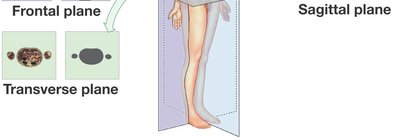
Body planes are imaginary lines used to divide the body into sections, aiding in anatomical study and medical imaging.
Frontal (Coronal) Plane: Divides the body into anterior and posterior parts.
Transverse Plane: Divides the body into superior and inferior parts.
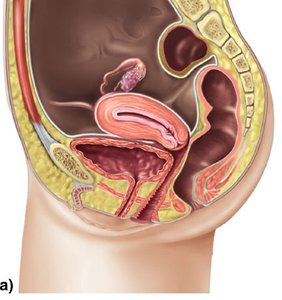
Sagittal Plane: Divides the body into right and left parts; midsagittal is exactly at the midline, parasagittal is off-center.
Oblique Plane: Cuts at an angle.
Body Cavities
Definition and Function
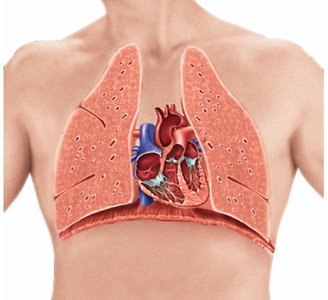
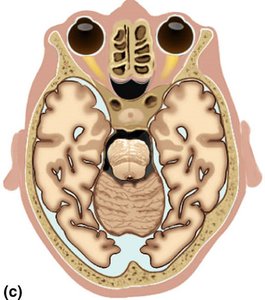
Body cavities are internal chambers that house and protect vital organs, allowing them to change shape and size as needed.
Protection: Cavities shield organs from injury.
Movement: Allow organs to expand and contract.
Ventral Body Cavity
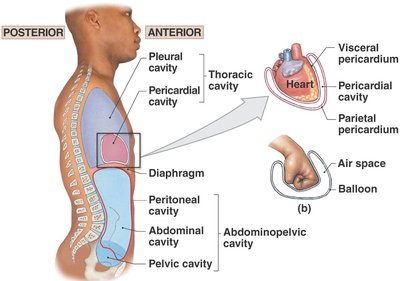
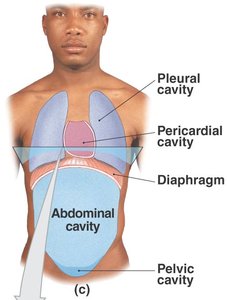
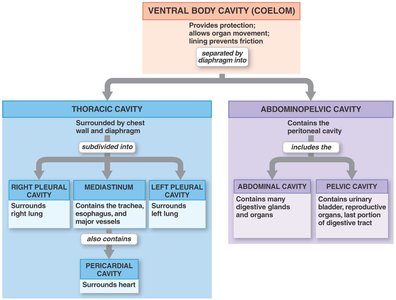
The ventral body cavity is subdivided into the thoracic and abdominopelvic cavities, each containing specific organs.
Thoracic cavity: Contains the pleural (lungs) and pericardial (heart) cavities.
Abdominopelvic cavity: Contains the abdominal (digestive organs) and pelvic (bladder, reproductive organs) cavities.
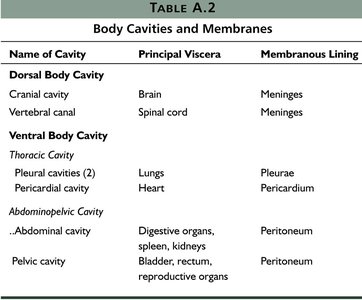
Name of Cavity | Principal Viscera | Membranous Lining |
|---|---|---|
Cranial cavity | Brain | Meninges |
Vertebral canal | Spinal cord | Meninges |
Pleural cavities | Lungs | Pleurae |
Pericardial cavity | Heart | Pericardium |
Abdominal cavity | Digestive organs, spleen, kidneys | Peritoneum |
Pelvic cavity | Bladder, rectum, reproductive organs | Peritoneum |
Anatomical Variability
Rule #2: Anatomical Variation
Anatomical variation is common among humans. Over 90% of anatomical structures match textbook descriptions, but minor differences exist.
Examples: Nerves or blood vessels may be out of place; small muscles may be missing.
Extreme variations: Rarely seen, but important to recognize in clinical practice.
Homeostasis
Definition and Importance
Homeostasis is the maintenance of a stable internal environment within the body, essential for survival and function.
Definition: The body's ability to maintain equilibrium by adjusting physiological processes.
Examples: Regulation of body temperature, blood pressure, and pH.


Homeostatic imbalance can lead to disorders such as dwarfism (growth hormone deficiency), fever (temperature regulation disruption), and hypertension (elevated blood pressure).
