 Back
BackAnatomy & Physiology: Introduction and Levels of Organization Study Guide
Study Guide - Smart Notes
 Tailored notes based on your materials, expanded with key definitions, examples, and context.
Q1. What are the biological hierarchical levels of organization from simplest to most complex?
Background
Topic: Levels of Organization in Anatomy
This question tests your understanding of how biological structures are organized, from the smallest chemical components to the entire organism.
Key Terms:
Atom: The smallest unit of matter.
Molecule: A group of atoms bonded together.
Organelle: Specialized structures within a cell.
Cell: The basic unit of life.
Tissue: A group of similar cells performing a specific function.
Organ: A structure composed of at least two types of tissues working together.
Organ System: A group of organs that work together to perform major functions.
Organism: An individual living being.
Step-by-Step Guidance
Start by identifying the smallest unit in the hierarchy, which is the atom.
Next, determine what atoms combine to form (molecules).
Continue up the hierarchy by identifying what molecules make up (organelles), and what organelles make up (cells).
After cells, think about how similar cells group together to form tissues.
Consider how tissues combine to form organs, and how organs work together in organ systems.
Finally, recognize that all organ systems together make up the organism.
Try solving on your own before revealing the answer!
Final Answer:
The correct order from simplest to most complex is:
Atom
Molecule
Organelle
Cell
Tissue
Organ
Organ System
Organism
This sequence shows how small components build up to form the complete human body.
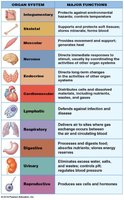
Q2. List an organ next to each of the 11 human organ systems.
Background
Topic: Human Organ Systems
This question tests your knowledge of the major organ systems in the human body and examples of organs found in each system.
Key Terms:
Organ System: A group of organs that work together to perform one or more functions.
Organ: A structure composed of different tissues working together for a specific function.
Step-by-Step Guidance
Review the names of the 11 organ systems (e.g., integumentary, skeletal, muscular, etc.).
For each system, think of a major organ that is a key part of that system (e.g., skin for integumentary, bones for skeletal).
Write down one organ for each system, making sure not to repeat organs across systems.
Check your answers by considering the main function of each system and matching it to the organ you chose.
Try solving on your own before revealing the answer!
Final Answer:
Integumentary: Skin
Skeletal: Femur (or any bone)
Muscular: Biceps brachii (or any muscle)
Nervous: Brain
Endocrine: Pituitary gland
Cardiovascular: Heart
Lymphatic: Spleen
Respiratory: Lungs
Digestive: Stomach
Urinary: Kidney
Reproductive: Uterus (female) or testes (male)
Each organ is a representative example of its respective system.
Q3. What are the characteristics of the anatomical position?
Background
Topic: Anatomical Position
This question tests your understanding of the standard reference position used in anatomy to describe locations and directions on the human body.
Key Terms:
Anatomical Position: The standard position in which the body is standing upright, facing forward, with arms at the sides and palms facing forward.
Step-by-Step Guidance
Recall that anatomical position is a universal reference for describing body parts and positions.
List the key features: body posture, head direction, arm position, and hand orientation.
Think about how the feet are positioned in this stance.
Write down each characteristic in a clear, concise manner.
Try solving on your own before revealing the answer!
Final Answer:
Standing upright
Facing forward
Arms at the sides
Palms facing forward
Feet slightly apart and facing forward
These characteristics ensure consistency when describing anatomical structures.
Q4. What is the difference between supine and prone positions?
Background
Topic: Body Positions
This question tests your understanding of terms used to describe how a person is lying down.
Key Terms:
Supine: Lying on the back, face upward.
Prone: Lying on the stomach, face downward.
Step-by-Step Guidance
Recall the definitions of supine and prone positions.
Think about which direction the face is pointing in each position.
Write the correct orientation for each term.
Try solving on your own before revealing the answer!
Final Answer:
Supine: Lying face upward
Prone: Lying face downward
These terms are important for describing patient positions in clinical settings.
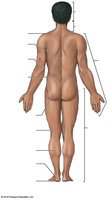
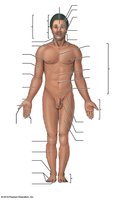
Q5. Label the following anatomical landmarks on the figure: cephalic, axillary, thoracic, brachial, antebrachial, cervical, abdominal, pelvic, carpal, manual, inguinal, pubic, femoral, patellar, crural, tarsal, digital, pedal.
Background
Topic: Anatomical Landmarks
This question tests your ability to identify and label key surface regions of the human body.
Key Terms:
Cephalic: Head
Axillary: Armpit
Thoracic: Chest
Brachial: Arm
Antebrachial: Forearm
Cervical: Neck
Abdominal: Abdomen
Pelvic: Pelvis
Carpal: Wrist
Manual: Hand
Inguinal: Groin
Pubic: Genital region
Femoral: Thigh
Patellar: Kneecap
Crural: Leg (lower)
Tarsal: Ankle
Digital: Fingers or toes
Pedal: Foot
Step-by-Step Guidance
Look at the figure and identify the general regions (head, neck, trunk, limbs).
Match each anatomical term to its corresponding region on the body.
Label each region on the figure, using the definitions provided above.
Double-check your placements by reviewing the standard anatomical terms.
Try solving on your own before revealing the answer!
Final Answer:
Cephalic: Head
Axillary: Armpit
Thoracic: Chest
Brachial: Arm
Antebrachial: Forearm
Cervical: Neck
Abdominal: Abdomen
Pelvic: Pelvis
Carpal: Wrist
Manual: Hand
Inguinal: Groin
Pubic: Genital region
Femoral: Thigh
Patellar: Kneecap
Crural: Lower leg
Tarsal: Ankle
Digital: Fingers/toes
Pedal: Foot
These terms are used to describe specific locations on the body.
