 Back
BackAnatomy & Physiology: The Endocrine System – Study Guide and Step-by-Step Guidance
Study Guide - Smart Notes
 Tailored notes based on your materials, expanded with key definitions, examples, and context.
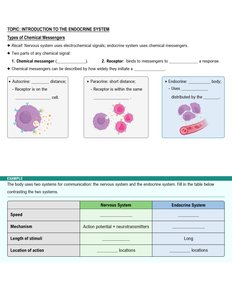
Q1. Compare the nervous system and the endocrine system as communication systems in the body. Fill in the table below with the correct characteristics for each system.
Background
Topic: Introduction to the Endocrine System
This question is testing your understanding of the differences between the nervous and endocrine systems, specifically how they communicate, their speed, and the duration of their effects.
Key Terms:
Nervous System: Uses electrical impulses and neurotransmitters for rapid, short-term communication.
Endocrine System: Uses hormones released into the bloodstream for slower, longer-lasting communication.
Step-by-Step Guidance
Look at the table and identify the four categories: Speed, Mechanism, Length of signal, and Location of action.
Recall that the nervous system is known for its rapid response, while the endocrine system is slower but has longer-lasting effects.
Think about the mechanism: the nervous system uses action potentials and neurotransmitters, while the endocrine system uses hormones.
For each category, match the correct characteristic to the appropriate system. For example, which system acts locally and which acts systemically?
Try solving on your own before revealing the answer!
Final Answer:
Nervous System: Speed: Fast; Mechanism: Action potential + neurotransmitters; Length of signal: Short; Location of action: Localized.
Endocrine System: Speed: Slow; Mechanism: Hormones; Length of signal: Long; Location of action: Systemic.
The nervous system is designed for quick, targeted responses, while the endocrine system is for widespread, longer-term regulation.
Q2. For a nerve impulse to travel from one neuron to another, the signal must be transmitted across a synapse. At the synapse, the neuron releases a neurotransmitter that then diffuses across the synapse and excites receptors on the next neuron. The transmission at a synapse is an example of what type of signaling?
Background
Topic: Types of Chemical Messengers
This question is testing your knowledge of the different types of cell signaling: endocrine, autocrine, paracrine, and intracellular.
Key Terms:
Endocrine signaling: Hormones travel through the bloodstream to distant targets.
Autocrine signaling: A cell targets itself.
Paracrine signaling: A cell targets a nearby cell.
Intracellular signaling: Signals within the same cell.
Step-by-Step Guidance
Identify the type of messenger involved in synaptic transmission (neurotransmitter).
Consider the distance the signal travels: is it local (nearby cell) or systemic (through the blood)?
Recall that neurotransmitters act on adjacent cells across a synapse, not on distant or the same cell.
Match this description to the correct type of signaling from the options provided.
Try solving on your own before revealing the answer!
Final Answer:
The correct answer is paracrine signaling. Neurotransmitters act locally on adjacent neurons across a synapse, which is characteristic of paracrine signaling.
Q3. Epinephrine (also known as adrenaline) is produced by your adrenal medulla during stressful situations. The adrenal medulla releases epinephrine into the bloodstream, where it travels to distant targets. For example, it can act on the heart, liver, and skeletal muscle. Based on this description, what type of signaling is involved in the release of epinephrine?
Background
Topic: Endocrine Signaling
This question is testing your understanding of how hormones like epinephrine are distributed and the type of signaling involved.
Key Terms:
Endocrine signaling: Hormones are released into the bloodstream and act on distant target organs.
Paracrine signaling: Local signaling to nearby cells.
Autocrine signaling: The cell targets itself.
Step-by-Step Guidance
Identify the source of the hormone (adrenal medulla) and its route (bloodstream).
Determine whether the targets are local or distant.
Recall that hormones traveling through the blood to distant organs is a hallmark of a specific type of signaling.
Match this process to the correct signaling type from the options provided.
Try solving on your own before revealing the answer!
Final Answer:
The correct answer is endocrine signaling. Epinephrine is released into the bloodstream and acts on distant organs, which is characteristic of endocrine signaling.
Q4. Which of the following statements best describes a significant difference between the endocrine and nervous systems?
Background
Topic: Comparison of Endocrine and Nervous Systems
This question is testing your ability to distinguish between the mechanisms and effects of the two major communication systems in the body.
Key Terms:
Endocrine system: Uses hormones, slower, longer-lasting, systemic effects.
Nervous system: Uses neurotransmitters, rapid, short-term, localized effects.
Step-by-Step Guidance
Read each statement carefully and identify which system is being described.
Recall the main differences: speed, mechanism, and duration of action.
Eliminate any statements that do not accurately reflect the unique features of each system.
Focus on the statement that highlights a key difference in how signals are transmitted and how quickly effects occur.
Try solving on your own before revealing the answer!
Final Answer:
The correct answer is: Hormonal signals in the endocrine system diffuse across a synapse, while in the nervous system they travel in the blood. (Note: This is a trick statement; actually, the nervous system uses synapses and the endocrine system uses the blood. The correct answer is the one that accurately describes this distinction.)
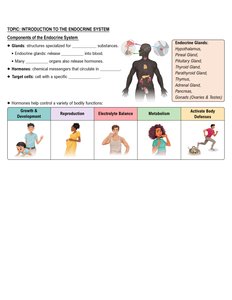
Q5. Glands are structures specialized for the secretion of substances. What are the main components of the endocrine system, and what is the role of target cells?
Background
Topic: Components of the Endocrine System
This question is testing your understanding of the basic anatomy and function of the endocrine system, including glands, hormones, and target cells.
Key Terms:
Glands: Organs that secrete hormones.
Hormones: Chemical messengers released into the bloodstream.
Target cells: Cells with specific receptors for hormones.
Step-by-Step Guidance
Identify the main organs that make up the endocrine system (e.g., pituitary, thyroid, adrenal glands).
Recall the function of hormones and how they are distributed in the body.
Understand the concept of target cells and why only certain cells respond to specific hormones.
Think about how hormones help regulate various bodily functions through their action on target cells.
Try solving on your own before revealing the answer!
Final Answer:
The main components of the endocrine system are glands that secrete hormones, hormones themselves, and target cells that have specific receptors for those hormones. Target cells respond to hormones and mediate their effects on the body.
