 Back
Anatomy of the Female Reproductive System
Study Guide - Smart Notes
 Tailored notes based on your materials, expanded with key definitions, examples, and context.
Anatomy of the Female Reproductive System
Overview of Female Reproductive Anatomy
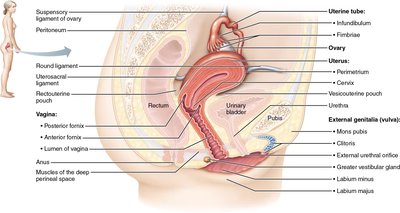
The female reproductive system is responsible for producing gametes (ova), secreting sex hormones, and supporting the development of a fetus. Unlike the male system, the female system undergoes cyclical changes to prepare for potential pregnancy each month. The primary organs include the ovaries, duct system (uterine tubes, uterus, vagina), and external genitalia.
Ovaries: Female gonads that produce ova and secrete estrogens (mainly estradiol) and progesterone.
Duct System: Includes the uterine tubes, uterus, and vagina, which transport gametes and support fetal development.
External Genitalia: Collectively called the vulva, these structures protect the internal reproductive organs and play a role in sexual arousal.
Ovaries
The ovaries are paired organs located in the pelvic cavity. They are responsible for:
Producing female gametes (ova)
Secreting sex hormones: estrogens (estradiol, estrone, estriol) and progesterone
Estrogens are crucial for the development of female secondary sexual characteristics and regulation of the menstrual cycle. Estradiol is the most abundant and biologically active estrogen in humans.
Female Duct System
The duct system transports ova from the ovaries to the uterus and provides the environment for fertilization and early development.
Uterine Tubes (Fallopian Tubes): Transport the ovulated oocyte from the ovary to the uterus. The infundibulum and fimbriae help capture the oocyte.
Uterus: A muscular organ where implantation and development of the embryo/fetus occur. Key regions include the fundus, body, cervix, and the uterine wall layers (perimetrium, myometrium, endometrium).
Vagina: A muscular canal that serves as the passageway for menstrual flow, receives the penis during intercourse, and acts as the birth canal during delivery.
External Genitalia (Vulva)
The external genitalia protect the internal reproductive organs and include:
Labia majora and labia minora: Folds of skin that protect the vaginal and urethral openings.
Clitoris: Erectile tissue important for sexual arousal.
Greater vestibular glands: Secrete lubricating fluid.
External urethral orifice: Opening of the urethra to the exterior.
Mons pubis: Fatty area overlying the pubic bone.
Summary Table: Main Structures and Functions
Structure | Main Function |
|---|---|
Ovary | Produces ova and sex hormones |
Uterine Tube | Transports oocyte; site of fertilization |
Uterus | Supports embryo/fetus development |
Vagina | Birth canal; receives penis during intercourse |
External Genitalia | Protection; sexual arousal |
Example: During ovulation, an oocyte is released from the ovary, captured by the fimbriae of the uterine tube, and transported toward the uterus. If fertilization occurs, the embryo implants in the uterine wall.
