Back
Anatomy of the Female Reproductive System
Study Guide - Smart Notes
 Tailored notes based on your materials, expanded with key definitions, examples, and context.
Anatomy of the Female Reproductive System
Overview of Female Reproductive Anatomy
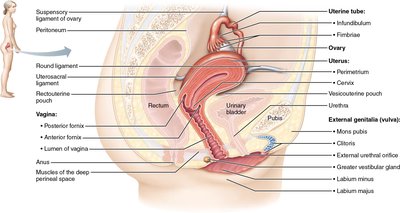
The female reproductive system is responsible for producing gametes (ova), secreting sex hormones, and nurturing a developing fetus. It consists of internal and external genitalia, each with specialized functions. The internal genitalia are primarily located in the pelvic cavity and include the ovaries and duct system, while the external genitalia are collectively referred to as the vulva.
Ovaries: Female gonads that produce ova and secrete estrogens (estradiol, estrone, estriol) and progesterone.
Internal Genitalia: Includes the ovaries, uterine tubes, uterus, and vagina.
External Genitalia: Includes structures such as the mons pubis, clitoris, labia majora, and labia minora.
Ovaries
The ovaries are paired organs that produce female gametes (ova) and secrete sex hormones. Estradiol is the most abundant estrogen and is primarily responsible for estrogenic effects in humans.
Location: Situated in the pelvic cavity.
Function: Gamete production and hormone secretion.
Duct System
The duct system transports ova and supports the needs of reproductive cells and a developing fetus. It consists of the uterine tubes, uterus, and vagina.
Uterine Tubes (Fallopian Tubes): Transport ova from the ovaries to the uterus. Key regions include the infundibulum and fimbriae.
Uterus: A muscular organ where implantation and fetal development occur. Regions include the perimetrium, cervix, and uterine cavity.
Vagina: Serves as the passageway for menstrual flow, intercourse, and childbirth. Contains the posterior and anterior fornix, lumen, and is bordered by the external genitalia.
External Genitalia (Vulva)
The external genitalia protect the internal reproductive organs and facilitate sexual intercourse.
Mons Pubis: Fatty area overlying the pubic bone.
Clitoris: Erectile tissue important for sexual arousal.
Labia Majora and Labia Minora: Folds of skin that protect the vaginal and urethral openings.
External Urethral Orifice: Opening for urine excretion.
Greater Vestibular Glands: Secrete mucus for lubrication.
Key Structures and Their Functions
Structure | Function |
|---|---|
Ovary | Produces ova and hormones |
Uterine Tube | Transports ova to uterus |
Uterus | Site of implantation and fetal development |
Vagina | Passageway for intercourse and childbirth |
External Genitalia | Protection and sexual function |
Hormones of the Female Reproductive System
The ovaries secrete estrogens (primarily estradiol) and progesterone, which regulate the menstrual cycle and prepare the body for pregnancy.
Estrogens: Promote development of secondary sex characteristics and regulate the menstrual cycle.
Progesterone: Prepares the uterus for implantation and supports early pregnancy.
Example: Monthly Preparation for Pregnancy
Each month, the female body undergoes hormonal changes that prepare the uterus for potential implantation of a fertilized egg. If fertilization does not occur, the uterine lining is shed during menstruation.