 Back
BackAnatomy of the Head and Neck: Musculature and Structures
Study Guide - Smart Notes
 Tailored notes based on your materials, expanded with key definitions, examples, and context.
Anatomy of the Head and Neck
Overview of the Sagittal Section of the Head
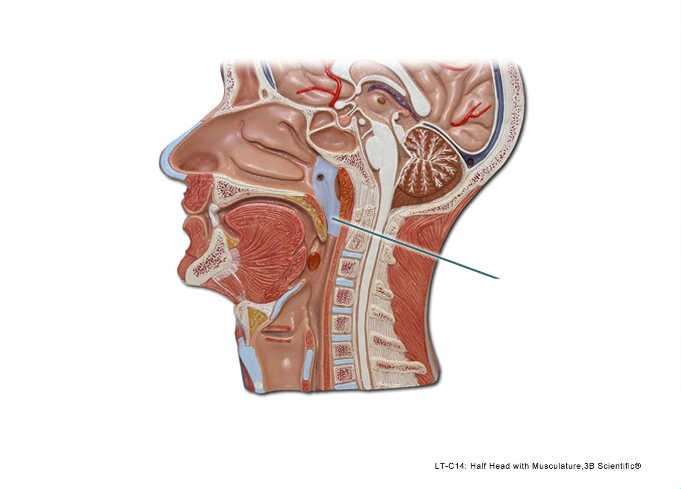
The sagittal section of the human head reveals the complex organization of anatomical structures, including the nasal and oral cavities, pharynx, larynx, vertebral column, and associated musculature. Understanding these relationships is essential for students of anatomy and physiology, as these regions are involved in critical functions such as respiration, digestion, and neural integration.
Major Anatomical Regions
Nasal Cavity: The uppermost airway passage, lined with mucosa, responsible for filtering, warming, and humidifying inhaled air.
Oral Cavity: The mouth region, involved in ingestion, mastication, and the initial stages of digestion.
Pharynx: A muscular tube that serves as a common pathway for both air (to the larynx) and food (to the esophagus). It is divided into the nasopharynx, oropharynx, and laryngopharynx.
Larynx: The voice box, located below the pharynx, responsible for sound production and protecting the lower airways during swallowing.
Vertebral Column (Cervical Region): The upper portion of the spinal column, providing structural support and protecting the spinal cord.
Musculature: Includes muscles of mastication, facial expression, and those involved in swallowing and speech.
Key Structures and Their Functions
Soft Palate: Separates the nasopharynx from the oropharynx during swallowing.
Epiglottis: A flap of cartilage that covers the laryngeal inlet during swallowing, preventing food from entering the airway.
Spinal Cord: Transmits neural signals between the brain and the rest of the body; visible in the cervical region in this section.
Brainstem: Controls vital autonomic functions and connects the brain to the spinal cord.
Example: Swallowing Mechanism
During swallowing, the soft palate elevates to close off the nasopharynx, the larynx rises, and the epiglottis folds down to protect the airway. Muscles of the pharynx contract to propel the bolus into the esophagus.
Additional info:
This sagittal anatomical model is commonly used in anatomy and physiology courses to illustrate the spatial relationships of head and neck structures, including the integration of muscular, nervous, and respiratory systems.
