 Back
BackAnatomy of the Nervous System: Central and Peripheral Structures
Study Guide - Smart Notes
 Tailored notes based on your materials, expanded with key definitions, examples, and context.
The Central Nervous System (CNS)
Overview of the CNS
The central nervous system consists of the brain and spinal cord, serving as the main control centers for processing and integrating information throughout the body. The CNS is responsible for higher cognitive functions, sensory perception, and motor control.
Brain: Divided into four major regions: cerebrum, diencephalon, brain stem, and cerebellum.
Spinal Cord: Connects the brain to the peripheral nervous system and mediates reflexes.
Major Regions of the Brain
Cerebrum: Largest part, responsible for higher brain functions.
Diencephalon: Contains the thalamus and hypothalamus, relaying sensory information and regulating homeostasis.
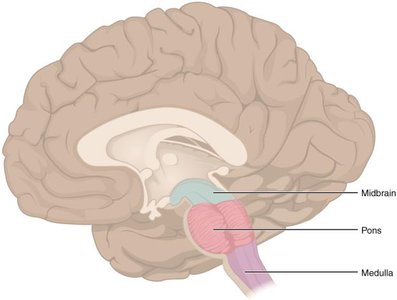
Brain Stem: Includes midbrain, pons, and medulla oblongata; controls vital functions and cranial nerves.
Cerebellum: Coordinates movement and balance.
Cerebral Cortex and Surface Features
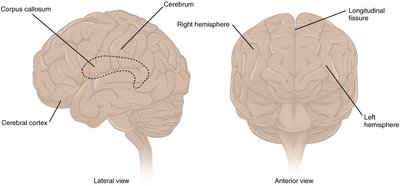
The cerebral cortex is the wrinkled outer layer of the cerebrum, composed of gray matter (neuron cell bodies and dendrites). The surface features include:
Gyri (gyrus): Ridges that increase surface area for higher cognitive functions.
Sulci (sulcus): Depressions between gyri.
Longitudinal fissure: Deep groove dividing the left and right cerebral hemispheres.
Corpus callosum: White matter tract connecting the hemispheres, allowing communication between them.
Lobes of the Cerebrum
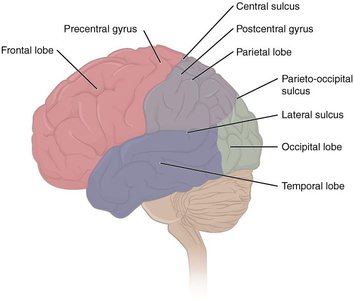
The cerebrum is divided into four lobes, each associated with specific functions:
Frontal lobe: Higher cognitive functions, decision making, problem-solving, and voluntary movement (motor cortex).
Parietal lobe: Processing tactile senses, proprioception, and visual perception.
Occipital lobe: Visual processing.
Temporal lobe: Auditory sensation and language comprehension.
Subcortical Structures and the Limbic System
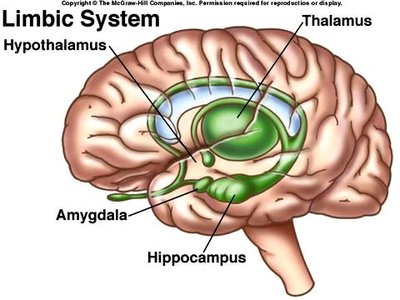
Subcortical structures are located deep to the cerebral cortex and include the limbic system, which is central to emotional and behavioral expression.
Amygdala: Involved in fear, anxiety, and long-term memory formation.
Hippocampus: Essential for long-term memory formation.
Hypothalamus: Regulates memory, emotion, and homeostasis (body temperature, circadian rhythm, food/fluid intake, autonomic nervous system).
Thalamus: Principal relay center for sensory information (except olfaction).
Diencephalon
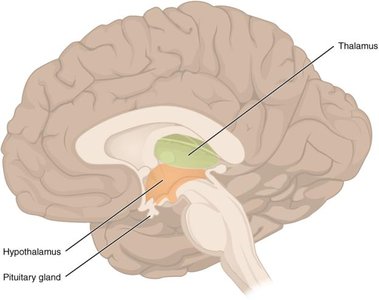
The diencephalon is located deep beneath the cerebrum and is primarily composed of the thalamus and hypothalamus. It serves as a major relay and processing center for information traveling to and from the cerebrum.
Thalamus: Relays and processes sensory information to the cerebrum.
Hypothalamus: Regulates homeostasis and controls the endocrine system via the pituitary gland.
Brain Stem
The brain stem consists of the midbrain, pons, and medulla oblongata. It is the main pathway for ascending (sensory) and descending (motor) tracts between the cerebrum and spinal cord.
Midbrain: Processes auditory and visual information; contains nuclei for cranial nerves III and IV.
Pons: Connects cerebellum and brain stem; contains nuclei for cranial nerves V–VIII.
Medulla oblongata: Regulates heart rate, blood pressure, and breathing; contains nuclei for cranial nerves IX–XII.
Cerebellum
The cerebellum, also known as the "little brain," is involved in the maintenance of balance and posture. It compares motor commands from the cerebrum with proprioceptive and vestibular information, sending corrective commands as needed.
Spinal Cord Structure
The spinal cord is composed of gray and white matter. The gray matter is divided into horns:
Anterior horns: Motor neuron cell bodies; send motor signals to skeletal muscles.
Posterior horns: Receive sensory information from the body.
Lateral horns: (thoracic and upper lumbar regions) Contain visceral motor neurons (autonomic nervous system).
The white matter is organized into columns containing ascending (sensory) and descending (motor) tracts.
Meninges and Cerebrospinal Fluid (CSF)
The CNS is protected by three connective tissue membranes called meninges:
Dura mater: Tough, outermost layer attached to the inner skull.
Arachnoid mater: Middle layer forming a sac around the CNS; subarachnoid space contains CSF.
Pia mater: Thin, delicate layer lining the brain's surface and sulci.
CSF circulates through the ventricular system, providing cushioning and removing metabolic waste. It is produced by ependymal cells and reabsorbed via arachnoid granulations.
The Peripheral Nervous System (PNS)
Ganglia and Nerves
The PNS consists of nerves and ganglia outside the CNS. A ganglion is a group of neuron cell bodies in the PNS, classified as sensory or autonomic ganglia.
Dorsal root ganglion: Contains sensory neuron cell bodies; transmits sensory information to the CNS.
Nerves: Bundles of axons surrounded by connective tissue layers (epineurium, perineurium, endoneurium).
Spinal Nerves
There are 31 pairs of spinal nerves, named according to their region of emergence. Each spinal nerve splits into a dorsal (sensory) and ventral (motor) root near the spinal cord.
Ascending tracts: Carry sensory information to the brain (three-neuron pathway).
Descending tracts: Carry motor information from the brain to the PNS (two-neuron pathway).
Contralateral organization: Many pathways cross over, connecting each body side to the opposite brain hemisphere.
Cranial Nerves
There are 12 pairs of cranial nerves (CN I–XII), primarily responsible for sensory and motor functions of the head and neck. Each nerve has specific functions:
Nerve | Number | Type | Main Function(s) |
|---|---|---|---|
Olfactory | CN I | Sensory | Smell |
Optic | CN II | Sensory | Vision |
Oculomotor | CN III | Motor | Eye movement, eyelid lifting, pupillary constriction |
Trochlear | CN IV | Motor | Eye movement |
Trigeminal | CN V | Both | Mastication, facial sensation |
Abducens | CN VI | Motor | Eye movement |
Facial | CN VII | Both | Facial expressions, taste, saliva production |
Vestibulocochlear | CN VIII | Sensory | Hearing, balance |
Glossopharyngeal | CN IX | Both | Swallowing, speech, taste, saliva production |
Vagus | CN X | Both | Swallowing, voice, autonomic control of thoracic/abdominal organs |
Accessory | CN XI | Motor | Swallowing, head/neck/shoulder movement |
Hypoglossal | CN XII | Motor | Tongue movement (speech, swallowing) |
Summary Table: Major Brain Regions and Functions
Region | Main Function(s) |
|---|---|
Cerebrum | Higher cognitive functions, sensory perception, voluntary movement |
Diencephalon | Sensory relay, homeostasis, endocrine control |
Brain Stem | Vital functions, cranial nerves, sensory/motor pathways |
Cerebellum | Coordination, balance, posture |
Additional info: The above notes integrate and expand upon the provided lecture slides, including definitions, examples, and tables for clarity. Images are included only where they directly reinforce the anatomical structures discussed.
