 Back
BackAnatomy of the Skeletal System: Bones and Skeletal Tissues
Study Guide - Smart Notes
 Tailored notes based on your materials, expanded with key definitions, examples, and context.
Bones and Skeletal Tissues
Overview of the Skeletal System
The skeletal system provides the structural framework for the human body, supporting movement, protecting organs, and serving as a reservoir for minerals and blood cell production. It is composed of bones, cartilage, ligaments, and other connective tissues.
Support: Bones form the body’s supporting structure.
Protection: Vital organs such as the brain, heart, and lungs are protected by bones (e.g., skull, rib cage).
Movement: Bones act as levers for muscles to produce movement.
Mineral Storage: Bones store calcium and phosphate, releasing them as needed.
Blood Cell Formation: Hematopoiesis occurs in red marrow cavities.
Fat Storage: Yellow marrow stores triglycerides.
Hormone Production: Osteocalcin regulates bone formation and energy metabolism.
Major Regions of the Skeleton
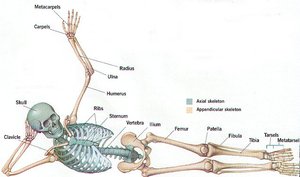
The human skeleton is divided into two main regions:
Axial Skeleton: Forms the long axis of the body and includes the skull, vertebral column, and rib cage. It primarily supports and protects internal organs.
Appendicular Skeleton: Comprises the bones of the limbs and girdles (shoulder and pelvic) that attach them to the axial skeleton. It is essential for movement and manipulation of objects.
Classification of Bones by Shape
Bones are classified into four groups based on their shape, not size:
Long Bones: Longer than they are wide (e.g., femur, humerus).
Short Bones: Cube-shaped (e.g., carpals, tarsals).
Flat Bones: Thin, flattened, and usually curved (e.g., sternum, skull bones).
Irregular Bones: Complicated shapes (e.g., vertebrae, hip bones).
Structure of a Typical Long Bone
A typical long bone consists of:
Diaphysis: The shaft, composed of compact bone surrounding a medullary (marrow) cavity.
Epiphyses: The ends of the bone, consisting of compact bone externally and spongy bone internally. Articular cartilage covers joint surfaces.
Membranes: The periosteum (outer covering) and endosteum (lining internal surfaces).
Epiphyseal Line: Remnant of the growth plate, marking where bone growth occurred in youth.
Microscopic Anatomy of Bone
Osteon (Haversian System): The structural unit of compact bone, consisting of concentric lamellae around a central canal.
Lamellae: Layers of bone matrix.
Lacunae: Small spaces housing osteocytes.
Canaliculi: Tiny canals connecting lacunae, allowing communication and nutrient/waste exchange.
Spongy Bone: Contains trabeculae aligned along lines of stress, with spaces filled by marrow.
Bone Cells
Osteoprogenitor Cells: Stem cells that differentiate into osteoblasts.
Osteoblasts: Bone-forming cells that secrete osteoid.
Osteocytes: Mature bone cells maintaining the matrix.
Osteoclasts: Cells that resorb bone matrix.
Chemical Composition of Bone
Organic Components: Cells and osteoid (collagen fibers and ground substance) provide tensile strength and flexibility.
Inorganic Components: Hydroxyapatites (mineral salts, mainly calcium phosphate) provide hardness and resistance to compression.
Bone Development (Ossification)
Intramembranous Ossification: Bone develops from fibrous membranes (e.g., flat bones of the skull, clavicles).
Endochondral Ossification: Bone forms by replacing hyaline cartilage (e.g., most bones below the skull).
Postnatal Bone Growth
Longitudinal Growth: Occurs at the epiphyseal plates by interstitial growth of cartilage, followed by ossification.
Appositional Growth: Bones increase in thickness by addition of bone matrix to the surface.
Bone Remodeling and Repair
Remodeling: Continuous process of bone deposition (by osteoblasts) and resorption (by osteoclasts), regulated by hormones and mechanical stress.
Repair: Involves hematoma formation, fibrocartilaginous callus formation, bony callus formation, and bone remodeling.
Hormonal Regulation of Bone Growth
Growth Hormone: Stimulates epiphyseal plate activity.
Thyroid Hormone: Modulates growth hormone effects.
Sex Hormones: Promote growth spurts and induce epiphyseal plate closure.
Parathyroid Hormone (PTH): Regulates calcium homeostasis by stimulating osteoclast activity.
Calcitonin: Lowers blood calcium levels (minor role in humans).
Osteoporosis
A group of diseases where bone resorption exceeds formation, leading to porous and fragile bones. Risk factors include age, hormonal changes, insufficient exercise, poor diet, smoking, genetics, and certain diseases.
Bone Markings
Bone markings are features on bones that serve as sites for muscle, ligament, and tendon attachment, joint formation, or passage of blood vessels and nerves. They are classified as projections, depressions, and openings. Additional info: This guide covers the essential concepts from the provided slides and readings, expanding on definitions, processes, and clinical relevance for ANP college students.
